 ultimate-guide
Benefits of Asphalt Crack Sealing for Businesses
Table of Contents
- What Asphalt Crack Sealing Does for Commercial Pavement
- Crack Sealing vs Sealcoating: Two Different Jobs
- How Long Does Crack Sealing Last on a Commercial Lot?
- The Financial Case: Cost-Effectiveness and ROI
- Liability, Risk Management, and Pavement Management Systems
- An Asphalt Maintenance Schedule for Businesses
- Environmental Impact and Seasonal Planning
- Frequently Asked Questions
Last Updated: September 12, 2026
What Asphalt Crack Sealing Does for Commercial Pavement
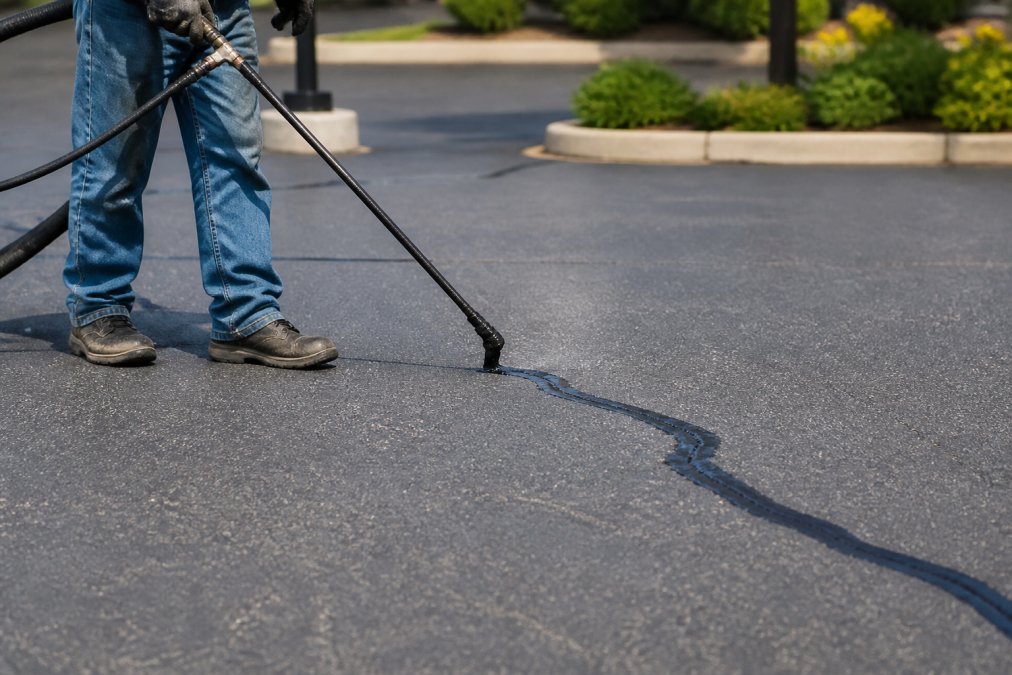
Asphalt crack sealing is the process of cleaning and filling pavement cracks with a hot-applied rubberized sealant to block water from reaching the sub-base. For businesses, it is the cheapest way to stop the damage that leads to potholes and structural failure.
At Houston Pavement Repair LLC, we treat crack sealing as the first line of defense in any pavement preservation program. Water is the enemy. It seeps through open cracks, weakens the aggregate base, and freezes and expands during thermal contraction cycles, widening the gap with every season. Sealing closes that path before moisture damage becomes sub-base erosion.
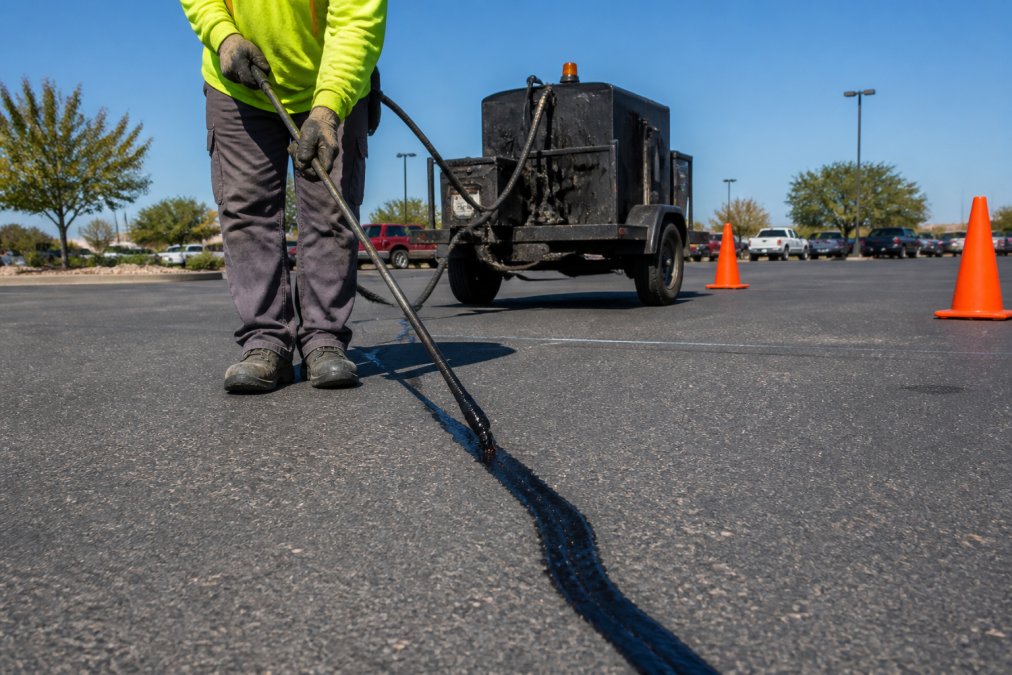
The FHWA pavement preservation guidance frames crack sealing as a proactive treatment, not a repair. That distinction matters. You are not fixing a broken lot; you are protecting a working one.
Crack Sealing vs Sealcoating: Two Different Jobs
Crack sealing and sealcoating are not interchangeable. Crack sealing fills individual working and non-working cracks with hot-applied sealant to block water infiltration. Sealcoating is a surface coating applied across the entire lot to slow asphalt oxidation and restore curb appeal.
Property managers often confuse the two, and that confusion costs money. Sealcoating a lot with open cracks traps nothing, it simply coats over a problem that continues to grow underneath. The correct sequence is crack sealing first, then sealcoating once cracks are addressed.
| Treatment | What It Does | Best Timing | Typical Trigger |
|---|---|---|---|
| Crack sealing | Fills cracks to block water | Before cracks widen | Cracks 1/4 inch or wider |
| Sealcoating | Coats surface, slows oxidation | After cracks are sealed | Faded, dried-out surface |
| Crack filling | Fills non-working cracks | Same as sealing | Stable, inactive cracks |
A common mistake is scheduling sealcoating alone and expecting it to solve a cracking problem. It won't.
How Long Does Crack Sealing Last on a Commercial Lot?
Properly applied crack sealing typically lasts two to five years on a commercial lot, depending on traffic, climate, and how well the cracks were prepared (asphaltinstitute.org). Routing and cleaning before application are what separate a seal that lasts from one that fails in a single season.
Crack routing widens and shapes the crack so the sealant bonds to clean asphalt rather than sitting on top of debris. Skipping that step is the fastest way to watch sealant peel out within months. Houston's heat and heavy rain cycles are hard on pavement, so preparation quality matters more here than in milder climates. Heat accelerates asphalt oxidation; rain drives water into any gap left behind.
Asphalt Institute guidance on pavement maintenance notes that sealant performance depends heavily on proper installation. In practice, this means the crew's preparation discipline determines your service life extension far more than the brand of sealant.
The Financial Case: Cost-Effectiveness and ROI
The financial argument for crack sealing rests on a simple mechanic: you are trading a small, recurring line item now for the avoidance of a large, lumpy capital expense later. Most pavement maintenance budgets fail not because owners spend too much, but because they spend it in the wrong order, reactively patching failures instead of proactively sealing cracks.
Here is how the cost ladder actually stacks up, from cheapest to most expensive per square foot of pavement touched:
- Crack sealing: Lowest cost per linear foot of crack treated. Small crew, small equipment, fast cure.
- Crack filling: Similar cost profile, but only appropriate for stable, non-working cracks.
- Sealcoating: Priced per square foot across the whole lot, so it scales with lot size rather than crack count.
- Patching: Priced per patch, and repeated patches on the same spot compound over time.
- Full-depth repair: Excavation, base replacement, and compaction, an order of magnitude above sealing.
- Mill and overlay or full replacement: The most expensive option, and the one sealing is designed to delay.
The ROI logic is not that sealing is cheap in isolation. It is that every dollar spent sealing cracks is a dollar that does not have to be spent on the rungs above it. A lot that gets sealed on a two-to-five-year cycle typically avoids the mid-tier repairs that a neglected lot accumulates, because water never reaches the aggregate base in the first place.
The hidden cost of deferral is what most budgets miss. A crack that costs little to seal this year becomes a patched pothole next year, a full-depth repair the year after, and a liability claim the year after that. Each stage is more expensive than the last, and the escalation is driven by water, not by traffic. That is why the cheapest time to seal a crack is always before it becomes a pothole.
For budgeting purposes, the practical takeaway is to treat crack sealing as a fixed annual line item rather than an emergency expense. Property managers who do this report more predictable five-year maintenance spend than those who wait for visible failure, because they are funding prevention instead of paying for recovery.
Liability, Risk Management, and Pavement Management Systems
Crack sealing reduces liability exposure by keeping the lot surface intact and free of trip-and-fall hazards. For commercial property owners, a deteriorating parking lot is a risk management issue as much as a maintenance one. Proactive maintenance measures like professional driveway sealing extend the structural integrity of the pavement while minimizing the long-term costs associated with extensive surface repairs.
Call now to schedule your free estimate →
Trip-and-fall claims from cracked or heaved pavement are a real exposure for retail and multifamily properties. Documented, scheduled maintenance is your defense. This is where integration with a Pavement Management System (PMS) pays off. A PMS tracks pavement condition over time, flags when cracks cross the repair threshold, and builds a maintenance history that supports both budgeting and liability defense.
If you're coming from a reactive approach, expect the shift to feel slower at first. You're spending on a lot that isn't visibly broken yet. That's the point. Preventative maintenance is cheaper than emergency repair, and a documented schedule is evidence you maintained the property responsibly.
An Asphalt Maintenance Schedule for Businesses
An asphalt maintenance schedule for businesses should combine routine inspection, timely crack sealing, and periodic sealcoating in a predictable annual cycle. Seasonal planning for commercial properties is what keeps the budget predictable and the pavement protected.
A workable schedule looks like this:
- Spring: Inspect for winter damage, standing water, and new cracks after freeze-thaw cycles
- Late spring to early summer: Route and seal all working cracks before heat peaks
- Summer: Apply sealcoating to sealed, clean surfaces
- Fall: Re-inspect, address new cracks before the next freeze cycle
- Annually: Log conditions in your PMS and update the maintenance budget
Timing matters because sealant needs dry, warm conditions to bond properly. Scheduling sealing in the shoulder seasons, before thermal expansion and contraction stress the pavement, gives the sealant its best chance to hold.
Environmental Impact and Seasonal Planning
Crack sealing has a genuine environmental upside that most guides skip entirely: it extends the service life of asphalt that already exists, which defers the resource-intensive process of milling and repaving. In sustainability terms, pavement preservation is waste reduction at the asset level.
The mechanism is straightforward. Asphalt is a petroleum-derived material with significant embodied energy, the energy consumed to extract, refine, transport, and place it. Every year a lot stays in service without a mill-and-overlay is a year of embodied carbon that does not have to be spent again. Add to that the construction debris diverted from landfill, the raw aggregate not quarried, and the heavy equipment emissions avoided, and preservation starts to look less like a maintenance tactic and more like a carbon strategy.
For businesses with public sustainability commitments, this matters more than it used to. Corporate ESG reporting increasingly looks at Scope 3 emissions, the emissions embedded in a company's supply chain and physical assets, and pavement is part of that footprint. A preservation-first maintenance program gives facility and sustainability teams something concrete to point to: documented crack sealing cycles that measurably defer repaving events.
Seasonal planning reinforces the environmental case. Sealing on a schedule prevents small defects from becoming full replacement projects, and full replacement is where the environmental cost spikes. The same discipline that protects your budget also protects your footprint.
This is the angle competitors miss. They sell crack sealing as a cosmetic or budget fix. It is both a financial and an environmental decision, and the two point the same direction: seal early, replace rarely.
Frequently Asked Questions
Is asphalt crack sealing profitable for a business property?
It is best framed as cost avoidance rather than profit. Sealing cracks stops water from reaching the aggregate base, which is the main driver of potholes and structural failure. A small annual spend on asphalt crack sealing typically costs far less than full-depth patching or repaving a section of lot. Pricing depends on crack length, lot size, and scheduling, so request a current quote for your property.
How long does crack sealing last?
Most hot-applied rubberized sealants hold up for two to five years on a commercial lot, depending on traffic volume, sun exposure, and how well the cracks were cleaned and routed before sealing. Working cracks that open and close with thermal expansion and contraction may need re-sealing sooner than stable non-working cracks. Inspecting the lot each spring and fall tells you when the sealant has worn or pulled away.
What is the difference between crack sealing and sealcoating?
Crack sealing fills individual cracks with hot-applied sealant to block water infiltration. Sealcoating spreads a protective coating over the entire asphalt surface to slow oxidation and restore appearance. They solve different problems and are often done together: seal the cracks first, then sealcoat the surface. Skipping crack sealing before sealcoating traps moisture under the coating and shortens its life.
When is the best time of year to perform asphalt crack sealing?
Late spring through early fall works best in most U.S. climates, when pavement temperatures stay warm enough for the sealant to bond and cure properly. Sealing in cold weather can leave the material brittle and prone to pulling out. For a commercial property, scheduling during a slow traffic period reduces disruption, and pairing the work with a seasonal maintenance calendar keeps the lot ahead of freeze-thaw and heavy rain cycles.