 how-to
How to Fix Driveway Drainage Issues: 2026 Guide
Table of Contents
- Signs of Driveway Water Damage You Shouldn't Ignore
- Identifying the Source of Your Driveway Drainage Issues
- How to Regrade a Driveway for Drainage
- Installing a Trench Drain, French Drain, or Catch Basin
- Trench Drain Installation Cost and DIY vs. Professional Breakdown
- Permeable Pavers and Erosion Control Alternatives
- Local Building Codes, Permits, and Common Mistakes to Avoid
- Fix Driveway Drainage Issues Before They Cost You More
- Frequently Asked Questions
Last Updated: August 13, 2026
Signs of Driveway Water Damage You Shouldn't Ignore
Driveway drainage issues develop gradually, and what starts as a surface problem becomes structurally expensive if ignored. Learning to read the early signs saves money.
Surface Cracks, Potholes, and Soft Spots
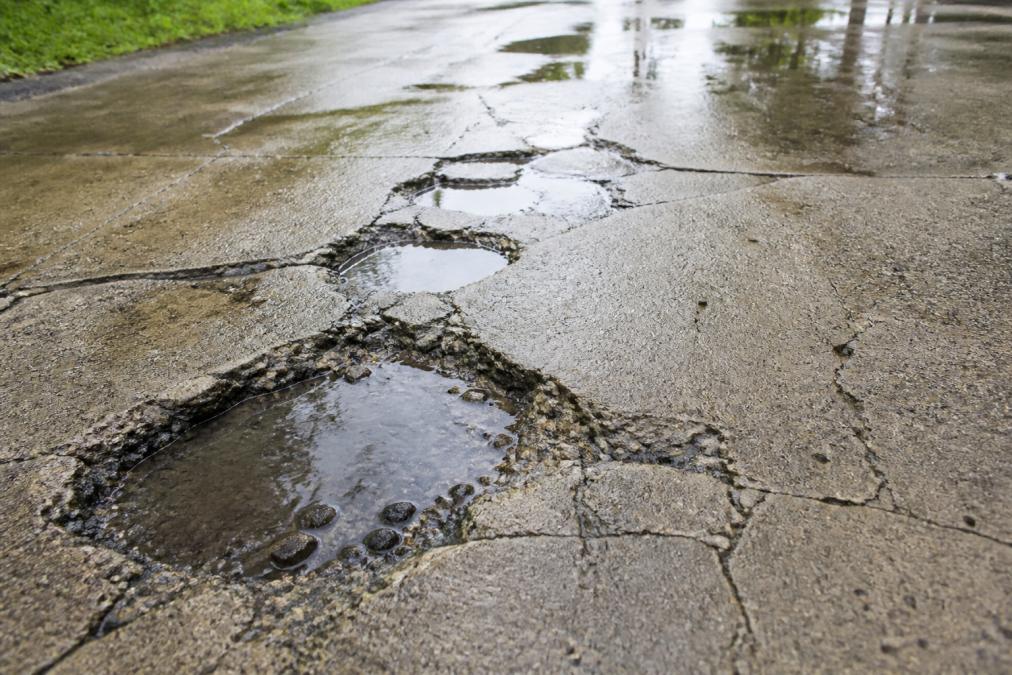
Surface cracks indicate water penetrating the surface and weakening the base material below. Watch for alligator cracking (interconnected cracks resembling reptile skin from repeated water saturation and freeze-thaw cycling), potholes (formed when weakened surface material collapses under vehicle weight), and soft spots (areas that flex or sink underfoot, indicating soil saturation). A soft spot today becomes a pothole within one or two wet seasons.
Water Pooling and Soil Saturation Patterns
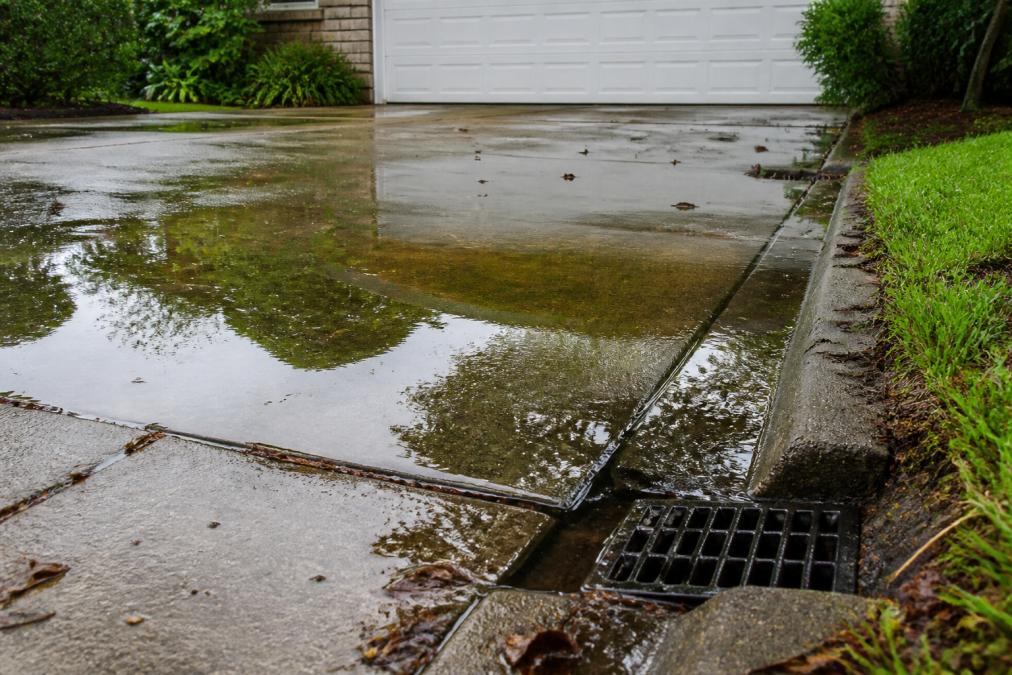
Standing water on a driveway after rain indicates drainage failure. Water should sheet off within minutes. If it sits for hours, the driveway pitch is wrong, the surface is too flat, or surrounding landscape is directing runoff toward the pavement. Waterlogged ground loses load-bearing capacity, and hydrostatic pressure builds under the slab, causing heaving, cracking, and displacement. Pay attention to where water pools, the location reveals the source.
Identifying the Source of Your Driveway Drainage Issues
The biggest mistake is treating the symptom without diagnosing the cause. Patching cracks without fixing the underlying water problem ensures they'll crack in the same spots year after year. Driveway drainage issues stem from three primary sources: slope problems, soil conditions, and stormwater routing.
Slope Gradient and Driveway Pitch Problems
Driveway pitch is the degree to which a surface slopes to direct water away from structures toward a designated drainage point. The Federal Highway Administration guidance on pavement drainage recommends a minimum cross-slope of 1.5% to 2% for paved surfaces. For residential driveways, 1% to 2% pitch away from the garage or home foundation is generally sufficient.
Problems occur when the driveway was originally graded incorrectly, soil settling has flattened the surface, or landscaping changes have altered water flow. Use a long level and tape measure to check your current pitch. A 1-inch drop over 8 feet equals roughly 1% slope. Less than that requires regrading.
Soil Type Analysis and Subsurface Drainage
Soil type determines how quickly water moves through the ground beneath your driveway. Clay-heavy soils, common in Gulf Coast regions, have very low permeability, leading to prolonged saturation and subsurface pressure buildup. A basic soil assessment involves digging a test hole 12 inches deep near the problem area, filling it with water, and timing drainage. Fast drainage (under 30 minutes) indicates sandy soil with good permeability. Slow drainage (over 2 hours) indicates clay-heavy soil requiring a French drain or subsurface system.
Downspout Diversion and Stormwater Runoff
Roof downspouts are frequently overlooked contributors to driveway damage. When downspouts discharge directly onto or near a driveway, they concentrate large volumes of runoff in one location, overwhelming the surface's ability to shed water. Check where each downspout terminates. If any discharge within 10 feet of your driveway, redirecting them with extension pipes or underground diversion is one of the most cost-effective drainage fixes available.
How to Regrade a Driveway for Drainage
Regrading restores proper slope so water moves away from the structure toward a designated outlet. Before beginning, gather a long level (4-foot minimum), tape measure, stakes, string line, plate compactor, gravel or crushed stone, and topsoil or fill material.
Step-by-Step Landscape Grading Process
- Establish your target grade. Use stakes and string to mark the desired slope, aiming for minimum 1% to 2% pitch away from the structure.
- Remove excess material or add fill. Excavate high areas; add compacted fill to low areas.
- Compact the base thoroughly. Use a plate compactor in overlapping passes. Skipping this step leads to settlement and new drainage problems within months.
- Check grade with the level. Verify slope at multiple points before applying surface material.
- Resurface or repave. Apply appropriate surface material at the corrected grade.
- Address surrounding landscape grade. Grade adjacent soil to slope away from the driveway by at least 6 inches over 10 feet.
Installing a Trench Drain, French Drain, or Catch Basin
When regrading alone isn't enough, a dedicated drainage system intercepts water before it damages the pavement. Three systems are most commonly used: trench drains, French drains, and dry creek beds.
Trench Drain Installation: Steps and Placement
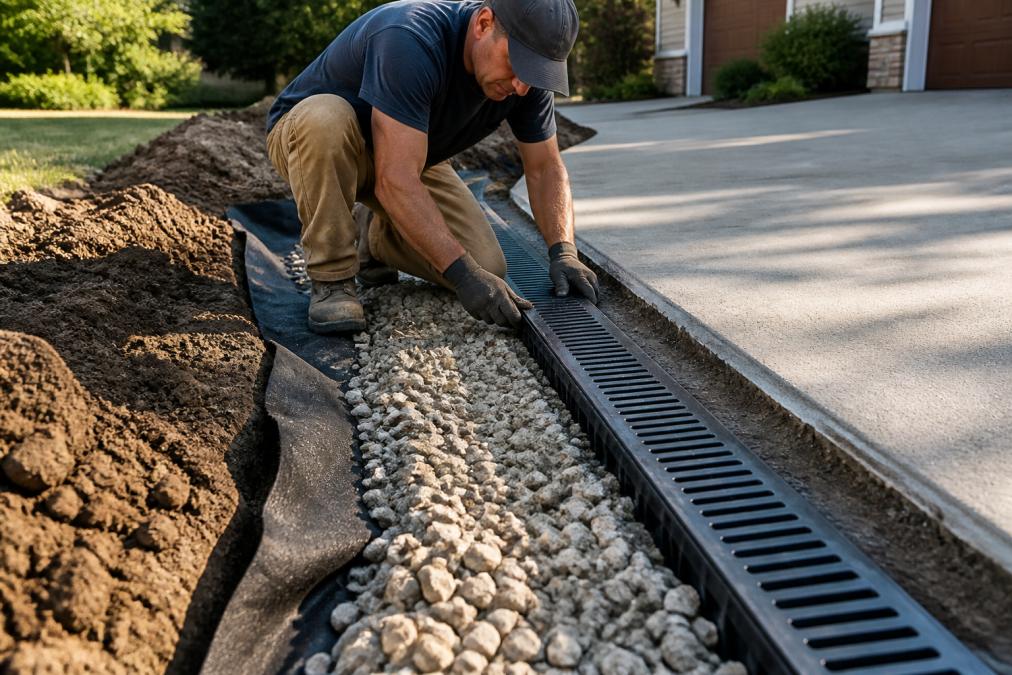
A trench drain is a linear channel drain set flush with the driveway surface, covered by a drainage grate, designed to intercept sheet flow across the pavement. Typical placement is at the base of a sloped driveway, just before the garage apron, or where driveway meets street.
Installation steps: Mark the trench line across the full driveway width, excavate to the required depth (typically 12 to 18 inches), lay a gravel bed for drainage pipe support, set the drain channel at the correct elevation with minimum 0.5% slope toward the outlet, connect the outlet to a catch basin or culvert (check local code before connecting to municipal systems), backfill with compacted gravel, and set the drainage grate flush with the driveway surface.
French Drains and Perforated Pipe Systems
A French drain is a subsurface drainage system consisting of perforated pipe wrapped in geotextile fabric, set in a gravel-filled trench. It captures groundwater and subsurface runoff before it saturates soil beneath the driveway. French drains are installed alongside or beneath the driveway at a depth of 18 to 24 inches.
Use corrugated or rigid perforated pipe depending on run length and required flow capacity. Wrap all pipe and gravel in geotextile fabric to prevent soil migration into the system. Maintain minimum 1% slope toward the outlet throughout the run. Outlet to daylight, a dry well, or a storm drain connection. According to USDA Natural Resources Conservation Service guidance on subsurface drainage, proper geotextile fabric selection based on local soil type is critical to long-term French drain performance.
Dry Creek Beds as a Surface Runoff Solution
A dry creek bed is a landscaped channel lined with river rock or gravel that directs surface runoff away from the driveway into a designated collection area. It's a surface runoff solution requiring no pipe installation, making it a lower-cost option for properties where drainage problems originate from adjacent landscape rather than the driveway surface itself.
Call now to schedule your free estimate →
Trench Drain Installation Cost and DIY vs. Professional Breakdown
Trench drain installation cost varies based on driveway width, drain type, outlet complexity, and whether surrounding pavement needs cutting and repair.
| Factor | DIY Approach | Professional Installation |
|---|---|---|
| Excavation | Manual or rented equipment | Mechanical excavation included |
| Materials | Sourced independently | Contractor-supplied, volume pricing |
| Outlet connection | Limited by permit access | Permitted connection to storm system |
| Surface repair | Requires separate trade | Included in scope |
| Warranty | None | Typically provided |
| Best for | Simple surface corrections | Full drainage system installs |
DIY is realistic for dry creek beds and minor landscape grading. French drain installation is manageable for experienced DIYers with the right equipment. Trench drain installation requiring cutting existing concrete or asphalt and connecting to a storm drain outlet is not a DIY project, it requires professional equipment and expertise.
For accurate trench drain installation cost specific to your property, contact Houston Pavement Repair LLC for a free estimate.
Permeable Pavers and Erosion Control Alternatives
Permeable pavers are interlocking units installed over an open-graded aggregate base that allows water to infiltrate directly into the ground. They eliminate surface runoff in moderate rain events, reduce hydrostatic pressure beneath the pavement, and support stormwater management compliance. The EPA Stormwater Management guidance on permeable pavement identifies permeable pavement as an effective low-impact development technique for residential and commercial stormwater control.
Permeable pavers are not appropriate for every situation. Clay-heavy soils with low permeability will cause water to back up in the aggregate base rather than infiltrate. A soil permeability test is essential before specifying this solution. For erosion control at driveway edges, options include geotextile fabric under gravel borders, riprap or river rock at downspout discharge points, and sod or ground cover on graded slopes adjacent to the driveway.
Local Building Codes, Permits, and Common Mistakes to Avoid
Most municipalities require permits for drainage work connecting to public storm drains, altering stormwater flow to adjacent properties, or involving excavation near underground utilities. Before starting any drainage project beyond minor landscape grading, check with your local building department.
Key regulatory considerations: Storm drain connections typically require a permit and inspection. Regrading that directs water onto neighboring property creates legal liability. Call 811 before any excavation, digging without a utility locate is illegal and dangerous. Some municipalities cap the percentage of a lot covered with impervious materials.
Common mistakes that worsen driveway drainage issues: installing a trench drain without a proper outlet, skipping geotextile fabric in French drain installations, grading toward the foundation, ignoring downspout routing, and insufficient compaction after excavation.
Fix Driveway Drainage Issues Before They Cost You More
Driveway drainage issues follow a predictable trajectory: ignored water pooling leads to base saturation, which leads to cracking, which leads to structural failure. Most drainage problems are solvable with the right diagnosis and system, regrading the surface, installing a trench drain or French drain, redirecting downspouts, or switching to permeable pavers. The mistake is treating them as cosmetic.
Persistent driveway drainage problems rarely resolve on their own, and temporary patches don't address the water causing the damage. Houston Pavement Repair LLC provides expert asphalt and concrete paving and repair services for residential and commercial properties, including drainage-related repairs that address the root cause rather than the surface symptom. Call now to schedule your free estimate and get a clear plan for fixing driveway drainage issues before they compound into a full replacement.
Frequently Asked Questions
How do I fix drainage issues in my driveway?
Start by identifying where water pools and why. Common fixes include regrading the surface to correct the driveway pitch, installing a trench drain or French drain with perforated pipe, redirecting downspouts away from the driveway, and adding a catch basin at low points. The right solution depends on your soil type, the severity of the slope problem, and whether the issue is surface runoff or subsurface drainage. A professional assessment helps you avoid repeat repairs.
What are the signs of poor driveway drainage?
The most obvious sign is water pooling on or near the driveway after rain. Beyond that, look for surface cracks that follow water channels, soft or spongy spots in asphalt, soil erosion along the driveway edges, and efflorescence or staining on concrete. Repeated cracking in the same spots often points to hydrostatic pressure building beneath the surface due to poor subsurface drainage rather than simple wear and tear.
How much does trench drain installation cost?
Trench drain installation cost varies based on drain length, materials (plastic channel vs. concrete-encased), grate type, and excavation depth required. DIY kits are available at home improvement stores, but professional installation ensures correct slope gradient, proper backfill, and code compliance. Because costs depend heavily on site conditions and local labor rates, contact a licensed paving contractor for an accurate quote specific to your driveway.
When should I hire a professional for driveway drainage?
Hire a professional when water pooling has already caused cracking, heaving, or soft spots in your pavement, those are signs the drainage problem has damaged the base layer. You should also call a pro if regrading requires heavy excavation, if your property sits on clay-heavy soil with poor infiltration, or if local building codes require a permit for drainage work. Repeated DIY patches that keep failing are another clear signal that the root cause needs expert diagnosis.
This article was written using GrandRanker