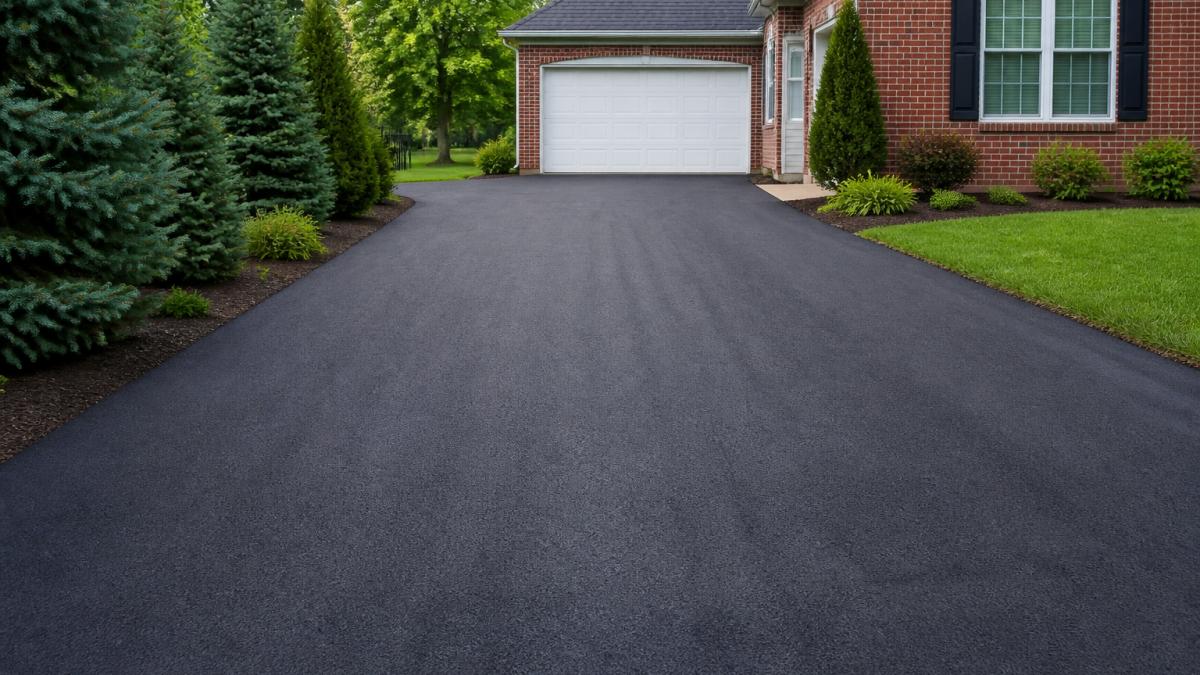
 listicle
8 Benefits of Asphalt Driveway Installation You'll Notice
Table of Contents
- Faster Installation, Less Disruption
- Lower Upfront Cost Than Concrete or Pavers
- How Long Does Asphalt Paving Last in a Freeze-Thaw Climate?
- Asphalt vs Concrete Driveway Pros and Cons
- Residential Asphalt Driveway Maintenance Tips That Add Years
- Repairs That Actually Fix the Root Cause
- Frequently Asked Questions
Last Updated: September 27, 2026
Faster Installation, Less Disruption
Asphalt driveway installation moves faster than almost any other paving option, and that speed shows up in your schedule, not just the contractor's. A typical residential asphalt driveway is laid and compacted in a day or two, then ready for foot traffic almost immediately. Concrete needs several days of curing before you can park on it.
That matters when you're juggling work, kids, and a car that needs somewhere to sit. Less time under construction means less disruption to your daily routine and fewer days of gravel, cones, and detours.
Speed also affects cost. Labor is the biggest variable in any paving quote, and fewer crew hours usually means a lower bill.
Lower Upfront Cost Than Concrete or Pavers
Asphalt usually costs less upfront than concrete or pavers for the same driveway footprint, and the gap is large enough to change what a homeowner can afford to pave. The reason comes down to materials and labor: asphalt is quicker to place, easier to shape, and requires less formwork and finishing labor than concrete, and far less hand-setting than pavers.
| Surface | Typical installed cost per sq ft | Typical 2-car driveway (approx. 600 sq ft) |
|---|---|---|
| Asphalt (new install) | $3 to $5 | $1,800 to $3,000 |
| Concrete (new install) | $6 to $10 | $3,600 to $6,000 |
| Pavers (new install) | $10 to $20 | $6,000 to $12,000 |
What actually drives the quote:
- Excavation and haul-off. Removing existing material and disposing of it is a real line item, not a rounding error.
- Aggregate base. Depth and compaction of the crushed stone base is the single biggest determinant of how long the driveway lasts.
- Asphalt binder and surface mix. Binder course plus surface course, at the specified thickness.
- Compaction and finishing. Roller passes and edge work.
- Cleanup and re-seeding. Often overlooked, sometimes billed.
How Long Does Asphalt Paving Last in a Freeze-Thaw Climate?
A well-built asphalt driveway typically lasts 15 to 20 years with proper maintenance, though freeze-thaw cycles can shorten that if the base and drainage aren't right. Water is the real enemy. When moisture gets into the pavement and the sub-base, it expands as it freezes and contracts as it thaws, and that cycle pries the surface apart from underneath.
- A properly compacted aggregate sub-base that drains well
- Correct slope and edge drainage so water runs off, not under
- Timely crack filling and sealcoating before water gets in
Asphalt vs Concrete Driveway Pros and Cons
Asphalt wins on cost, installation speed, and cold-weather flexibility. Concrete wins on lifespan and low routine maintenance, but it costs more upfront and cracks more easily under soil movement. Neither is universally better; the right choice depends on your budget, climate, and how much upkeep you're willing to do.
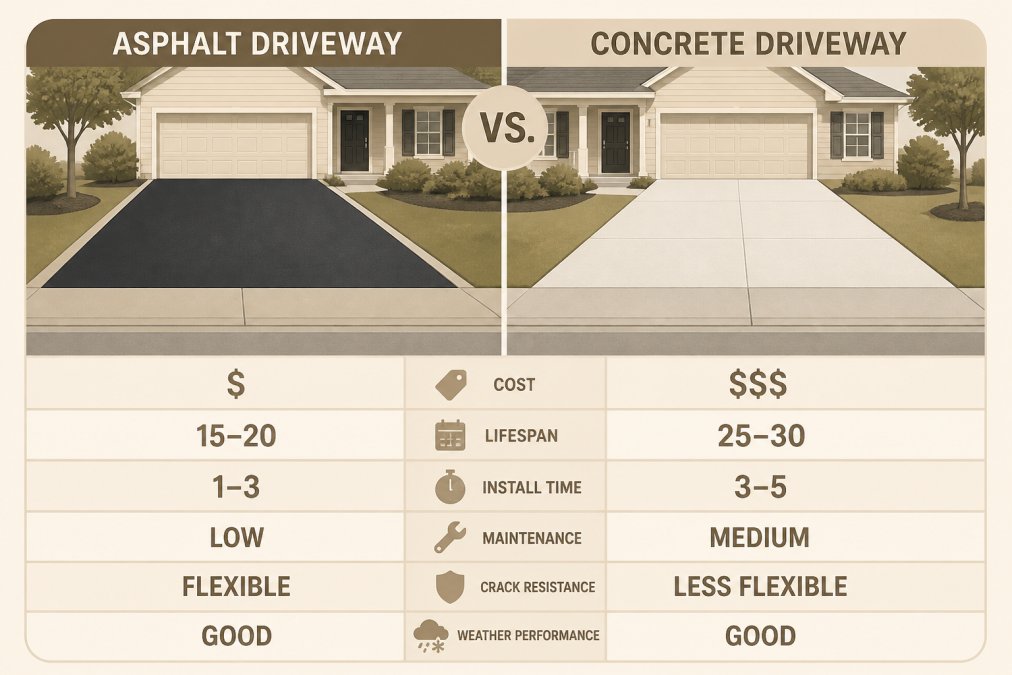
| Factor | Asphalt | Concrete |
|---|---|---|
| Upfront cost | Lower | Higher |
| Installation time | 1-2 days | Several days plus curing |
| Lifespan | 15-20 years with care | 20-30 years with care |
| Routine maintenance | Sealcoat every 2-4 years | Minimal, but repairs are costlier |
| Freeze-thaw performance | Flexible, handles movement well | Rigid, cracks under movement |
| Repair ease | Patch and re-compact | Full slab replacement often needed |
Residential Asphalt Driveway Maintenance Tips That Add Years
Residential asphalt driveway maintenance comes down to three habits: sealcoat on schedule, fill cracks early, and keep water away from the edges. Do those consistently and you can add years to the surface before it needs resurfacing. The problem is that "on schedule" is vague, and most homeowners don't know what to do in year one versus year ten. Here's a roadmap.
Year 1 (new install)
- Do not sealcoat a new asphalt driveway. The surface needs time to cure and for light oils to evaporate. Most practitioners recommend waiting at least 6 to 12 months, and often a full season, before the first sealcoat.
- Keep heavy vehicles, trailers, and dumpsters off the surface during the first summer, especially in hot weather when the asphalt is softest.
- Park in slightly different spots for the first few months to avoid setting permanent depressions.
Years 2 to 4
Call now to schedule your free estimate →
- Apply the first sealcoat once the driveway has cured. This is the highest-return task you will ever do for the surface.
- Walk the driveway each spring and fall and mark any crack wider than a pencil lead.
- Fill those cracks before winter. Water that freezes inside a crack widens it fast, and a filled crack is far cheaper than a repaired one.
Years 5 to 7
- Second sealcoat application, typically 2 to 4 years after the first.
- Inspect edges and the apron where the driveway meets the street. Edge breakdown is common and easy to miss.
- Check that gutters and downspouts still discharge away from the pavement, not onto it. Grading and landscaping settle over time.
Years 8 to 10
- Third sealcoat, again on the 2-to-4-year cycle.
- Look for alligator cracking (interconnected cracks that look like reptile scales). That pattern signals a failing sub-base, not a surface problem, and sealcoating will not fix it.
- Consider a resurfacing (overlay) if the surface is oxidized, raveling, or has widespread cracking but the base is still sound. An overlay is far cheaper than full replacement.
Every year, regardless of age
- Keep gutters and downspouts discharging away from the pavement.
- Clear debris from the edges so water can drain off the sides.
- Address oil and gas drips promptly; petroleum softens asphalt binder.
- Avoid parking on the driveway immediately after sealcoating, cure time is typically 24 to 48 hours, longer in cool or humid weather.
A simple maintenance calendar keeps you on track:
- Every 2 to 4 years: Apply a fresh sealcoat to protect the binder from sun, oil, and water.
- Every spring and fall: Walk the driveway and mark any cracks wider than a pencil lead.
- As cracks appear: Fill them before winter.
- Year-round: Keep gutters and downspouts discharging away from the pavement, not onto it.
- Annually: Clear debris from the edges so water can drain off the sides.
Repairs That Actually Fix the Root Cause
Most driveway cracks come back because the repair treated the symptom, not the cause. If water is pooling against the pavement or the sub-base wasn't compacted properly, patching the surface just buys time until the same crack reappears.
Frequently Asked Questions
How much does a 2000 sq ft asphalt driveway cost?
Pricing depends on your sub-base condition, drainage needs, and project timing, so no single number fits every property. For a 2000 sq ft residential asphalt driveway, the total reflects excavation, aggregate base, compaction, and hot-mix asphalt placement. A contractor who skips the base prep may quote lower, but that shortcut leads to cracking within a few seasons. Request a free estimate from Houston Pavement Repair LLC for a figure based on your actual site conditions.
Does putting in a new asphalt driveway increase home value?
A well-installed asphalt driveway improves curb appeal immediately, and that first-impression boost shows up in appraisals and buyer interest. Asphalt driveway installation also signals that the property has been maintained, which matters to buyers who do not want a paving project on their to-do list. The return depends on your market and the quality of the sub-base work, but a clean, uniform surface consistently reads as a maintained home rather than a neglected one.
How many years should an asphalt driveway last?
A properly installed asphalt driveway typically lasts 15 to 20 years before it needs resurfacing, and some reach 25 years with diligent sealcoating and crack filling. The variables that shorten lifespan are poor drainage, a thin or uncompacted sub-base, and deferred maintenance. In freeze-thaw climates, water that seeps into cracks and expands overnight does more damage than traffic. Sealcoating every two to three years and filling cracks early are the two habits that protect driveway longevity.
Why is sealing your blacktop driveway pointless?
Sealing is not pointless, but sealing too early or too often wastes money. New asphalt needs 6 to 12 months to cure before the first sealcoat, because the binder needs time to harden. After that, sealcoating every two to three years protects the surface from UV oxidation, fuel spills, and water intrusion. Skipping sealcoat entirely lets the binder dry out, turning the surface gray and brittle. The real mistake is sealing a brand-new driveway before it cures.
Is asphalt more cost-effective than concrete for residential driveways?
Asphalt usually costs less upfront than concrete, and repairs are simpler because you can patch a section instead of replacing a slab. Concrete lasts longer in ideal conditions but cracks with ground movement and costs more to fix when it fails. Asphalt is also a recyclable material, and its flexible pavement structure handles minor settling without shattering. For most homeowners, the lower initial cost plus straightforward maintenance makes asphalt the more cost-effective choice.