 Listicle
Best Erosion Control Plants for Driveways: 9 Options Compared
Last Updated: November 6, 2026
Quick Summary
The best erosion control plants for driveways are deep-rooted natives like switchgrass and Baptisia on sunny slopes, Pennsylvania sedge or Christmas fern in shade, and dense groundcovers like Liriope or creeping juniper on edges. Pick plants by sun, slope and moisture, and keep them 12 to 36 inches back from the pavement.
- Switchgrass and Baptisia have deep roots that hold soil on steep, sunny driveway slopes.
- Pennsylvania sedge and Christmas fern suit shaded banks where turf tends to fail.
- Plant groundcovers 12 to 18 inches back from pavement and shrubs 24 to 36 inches back.
- Fix concentrated runoff with a swale or drainage outlet before relying on plants alone.
- Check your state's invasive-plant list before planting spreaders like Liriope near property lines.
Table of Contents
- Why Driveway Edges Erode and What Plants Can Fix
- Quick Comparison: Best Erosion Control Plants for Driveways
- Best Erosion Control Plants for Driveways on Sunny Slopes
- Erosion Control Plants for Shaded Driveway Banks
- Native Plants for Controlling Erosion Along Driveways
- Low-Maintenance Ground Covers for Driveway Edges
- Planting Distance, Installation and Keeping Plants From Spreading Onto the Drive
- Booking a Driveway Edge Assessment Before You Plant
- Frequently Asked Questions
Why Driveway Edges Erode and What Plants Can Fix
Driveway edges often fail the same way again and again: water runs off the pavement, concentrates at the shoulder and carries soil away. Choosing the right erosion control plants for driveways stops that loss before it undermines the paving. Because the pavement itself can also shape runoff at the shoulder, comparing plants with materials for sloped driveways helps keep the whole edge in view.
Runoff from pavement and where it concentrates
Hard surfaces shed water quickly. Rain that lands on a driveway runs toward the lowest point, and at the edge it drops onto soil with nothing holding it in place. To see how these drainage problems damage pavement and edges, read drainage problems that destroy commercial pavement. For the practical side of handling heavy rainfall on a driveway, see managing heavy rainfall on driveways.
Shoulders, banks and the gap between pavement and planting
The strip between the concrete or asphalt and the planting bed is where erosion starts. Keep plants far enough from the pavement that roots do not lift the edge, yet close enough to catch runoff. Plant choice matters more on steep banks than on flat ground.
Quick Comparison: Best Erosion Control Plants for Driveways
We recommend matching the plant to the spot. The table below summarizes the nine options.
| Plant | Type | Best For | Starting Price |
|---|---|---|---|
| Creeping Juniper | Evergreen shrub | Large sloped embankments | $15.00/plant |
| Switchgrass | Native perennial grass | Deep-root slope hold | $12.00/plant |
| Liriope | Grass-like perennial | Tight driveway edges | $10.00/plant |
| Daylily | Perennial | Functional, flowering banks | $14.00/plant |
| Pennsylvania Sedge | Native grass-like plant | Shaded areas | $9.00/plant |
| Baptisia | Perennial | Long-term steep hillsides | $18.00/plant |
| Christmas Fern | Evergreen fern | Shaded, moist banks | $12.00/plant |
| Creeping Phlox | Mat-forming perennial | Sunny borders | $11.00/plant |
| Coyote Brush | Woody evergreen shrub | Large exposed embankments | $20.00/plant |
Starting Price
Best Erosion Control Plants for Driveways on Sunny Slopes
Sunny, steep banks need roots that go deep. These options handle full sun and hold soil on the grade.
Switchgrass and Baptisia for deep-root hold
Switchgrass is a hardy native perennial with a deep, fibrous root system. It tolerates a range of soil types and needs cutting back in late winter.
- Pros: very low maintenance, supports local wildlife
- Cons: annual cutting back required
- Best for: large driveway slopes that need deep-root stabilization
Baptisia develops a deep woody taproot that gives long-term structural stability. It is hardy and long-lived, though it spreads slowly.
- Pros: extremely hardy, improves soil health
- Cons: does not cover large areas quickly
- Best for: long-term stabilization of steep driveway hillsides
Creeping juniper and coyote brush for large embankments
Creeping Juniper spreads quickly into a dense mat and suppresses weeds. Poor drainage can invite fungal blight, so check the site first.
- Pros: dense surface cover, good weed suppression
- Cons: susceptible to fungal blight in poorly drained soil
- Best for: sloped areas beside driveways that need fast, permanent cover
Coyote Brush is a woody evergreen with an extensive root system, tolerant of drought and salt. It suits exposed banks but becomes woody and needs occasional pruning.
- Pros: extremely durable, excellent soil retention
- Cons: requires occasional pruning
- Best for: large, exposed driveway embankments
Erosion Control Plants for Shaded Driveway Banks
Shade limits your options, but a few plants perform well under it.
Christmas Fern is an evergreen fern that grows in clumps and holds soil on shaded, sloped banks. It provides winter color and needs little care, but it must have steady moisture while it establishes.
- Pros: winter color, very low maintenance
- Cons: needs consistent moisture to establish
- Best for: shaded, moist areas along driveways
Pennsylvania Sedge is a native, low-growing plant that spreads by rhizomes into a soft, lawn-like barrier. It needs no mowing and thrives in partial shade, though it establishes more slowly than many non-native groundcovers.
- Pros: strong erosion control in shade, supports local ecosystems
- Cons: slower to establish
- Best for: shaded areas where turf fails
Native Plants for Controlling Erosion Along Driveways
Native species are the default recommendation for driveway edges because they tend to match local rainfall, soil, and temperature patterns, which means less watering and fewer replacements after a hard winter. If your edge sits on clay, first compare the best driveway materials for clay soil so the paving and the planting work together. But "native" is not a single list, a plant native to a coastal plain may struggle on a high-desert shoulder, and a species that behaves in one region can spread aggressively in another.
Why natives hold driveway shoulders better
Most native prairie and meadow grasses root deeper than turf. Deep roots also open channels in compacted soil, so the next rain infiltrates rather than sheeting straight across the pavement edge. That combination, deep roots plus improved infiltration, is the mechanism that makes natives worth the slower establishment.
The short list that earns its place on a driveway edge
- Switchgrass (Panicum virgatum): clumping native grass, full sun, tolerates both dry shoulders and occasional flooding; cut back in late winter.
- Pennsylvania sedge (Carex pensylvanica): low, rhizomatous native sedge for partial to full shade; spreads into a soft mat that needs no mowing.
- Baptisia (Baptisia australis and relatives): deep woody taproot for long-term structural hold on steep banks; slow to spread, so pair it with a faster filler.
Regional suitability: match the plant to your ecoregion
A native plant list is only useful if it is local. Before you buy, check the plant's native range against your state's extension publications or your regional native plant society's recommended list. A few rules of thumb:
- In the Northeast and Midwest, switchgrass, little bluestem, and Pennsylvania sedge are widely recommended for shoulders and banks.
- In the Southeast, add native muhly grasses and shade-tolerant sedges; avoid desert species that will rot in humid summers.
- In the arid West, choose drought-adapted natives and plan for supplemental water during the first two summers.
Invasive-plant cautions
Some plants sold as "native" or "naturalized" are invasive in parts of the country and should not be planted along a driveway where they can escape into adjacent land. Liriope and creeping juniper can spread aggressively in some regions, check your state's invasive-plant list before planting them near a property line or natural area. The same caution applies to any fast-spreading groundcover: the traits that make it good at holding soil also make it good at colonizing a neighbor's yard.
Low-Maintenance Ground Covers for Driveway Edges
Ground covers are the simplest answer for narrow edges. Liriope forms clumping mats that can define the edge.
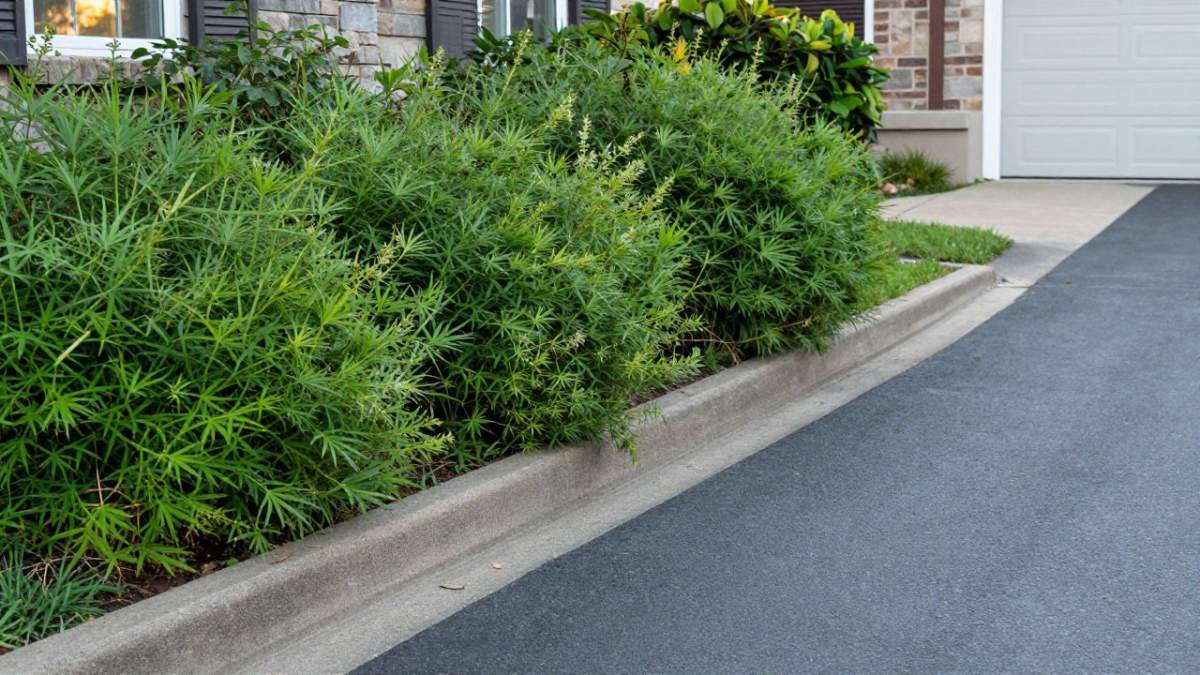
Creeping Phlox adds spring color and a dense surface mat. It is sun-loving and suits sunny borders, but it does not provide deep-root stabilization on steep slopes.
Daylily is a perennial with a fibrous root mass. Its foliage can look untidy after blooming.
Planting Distance, Installation and Keeping Plants From Spreading Onto the Drive
Planting distance and installation are where most driveway-edge plantings succeed or fail. The goal is a bed that catches runoff, holds the shoulder, and never crowds the pavement, the sightline, or the vehicle door swing.
How far from the pavement to plant
There is no single number, but a few working rules keep roots away from the slab and growth off the drive:
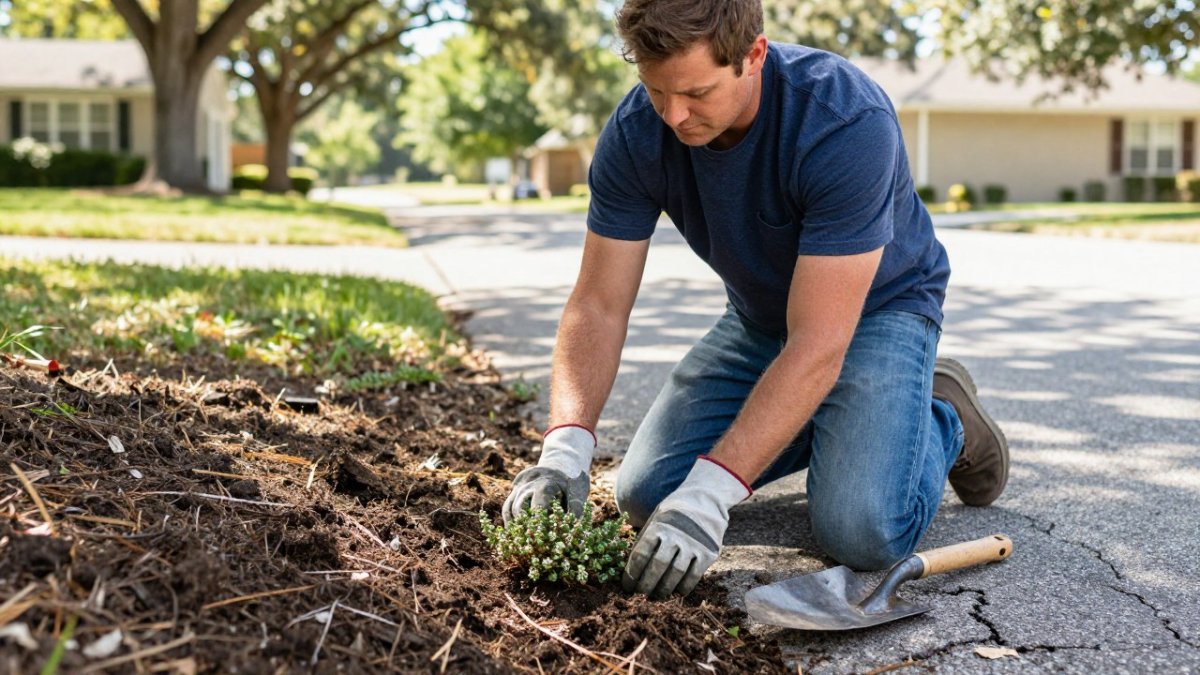
- Small groundcovers and sedges (Liriope, Pennsylvania sedge, creeping phlox): set the front of the bed 12 to 18 inches back from the pavement edge. These spread by rhizomes or runners and will close that gap within a season or two.
- Clumping perennials and grasses (daylily, switchgrass, baptisia): allow 18 to 24 inches from the pavement to the center of the plant, so the mature clump stays clear of the slab.
- Shrubs and woody evergreens (creeping juniper, coyote brush): allow 24 to 36 inches from the pavement to the trunk or crown center, and check the mature spread on the tag, a juniper that spreads 6 feet will overhang a drive if planted too close.
Roots are the reason for the setback. For guidance on improving drainage in the strip between pavement and planting, see how to improve concrete drainage around your house. Tree and shrub roots can lift and crack a concrete edge as they expand, and even vigorous groundcover roots will find the joint between pavement and soil. A 12- to 36-inch buffer costs a little planting space and saves the slab.
Step-by-step installation for a driveway edge
- Check the drainage first. Watch where water actually leaves the pavement during a rain. If it concentrates in one spot, that spot needs a swale or a drainage outlet before plants can help, see the runoff section below.
- Loosen compacted soil. Driveway shoulders are often compacted by vehicles and construction. Break up the top 6 to 8 inches with a garden fork or tiller, and mix in compost so roots can penetrate.
- Shape a shallow berm or swale. A slight depression along the bed catches sheet flow; a low berm on the downhill side slows it. Keep the grade falling away from the pavement so water does not pond against the slab.
- Plant at the right density. Space groundcovers 12 to 18 inches apart on center, clumping perennials 18 to 24 inches, and shrubs according to their mature spread. Denser planting closes the canopy faster and shades out weeds.
- Mulch, but not against the pavement. Two to three inches of shredded bark or arborist chips holds moisture and slows runoff. Leave a 2-inch gap between mulch and the pavement edge so the mulch does not wick water onto the slab or harbor pests against the house.
- Water to establish. New plantings need deep, infrequent watering for the first growing season, roughly an inch per week, delivered slowly, is the common extension recommendation. Cut back once plants are rooted.
- Add temporary erosion protection. Bare soil between new plants will wash before the roots knit. Use an erosion control blanket, straw wattles, or a temporary mulch cover on the shoulder until the planting fills in.
Keeping plants off the drive
Spreaders such as Liriope, creeping juniper, and creeping phlox will creep onto pavement if left alone. A steel or aluminum edging set 4 to 6 inches deep along the bed line gives a clean, mowable boundary and stops rhizomes from crossing.
Watch out: planting too close to the pavement, especially a woody shrub within a foot of the slab, is the most common cause of cracked and heaved driveway edges, and the damage usually shows up two or three seasons after planting.
Runoff management beyond planting
Plants are part of the fix, not the whole fix. Where runoff from the pavement concentrates, pair the planting with one of these:
- A grass swale or shallow ditch along the shoulder to carry water to a safe outlet instead of letting it sheet across the bed.
- A drainage outlet or dry well at the low point, so water has somewhere to go besides the neighbor's yard.
- Edging or a gravel-filled trench at the pavement joint to slow flow and trap sediment before it reaches the plants.
If the pavement is already cracking or the shoulder is washing out, planting alone will not fix it, the drainage has to be corrected first, then the plants can hold the repaired edge.
Booking a Driveway Edge Assessment Before You Plant
The right plant depends on your slope, sun exposure, soil and how water moves across your driveway. If your pavement is already cracking or the edge is washing out, call Houston Pavement Repair LLC to schedule your free estimate.
Houston Pavement Repair LLC provides asphalt and concrete paving and repair for residential and commercial clients in Houston and Katy, TX.
Frequently Asked Questions
What is the best plant to stop erosion?
No single plant fits every driveway. For sunny slopes, switchgrass and baptisia hold soil with deep roots, while creeping juniper forms a fast mat at the surface. In shade, Pennsylvania sedge and Christmas fern work well. Match the plant to sun exposure, moisture and slope steepness first, then choose the one whose root depth fits the problem. Surface washout needs a mat-forming plant; deep slumping needs deep roots.
What is the best plant to line a driveway with?
For driveway edges, liriope and creeping phlox are common choices because they form tight clumps or mats that hold the shoulder without growing far onto the pavement. Liriope tolerates both sun and shade and needs little pruning, though it can spread aggressively in good conditions. Keep edging or a root barrier between the planting and the asphalt so roots and runoff do not undermine the drive.
How do I choose plants that won't spread onto a driveway?
Look for plants that stay low, clump rather than run, and have a known spread habit. Liriope and Pennsylvania sedge are less likely to creep across pavement than creeping juniper or some grasses. Plant at least several inches back from the edge, check mature spread in the product description, and plan a simple edging strip. Pruning once or twice a year is usually enough to keep growth off the drive.
How do I stop erosion on my driveway?
Plants help, but they work best alongside control of the water that causes the damage. Identify where runoff enters the shoulder, whether from a downspout, a sloped drive or a low spot. Plant the banks and edges with deep-rooted species, use a mat-forming ground cover at the surface, and repair cracked or sunken pavement that channels water. If the drive floods after every rain, a site assessment can confirm the grade and drainage cause before you commit to planting.