 How-to
How to Manage Heavy Rainfall on Residential Driveways
Last Updated: November 2, 2026
Quick Summary
Managing heavy rainfall driveways starts with finding where water collects and where it leaves the surface. Correct the slope so water runs toward the street, clean drains and gutters, and extend downspouts away from the driveway. Small surface problems can be handled yourself, while settled slabs or drains that run toward the house need a professional.
- A driveway should drop about one-quarter inch per foot away from the garage and house.
- Extend downspouts so water lands at least 4 to 6 feet from the driveway.
- Clear grates and channels of leaves, dirt, and debris every few months.
- Filling a low spot without fixing the slope usually brings the same puddle back.
- Trench drains capture surface water, while French drains handle wet, saturated ground.
Table of Contents
- Why Driveways Flood During Heavy Rain
- Step-by-Step Site Assessment: Finding Where the Water Comes From
- How to Fix Water Pooling in Driveway DIY
- Sloping Driveway Drainage Solutions and Grading Options
- Driveway Trench Drain and French Drain Options Compared
- Drain Sizing, Discharge Points and Local Stormwater Rules
- Scheduling Your Drain Maintenance and Requesting a Drainage Assessment
- Frequently Asked Questions
Why Driveways Flood During Heavy Rain
Heavy rainfall on driveways is one of the most common causes of cracking, crumbling edges, and standing water near the garage, and heavy rainfall driveways are where we see this most often. Find out which local driveway cracking causes make water intrusion worse.
A driveway floods when water arrives faster than it can leave. Concrete and asphalt are solid, so rain has only two ways to go: off the surface or into the ground beneath it.
Common reasons driveways hold water:
- The slope runs toward the house or garage instead of the street
- Settled sections create low spots where puddles form
- Gutters and downspouts empty onto the driveway
Each cause calls for a different fix. A new surface without correcting the water flow only gives the same problem a fresh start.
Step-by-Step Site Assessment: Finding Where the Water Comes From
Before you fix anything, find out where the water comes from and where it goes. A walk-through during or right after a storm works well; bring a flashlight and a broom.
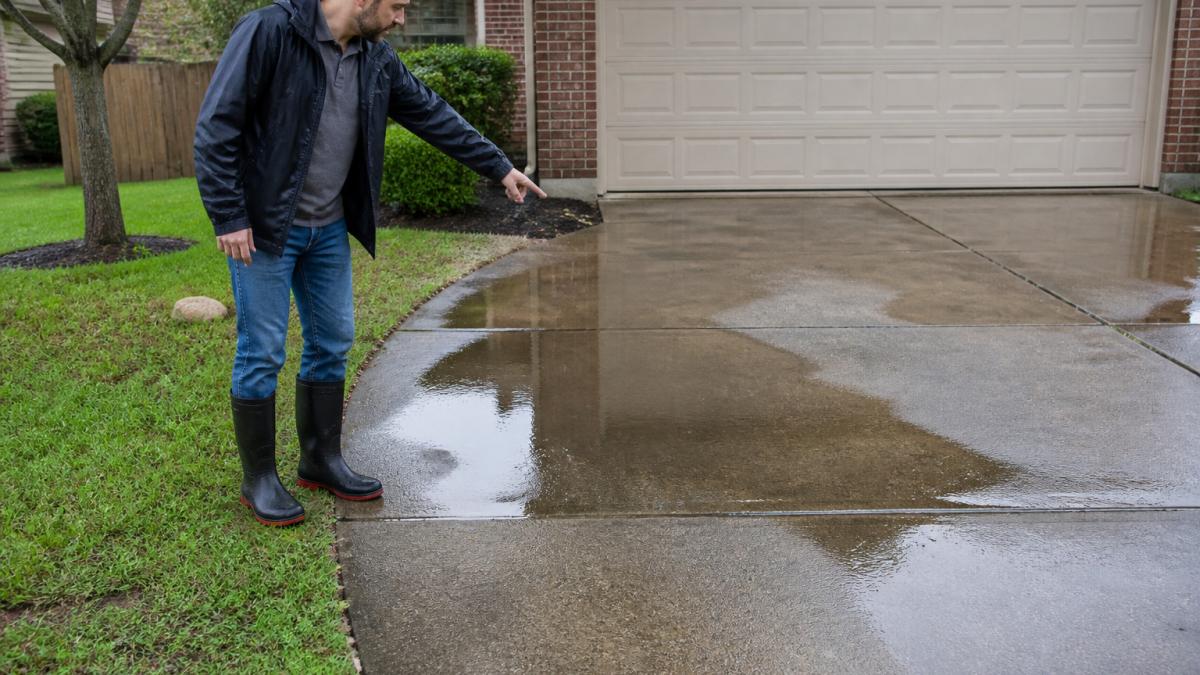
- Watch the driveway during rain. Note where water collects, which way it flows, and where it leaves the surface.
- Check the first 10 feet near the garage door for water pushing under the door or pooling against the foundation.
- Walk the gutters while it rains. Look for overflow or downspouts that drop water straight onto concrete.
- After the rain stops, look at the same spots again. Puddles that stay for more than a few hours signal a drainage problem.
- Take photos and notes to help you talk with a contractor and track changes over time.
Checking Driveway Slope and Grading
Slope tells you where water wants to go. A driveway should drop about one-quarter inch per foot away from the garage and house.
Check it with a level and a straight board: place the board on the surface, set the level on top, and measure the gap at the low end.
Watch out: A flat driveway with no slope will never shed water on its own. Adding a drain alone rarely fixes a grading problem.
Tracing Gutter and Street Runoff
Gutters and street runoff can add a significant amount of water to a driveway during a heavy storm. Follow each downspout, it should carry water at least several feet away from the house and driveway edges.
Street runoff is different. If the road is higher than your driveway, water may flow onto your property from the curb. Look for signs like debris lines or silt on the surface after a storm.
How to Fix Water Pooling in Driveway DIY
Small pools and minor low spots can sometimes be handled without a contractor. Read how to improve concrete drainage around your house for more guidance.
Steps for a basic DIY fix:
- Clear debris and sediment from the surface and any nearby grates
- Extend downspouts so water lands at least 4 to 6 feet from the driveway
- Use a stiff broom or pressure washer to clear clogged cracks and edges
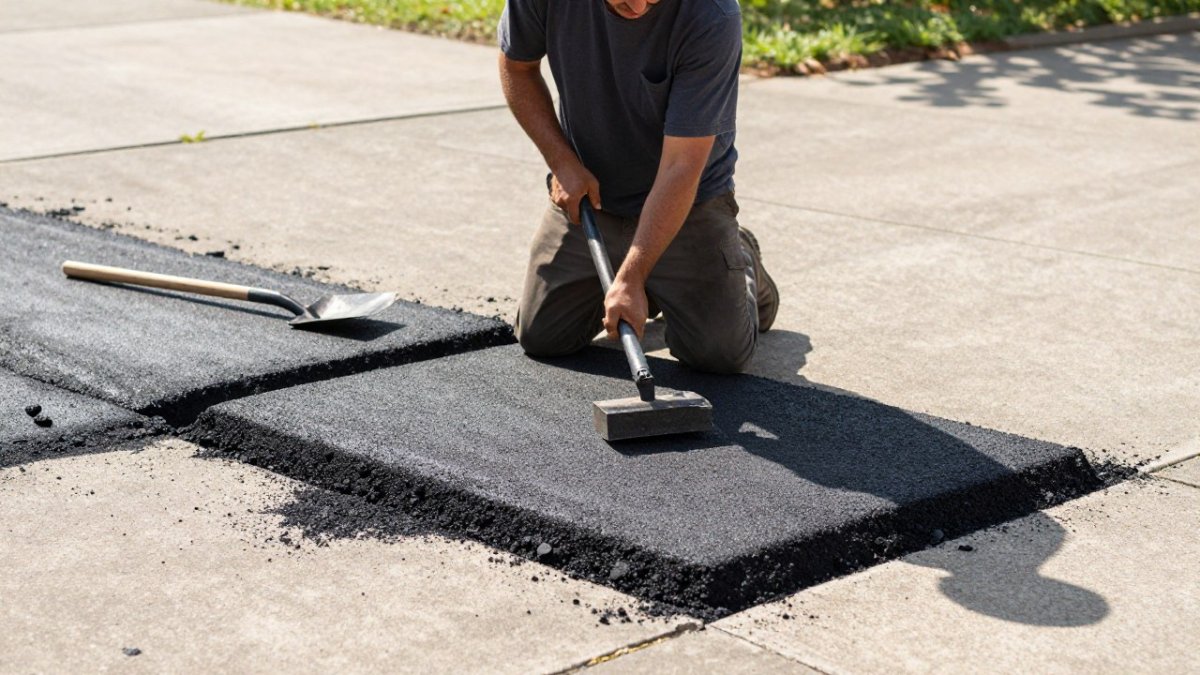
Watch out: Filling a low spot with patching material without fixing the slope usually brings the same puddle back within a season. DIY suits small, surface-level problems; if the slab has settled, cracked through, or drains toward the house, call a professional.
Here is a quick summary of when to DIY and when to call a pro:
| Problem | DIY? | Why |
|---|---|---|
| Clogged grates and debris | Yes | Simple cleaning |
| Downspout extensions | Yes | Low cost, quick install |
| Hairline cracks | Yes | Sealant handles small gaps |
| Settled or sloped low spots | Usually no | Needs proper regrading |
| Drain installation | Usually no | Requires slope and outlet planning |
Sloping Driveway Drainage Solutions and Grading Options
When a driveway slopes the wrong way, the fix is regrading or adding a drainage path. Follow the DIY driveway soil compaction step-by-step guide to prepare the base.
Common grading options include:
- Adding asphalt or concrete at the low end to create a proper slope
- Removing and re-laying a section with a corrected grade
- Building a shallow swale along the edge to carry runoff away
The right choice depends on how much of the driveway needs to change and what the base looks like underneath. A contractor can check the base and recommend the least disruptive route.
Driveway Trench Drain and French Drain Options Compared
Trench drains and French drains both move water away from a driveway, but they solve different problems. A trench drain captures water running across the surface; a French drain collects water in saturated ground and carries it away underground. See parking lot drainage solutions for commercial properties for how these options scale up. Picking the wrong one is a common and expensive mistake.
How each system works
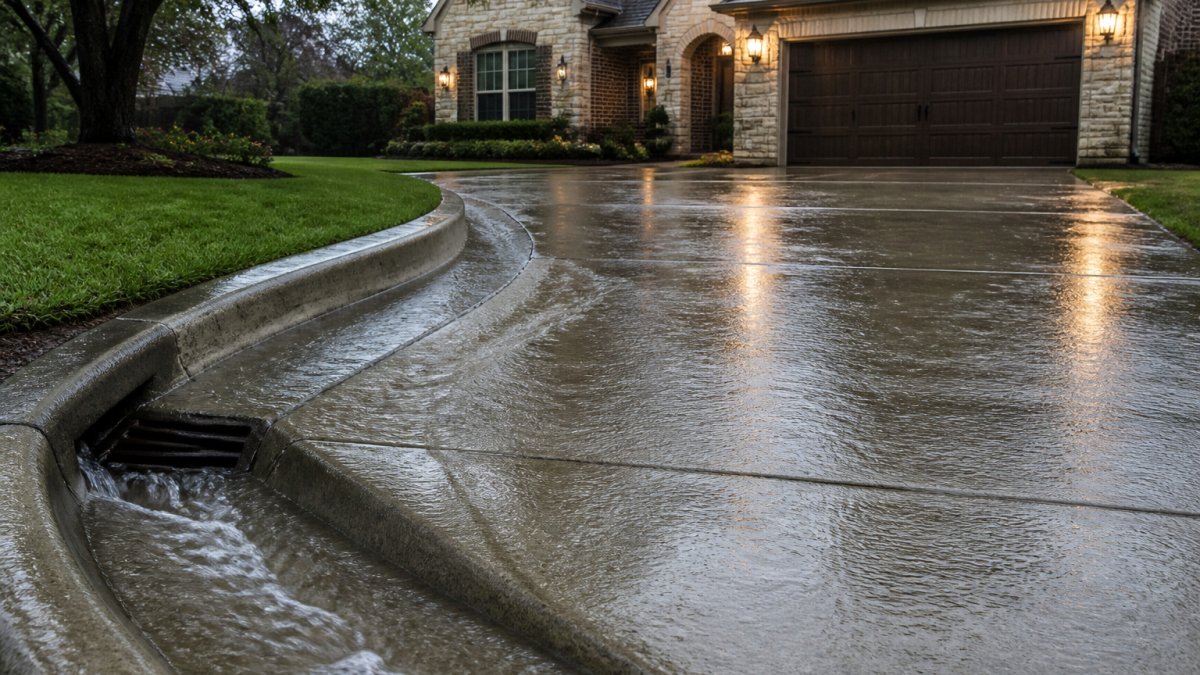
A trench, or channel, drain is a narrow open channel set flush with the driveway surface and covered by a grate. Water flows across the pavement, drops through the grate, and runs along the channel to an outlet.
A French drain is a gravel-filled trench containing a perforated pipe wrapped in filter fabric. Because a French drain will not correct surface washout on a gravel drive, restore gravel driveways by addressing the displaced stone and the runoff that moved it.
Many driveways need both: a trench drain at the low point to catch surface water, and a French drain along the uphill edge to cut off subsurface seepage before it reaches the base.
Capacity and layout trade-offs
Trench drains need a continuous slope along the channel to the outlet, and the outlet must be lower than the channel.
Call now to schedule your free estimate →
French drains move water more slowly and depend on soil permeability. In clay-heavy soils they can clog with fines over time, and the filter fabric and gravel must be specified correctly to keep silt out of the pipe.
Watch out: A French drain installed without a proper outlet or fall becomes an underground bathtub. Confirm the outlet elevation before any gravel goes in.
Matching the drain to the driveway surface and layout
- Concrete: Trench drains cut cleanly into concrete and are the usual choice at garage thresholds and low points. Saw-cutting and patching are straightforward, but the cut must be sealed to prevent water from getting under the slab.
- Asphalt: Trench drains can be installed, but the cut edge needs a proper binder and seal. French drains along asphalt edges are common where the subgrade stays wet.
- Pavers: A linear channel can be set into the paver field with the grate flush to the surface. Permeable paver systems can also be combined with a French drain beneath to handle both surface and subsurface water.
Cost and complexity
Adding a sump and pump, running a long outlet line, or crossing a sidewalk or utility trench pushes either system toward the higher end.
Complexity follows the same pattern. A short French drain along a wet edge is within reach of a confident DIYer. A trench drain across a driveway, tied into a storm inlet under a permit, is usually a professional job: the channel must be set to grade, the cut sealed, and the outlet approved.
A simple decision guide
- Surface water sheets across the driveway and pools at a low point: trench drain.
- Ground under the driveway stays wet and soft, or a hillside seeps toward the slab: French drain.
- Water arrives from both surface and subsurface: use both, with the French drain uphill and the trench drain at the low point.
Ask for a written quote that lists the drain type, length, pipe size, outlet location, and permit responsibility. That list is what lets you compare two bids on equal terms instead of on the headline price alone.
Drain Sizing, Discharge Points and Local Stormwater Rules
A drain that is too small will overflow during the storms it was meant to handle, and a drain that discharges to the wrong place can create a legal problem on top of a water problem. Review the common drainage problems that destroy commercial pavement. Most failed residential drainage systems fail on one of these two points, not on the pipe or the grate.
Sizing a drain for intense rainfall
Drain capacity depends on how much area drains to the inlet, local rainfall intensity, and how fast the outlet can carry water away.
The area draining to an inlet is almost never just the driveway.
Rainfall intensity is the second input.
Watch out: A large grate on a small pipe still floods. The pipe and outlet are usually the bottleneck, so size the whole path, inlet, pipe, and discharge, not just the visible grate.
Choosing a discharge point
Where the water goes matters as much as how much the drain can swallow. Acceptable discharge points typically include:
- A street gutter or curb inlet, where local rules allow it
- A storm sewer inlet, often requiring a permit and sometimes a pretreatment device
- A graded swale or drainage easement that carries water to an approved outfall
Discharging onto a neighbor's property, into a foundation zone, or across a property line is a common source of complaints and, in many places, a code violation. Water that ponds against a foundation or under a slab defeats the purpose of the drain.
Permits and local stormwater rules
Stormwater rules are set locally and vary widely.
Local and state stormwater requirements vary, so confirm the applicable permit requirements with your city or county before you dig.
A contractor who works in your area regularly will know which office to call, what drawings are needed, and whether an inspection is required before the trench is backfilled. Ask for permit responsibility in writing before work starts.
When to bring in a drainage professional
Bring in a professional when the contributing area is large, the only available outlet is far from the low point, the grade change needed is more than a few inches, or the jurisdiction requires engineered plans. A designer can calculate the contributing area, select the rainfall intensity, size the pipe and outlet, and confirm the discharge point is allowed, up-front work that is usually cheaper than replacing an undersized system after the first major storm.
Scheduling Your Drain Maintenance and Requesting a Drainage Assessment
Drainage works best when it is maintained. Clean drains and grates before the rainy season and again after major storms to keep small problems from becoming costly repairs.
A basic maintenance routine:
- Clear grates and channels of leaves, dirt, and debris every few months
- Flush drain lines with water to confirm they flow freely
- Check downspouts and extensions after storms
If water still pools, cracks keep returning, or you are not sure where the problem starts, request a drainage assessment. Contact Houston Pavement Repair LLC to schedule your free estimate and discuss your driveway's drainage.
Frequently Asked Questions
How do I fix water pooling in my driveway after heavy rain?
Start by identifying where the water enters and where it sits. Standing water in a shallow low spot often means the surface needs regrading or a filled depression leveled with compactable base and sealed. For small dips, a DIY fix can work: clean the area, fill with a patching material suited to your surface, compact it, and check drainage after the next storm. If water still pools after patching, the grade itself is likely the problem and a professional assessment is worth the cost.
Can a trench drain prevent driveway flooding?
Yes, a channel or trench drain can capture sheet runoff before it reaches the garage or street, especially where the driveway slopes toward the home. Its effectiveness depends on sizing for your rainfall intensity, proper slope to the drain body, and a safe discharge point. Trench drains do not fix a poorly graded surface on their own, so pair them with grading correction where needed. Keep the grate clear of debris to maintain capacity.
When should I use a French drain near a driveway?
A French drain suits situations where subsurface water saturates the soil under or beside the driveway, causing base failure or softened edges. It is a gravel-filled trench with perforated pipe that collects groundwater and carries it to a discharge point. For surface runoff alone, a trench drain or regrading is usually more direct. Check local requirements for discharge location before digging, since water must not be routed onto neighboring property.
How do you drain a sloped driveway?
Sloped driveways typically drain well along their length but can channel water toward the garage or house. Install a trench or channel drain across the lower end to intercept runoff, and extend gutter downspouts so roof water does not feed the driveway surface. Confirm that the discharge point sends water to a suitable location and not toward a foundation or a neighbor's yard.