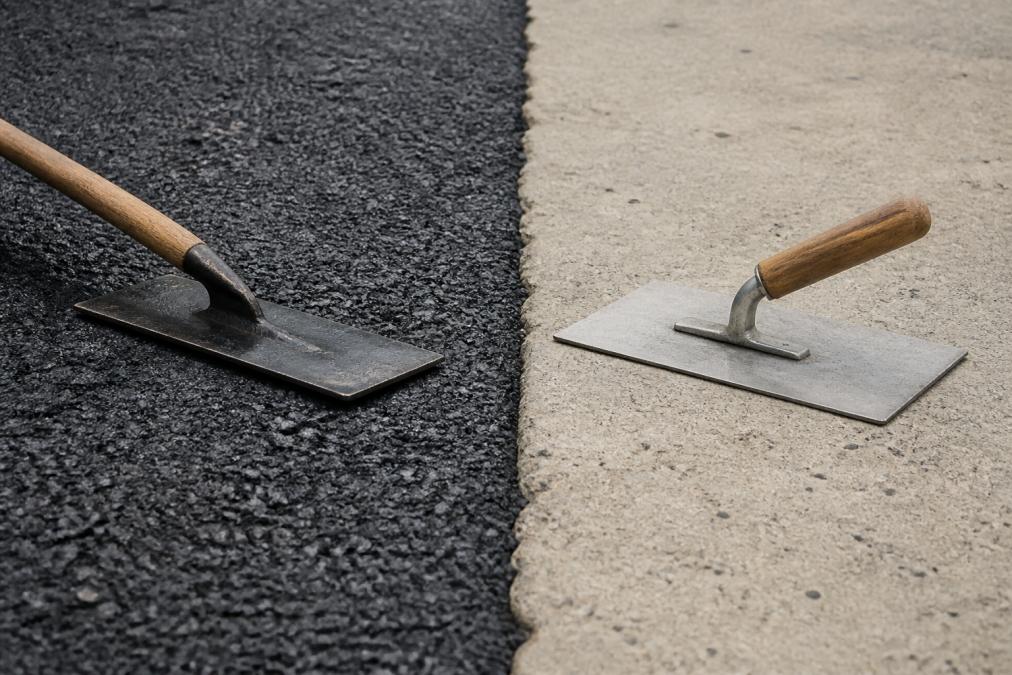
 comparison
Asphalt vs Concrete for Commercial Parking Lots: 2026 Guide
Table of Contents
- Asphalt vs Concrete for Commercial Parking Lots: Quick Comparison
- Initial Installation Costs: Asphalt Parking Lot Installation Cost vs Concrete
- Durability, Lifespan, and Load-Bearing Capacity for Heavy Truck Traffic
- How Climate and the Freeze-Thaw Cycle Affect Pavement Longevity
- Commercial Parking Lot Maintenance Tips: Sealcoating, Crack Sealing, and Pothole Repair
- Parking Lot Sealcoating Frequency: How Often Does Asphalt Need It?
- Lifecycle Cost Analysis and Drainage: What Most Comparisons Miss
- How to Choose the Right Surface for Your Property
- Frequently Asked Questions
Last Updated: September 16, 2026
Asphalt vs Concrete for Commercial Parking Lots: Quick Comparison
Choosing between asphalt vs concrete for commercial parking lots comes down to one trade-off: asphalt costs less upfront and is faster to install, while concrete lasts longer and handles heavy truck traffic with less maintenance. At Houston Pavement Repair LLC, we've paved and repaired both surfaces, and the right answer depends on your traffic, your climate, and how long you plan to own the asset.
Here's the short version: asphalt wins on initial installation cost and repairability. Concrete wins on lifespan, load-bearing capacity, and resistance to surface oxidation. Most commercial properties still choose asphalt, but that's a budget decision as much as an engineering one.
| Factor | Asphalt | Concrete |
|---|---|---|
| Initial installation cost | Lower | Higher |
| Lifespan | Shorter, with maintenance | Longer |
| Heavy truck traffic | Good with proper base | Excellent |
| Curing time | Days | Weeks |
| Repair process | Patch and seal | Patch, more involved |
| Best for | Tight budgets, fast turnover | Heavy loads, long holds |
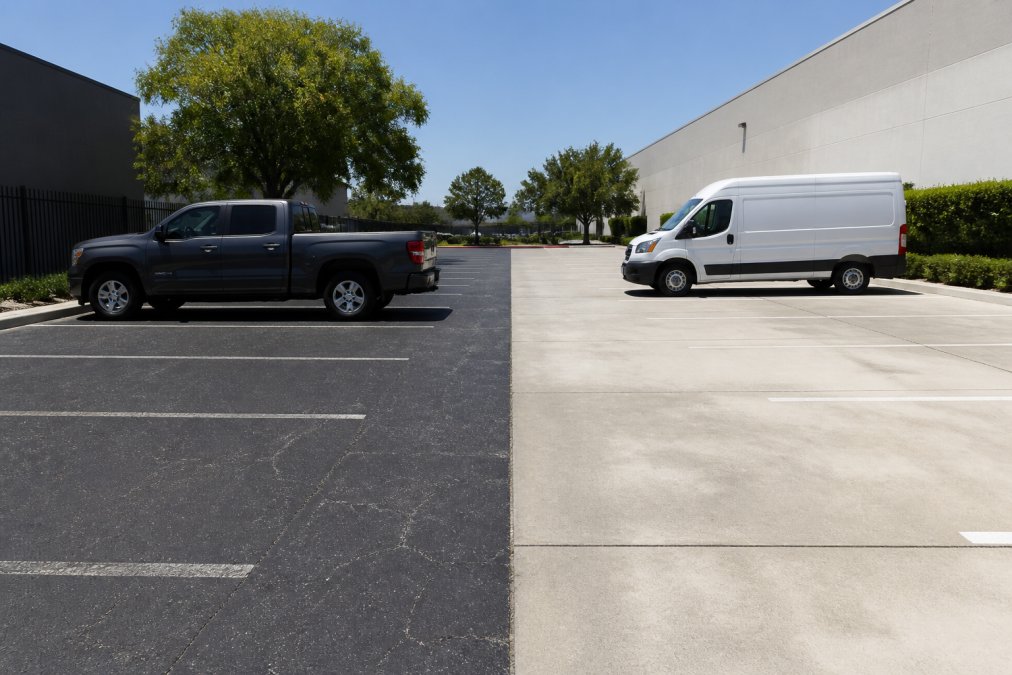
Initial Installation Costs: Asphalt Parking Lot Installation Cost vs Concrete
Asphalt parking lot installation cost runs lower than concrete for the same square footage, mainly because asphalt is cheaper to produce, faster to place, and requires less curing time before it can carry traffic. That speed matters: a shorter installation window means less disruption to tenants and customers, and less revenue lost to a closed lot.
Concrete carries a higher upfront price for several reasons:
- Material cost. Ready-mix concrete costs more per cubic yard than hot-mix asphalt, and commercial concrete lots are typically poured thicker (often 5 to 6 inches versus 2 to 3 inches of asphalt over a thicker aggregate base).
- Base preparation. Concrete's rigidity means it transfers load differently, so the aggregate base and subgrade have to be built to tighter tolerances. More excavation, more stone, more compaction passes.
- Curing time. Concrete needs roughly 7 days before it can carry light traffic and closer to 28 days to reach design strength. Asphalt can usually accept traffic the same day it's compacted.
- Reinforcement. Many commercial concrete lots use welded wire mesh or rebar, which adds material and labor.
Pricing for either surface depends on square footage, subgrade condition, drainage requirements, site access, and whether the existing pavement has to be removed and hauled off.
Where the upfront gap actually closes
The installation invoice is only the first line of the ledger. Asphalt typically needs sealcoating every 2 to 3 years, crack sealing as needed, and a mill-and-overlay or full-depth reclamation somewhere in the 15 to 25 year range. Concrete usually skips the sealcoat cycle entirely but may need joint resealing every few years and slab replacement where sub-base failure occurs.
Durability, Lifespan, and Load-Bearing Capacity for Heavy Truck Traffic
Concrete outlasts asphalt in most commercial settings, particularly where heavy truck traffic is constant. Its higher tensile strength and rigidity resist rutting and deformation under sustained loads, which is why loading docks, dumpster pads, and drive lanes for delivery fleets are often concrete.
Lifespan expectations
With routine maintenance, a well-built asphalt commercial lot commonly delivers 15 to 20 years before a major overlay or reconstruction is needed. Sealcoating every 2 to 3 years and sealing cracks while they're still hairline are what buy those years. Skip maintenance and the same lot can show serious distress in 7 to 10 years.
What actually drives failure
- Sub-base failure. Water reaching the base is the number one killer of both surfaces. Once the base loses strength, the surface follows.
- Drainage. A lot that ponds water will fail faster than a well-graded one, regardless of material.
- Load repetition. A single heavy truck once a month is very different from 40 loaded trucks a day turning in the same spot.
- Deicing salts. Chloride-based deicers attack concrete surfaces and accelerate scaling, especially on newer slabs.
- Thermal cycling. Wide temperature swings stress joints and cracks on both surfaces, but concrete feels it more because it can't flex.
Matching the surface to the traffic
For a retail lot with mostly passenger vehicles, asphalt holds up well for years and is easy to patch when it doesn't. For an industrial site with loaded semis turning daily, concrete's structural integrity is usually worth the premium, especially in drive lanes, dumpster pads, and loading zones. A common hybrid approach is concrete in the heavy-load areas and asphalt everywhere else, which captures most of the durability benefit without paying concrete prices across the whole lot.
How Climate and the Freeze-Thaw Cycle Affect Pavement Longevity
The freeze-thaw cycle is the single biggest climate threat to pavement longevity. Water seeps into small cracks, freezes, expands, and widens the crack each time temperatures swing. Over a few winters, that cycle turns hairline cracks into potholes.
Commercial Parking Lot Maintenance Tips: Sealcoating, Crack Sealing, and Pothole Repair
A simple commercial parking lot maintenance tips rule: seal asphalt before oxidation sets in, seal cracks while they're still hairline, and patch potholes before water reaches the base. These three habits add years to an asphalt lot.
- Sealcoating: restores the protective top layer and slows surface oxidation caused by sun and traffic.
- Crack sealing: fills cracks with flexible sealant so water can't enter and freeze.
- Pothole repair: removes loose material, addresses the base, and patches with proper compaction so the fix holds.
Parking Lot Sealcoating Frequency: How Often Does Asphalt Need It?
Parking lot sealcoating frequency for most commercial asphalt lots is every two to three years, though heavy-traffic lots and lots with poor drainage may need it sooner. The right interval depends on traffic volume, sun exposure, and how the surface is holding up.
Watch for these signs that it's time to seal:
- The surface looks gray and faded rather than black
- Fine cracks are appearing across the lot
- The original sealcoat has worn thin in turning lanes and parking stalls
Lifecycle Cost Analysis and Drainage: What Most Comparisons Miss
Lifecycle cost analysis (LCCA) is the practice of comparing total cost of ownership over a pavement's full life, not just the installation invoice. It's the angle most asphalt vs concrete comparisons skip, and it changes the math.
How to Choose the Right Surface for Your Property
Match the surface to your traffic, climate, and budget horizon, not to a generic rule. Use this framework:
- Mostly passenger vehicles, tight budget, shorter hold: asphalt.
- Heavy truck traffic, loading zones, long hold: concrete.
- Freeze-thaw climate with drainage issues: fix drainage first, then asphalt with a solid base.
- Chronic flooding or runoff concerns: consider permeable options and proper grading.
- Accessibility compliance concerns: verify slope and smoothness against ADA standards.
Frequently Asked Questions
Which is better for a parking lot, asphalt or concrete?
Neither wins outright. Asphalt costs less upfront, takes 1-2 days to cure, and handles freeze-thaw movement through flexibility, but needs sealcoating every 2-3 years. Concrete lasts 30+ years with minimal maintenance but costs more initially and takes 7 days to cure. For heavy truck traffic and long-term lifecycle cost, concrete often wins. For budget-conscious projects needing quick turnaround, asphalt is the practical choice.
How thick should asphalt be for a commercial parking lot?
Most commercial parking lots need 2 to 3 inches of compacted asphalt over 4 to 6 inches of aggregate base. Areas with heavy truck traffic may need 4 inches of asphalt and a thicker subgrade. Proper subgrade preparation and compaction matter more than thickness alone. A contractor should evaluate soil conditions and drainage before specifying depth.
How do initial installation costs differ between asphalt and concrete?
Asphalt typically costs roughly half of concrete per square foot for installation, though actual pricing depends on site conditions, base preparation, and square footage. Concrete's higher upfront cost is offset by lower long-term maintenance. Request a site-specific quote: pricing depends on quantity, site access, and current material rates. Contact Houston Pavement Repair LLC for a free estimate on your property.
What is the average lifespan of an asphalt parking lot compared to concrete?
A well-maintained asphalt parking lot lasts 15 to 20 years before needing resurfacing or overlay. Concrete parking lots commonly reach 30 years or more with minimal intervention. Asphalt's shorter lifespan is partly offset by lower installation cost and easier patching. Sealcoating every 2-3 years and prompt crack sealing extend asphalt life significantly.
How does climate impact the choice between asphalt and concrete paving?
In hot climates, asphalt stays flexible and resists thermal expansion cracking, while concrete expands and needs proper joint spacing. In freeze-thaw regions, asphalt flexes with ground movement and concrete can crack if the subgrade drains poorly. Drainage slope and permeability matter in both cases. A contractor should match the material to your local soil and weather patterns.
If your lot is cracking, flooding, or failing in the same spots year after year, patching alone won't fix it. Houston Pavement Repair LLC diagnoses the root cause, whether that's sub-base failure, poor drainage, or the wrong surface for your traffic, then delivers reliable pavement solutions built to last. We offer a free estimate and serve commercial and residential properties across Houston and Katy, TX. Call now to schedule your free estimate and get a surface that holds up.