 Comparison
Concrete vs Asphalt for Apartment Driveways: What Property Managers Should Know
Last Updated: November 8, 2026
Quick Summary
Concrete generally costs more to install but lasts longer with less routine care, while asphalt costs less upfront but needs sealcoating and patching. For apartment driveways, the right choice depends on your traffic, climate, drainage, and budget. Concrete suits heavy loads and hot sun; asphalt suits cold, budget-first sites.
- Concrete resists heavy loads and hot sun but cracks when the base shifts.
- Asphalt flexes with freeze-thaw cycles but fades and softens in extreme heat.
- Model a 20-year window comparing installation, maintenance, repairs, closures, and replacement.
- Use concrete at dumpster pads and entrances, asphalt in lighter-duty aisles.
- Phased construction keeps part of the lot open so tenants are not blocked in.
Table of Contents
- Concrete vs Asphalt for Apartment Driveways: The Core Tradeoffs
- Asphalt vs Concrete Driveway Pros and Cons for Multifamily Sites
- Using an Asphalt vs Concrete Driveway Cost Calculator for Apartment Budgets
- Concrete vs Asphalt in Cold Climates and Hot Sun
- Asphalt Driveway Repair and Resurfacing: What Apartment Managers Should Plan For
- Heavy Loads, Drainage, and Tenant Access on Apartment Driveways
- Request a Free Estimate for Your Apartment Driveway
- Frequently Asked Questions
Concrete vs Asphalt for Apartment Driveways: The Core Tradeoffs
Choosing between concrete and asphalt for apartment driveways comes down to how much you pay upfront versus how much you spend over the life of the surface. Concrete generally costs more to install but can last longer with less routine care. Asphalt generally costs less at the start but needs sealcoating and patching to stay in shape. This guide breaks down both materials for property managers who answer to tenants, owners, and a maintenance budget.
The core tradeoff is simple: concrete is a long-term buy, asphalt is a lower-entry buy. Concrete resists heavy loads and hot sun well, but it cracks under shifting soil and costs more to replace. Asphalt flexes with the ground and handles freeze-thaw movement, but it fades, oxidizes, and needs periodic resurfacing. For apartment driveways, where delivery trucks, garbage haulers, and dozens of daily vehicles share the same surface, the right answer depends on your traffic, your climate, and how much disruption your tenants will tolerate.
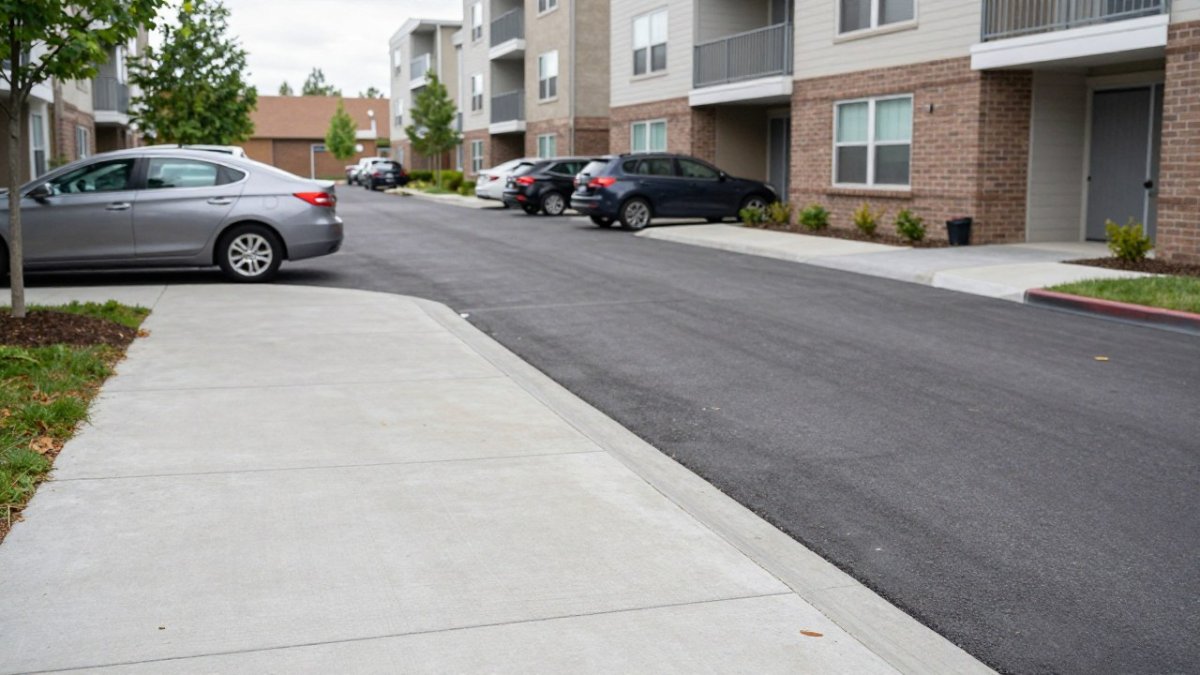
Here is the short version before the details:
| Factor | Concrete | Asphalt |
|---|---|---|
| Upfront cost | Higher | Lower |
| Lifespan | Longer | Shorter |
| Routine maintenance | Minimal | Sealcoat and patch |
| Best for | Heavy loads, hot sun | Cold, budget-first sites |
Asphalt vs Concrete Driveway Pros and Cons for Multifamily Sites
The asphalt vs concrete driveway pros and cons look different at an apartment complex than at a single-family home. You are not paving for one car. You are paving for a mix of residents, guests, delivery vans, moving trucks, and trash haulers, all on a surface that has to stay safe and passable.
Concrete pros: it holds up under heavy loads, resists sunlight and hot temperatures, and needs little routine maintenance. A light-colored surface also reflects heat and brightens the lot at night. Concrete cons: higher installation cost, longer curing time before vehicles can use it, and a tendency to crack when the base shifts or tree roots push up underneath.
Asphalt pros: lower upfront cost, faster drying time, and flexibility that lets it move with freeze-thaw cycles instead of cracking. Asphalt cons: it needs sealcoating every few years, fades in strong sun, and softens in extreme heat under heavy loads.
For a deeper same-topic breakdown of how these tradeoffs play out on commercial and multifamily pavement, see our guide to asphalt vs concrete for commercial parking lots.
Using an Asphalt vs Concrete Driveway Cost Calculator for Apartment Budgets
An asphalt vs concrete driveway cost calculator helps you compare bids on equal footing, but the number it spits out is only as good as what you feed it. Most online calculators ask for square footage and material, then apply a general per-square-foot range. For an apartment driveway, that range hides the real cost drivers: base preparation, grading, drainage, demolition of the old surface, and phased work to keep tenants moving.
A common approach is to price the job in three parts:
- Base and grading: the layer under the surface. Weak base is why driveways crack in the same spots again and again.
- Surface material and thickness: thicker concrete or asphalt for heavy-load lanes and dumpster pads.
- Drainage and edges: curbs, gutters, and slope so water runs off instead of pooling.
Pricing depends on quantity, dates, and delivery conditions, as well as your site, your soil, and how much of the work has to happen around tenants. Treat any calculator figure as a starting point, not a quote. For current prices or a quote, visit the Houston Pavement Repair LLC website.
Where a calculator really falls short is the total cost of ownership. A property manager does not buy a surface once; the budget has to carry installation, recurring maintenance, repairs, closures, and eventual replacement over a defined horizon. A common pattern is to model a 20-year window and compare the two materials on the same basis:
- Installation: the initial bid, including base, grading, drainage, and any phased staging.
- Routine maintenance: sealcoating and crack filling for asphalt; joint sealing and spot patching for concrete.
- Repairs: pothole patching and failed-panel replacement, priced per occurrence rather than as a lump sum.
- Closures and disruption: the cost of taking spaces out of service, rerouting tenants, and any temporary parking you have to provide.
- Replacement: the year each surface is likely to need full replacement, and what that replacement costs in today's dollars.
When you line those up, the lower upfront asphalt number often narrows or disappears once sealcoating cycles, patching, and an earlier replacement are added in. Concrete usually carries a higher first cost but fewer recurring line items. The right comparison is not price per square foot at installation; it is cost per year of service across the horizon you actually plan to own the property.
Watch out: a bid that looks low per square foot can hide thin base, missing drainage, or no phasing plan, and those omissions show up later as repairs and tenant complaints. Ask every bidder to break out base, surface, drainage, and staging separately so the numbers are comparable.
To plan the number realistically, read our guide on how to budget for commercial parking lot repairs.
Concrete vs Asphalt in Cold Climates and Hot Sun
Concrete vs asphalt in cold climates generally favors asphalt for flexibility, while hot climates generally favor concrete for heat resistance. That is the general picture, and it matters for any property manager weighing a surface that has to survive both ends of the weather.
In freezing temperatures, water gets into small cracks and expands when it freezes. That freeze-thaw cycle pries cracks wider. Asphalt flexes with that movement, so it handles cold better than rigid concrete, which can crack when the ground heaves.
In hot temperatures and strong sunlight, the picture flips. Dark asphalt absorbs heat, softens, and can rut under heavy loads on a hot day (Publication Details - Pavements). Concrete stays rigid, reflects sunlight, and holds its shape. In a hot-sun climate with heavy delivery traffic, concrete often wins on durability.
Asphalt Driveway Repair and Resurfacing: What Apartment Managers Should Plan For
Asphalt driveway repair and resurfacing is the ongoing cost that surprises first-time apartment managers. Asphalt is not a pave-and-forget surface. It needs a maintenance schedule, and skipping it shortens the service life fast.
Plan for these upkeep items:
- Crack filling: seals small cracks before water gets in and freeze-thaw widens them.
- Patching: repairs potholes and failed spots, usually after utility work or base failure.
- Sealcoating: a protective top coat that slows oxidation and sunlight damage, typically reapplied every few years.
- Resurfacing: a new asphalt layer over the old surface when wear is widespread but the base is still sound.
A common mistake is patching the same spot repeatedly without fixing the base or the drainage underneath. A patch over a bad base is a temporary fix. If your lot floods and cracks in the same places, the water is the root problem, not the pavement.
Not sure whether you are due for repair or full resurfacing? Our guide on the signs your parking lot needs resurfacing walks through the warning signs.
Heavy Loads, Drainage, and Tenant Access on Apartment Driveways
Heavy loads, drainage, and tenant access are the three factors that separate an apartment driveway from a residential one, and they should drive your material choice. A driveway built for passenger cars will fail early under garbage trucks and moving vans.
Traffic mix. An apartment drive is not one traffic stream. It carries residents' cars, visitor vehicles, delivery vans, moving trucks, service vehicles, and emergency access, often in the same lane. The heaviest loads concentrate at the entrance, the dumpster pad, and any turnaround, so those areas usually need a thicker base and surface than the resident parking aisles.
Drainage and grading. Water is the most common cause of premature pavement failure on multifamily sites. Without proper grading and stormwater flow, water pools, seeps into the base, and destroys the pavement from below. Apartment sites often have more impervious surface than a single home, so runoff from roofs, sidewalks, and parking areas has to be directed somewhere.
Tenant access and phasing. Tenant access shapes the schedule as much as the material. Keeping access routes clear also depends on choosing a surface and construction sequence that limit cracking under repeated traffic, making Construction Services part of the planning conversation.
Accessibility and pedestrian safety. Driveways meet sidewalks and parking areas, and those transitions matter for accessibility. Look at curb ramps, cross-slope at crossings, and whether the surface change from asphalt to concrete creates a lip or trip hazard. A light-colored concrete surface also improves visibility in the lot at night, which helps pedestrians and drivers alike.
Watch out: paving the whole lot at once without a phasing plan can leave tenants with nowhere to park for days and generate complaints that outlast the new surface. For a closer look at how water damages pavement, see our breakdown of drainage problems that destroy commercial pavement.
Request a Free Estimate for Your Apartment Driveway
The right surface for your apartment driveway depends on your traffic, climate, drainage, and budget, and no calculator replaces a site visit. Houston Pavement Repair LLC provides asphalt and concrete paving and repair for residential and commercial clients, and offers a free estimate so you can compare options for your property.
Before you commit to a contractor, read our guide on how to hire a commercial paving contractor, then reach out for a free estimate on your apartment driveway.
Ready to stop patching the same cracks and fix the surface for good? Houston Pavement Repair LLC offers expert asphalt and concrete paving and repair, a free estimate, and reliable pavement solutions for apartment properties. Get started with Houston Pavement Repair LLC and get a driveway surface built for your traffic and climate.
Frequently Asked Questions
Which is better for an apartment driveway, concrete or asphalt?
It depends on traffic volume, climate, and budget. Concrete handles heavy loads and hot sun well and needs less frequent maintenance, but it costs more upfront and repairs are harder. Asphalt costs less to install, flexes under freeze-thaw cycles, and is easier to patch, but it needs sealcoating and more routine upkeep. For apartment driveways with heavy vehicle traffic and limited maintenance windows, many property managers weigh the higher upfront cost of concrete against lower long-term repair bills.
How do concrete and asphalt compare in installation and maintenance costs?
Pricing depends on quantity, dates, and delivery conditions, as well as site conditions, base preparation, and drainage work. For current prices or a quote, visit the Houston Pavement Repair LLC website. Maintenance also differs: asphalt typically needs sealcoating every few years plus crack filling and patching, while concrete generally needs less routine treatment but costs more when joint or slab repairs are required. Building a cost calculator that includes both installation and 20-year upkeep gives the clearest picture.
How long do concrete and asphalt apartment driveways last?
With proper installation and base preparation, concrete driveways commonly last 30 years or more, while asphalt driveways typically last 15 to 20 years before resurfacing or replacement is needed. Heavy vehicle traffic, drainage problems, and freeze-thaw cycles shorten both lifespans. Sealcoating and timely crack repair extend asphalt service life, and keeping joints sealed helps concrete avoid water infiltration that leads to cracking and surface damage.
Can an apartment driveway be resurfaced instead of replaced?
Often yes, especially for asphalt. Resurfacing adds a new layer over the existing surface when the base is still sound, which costs less than full replacement and shortens downtime for tenants. Concrete is harder to resurface and usually needs slab replacement or patching at damaged sections. A contractor should inspect for base failure, drainage issues, and widespread cracking before recommending resurfacing, since paving over a failing base just delays the same problem.