 ultimate-guide
Best Asphalt Repair Methods for Heavy Traffic in 2026
Table of Contents
- Why Heavy Traffic Destroys Standard Patches
- Comparing the Best Asphalt Repair Methods for Heavy Traffic
- The Asphalt Maintenance Schedule for Commercial Lots
- Load-Bearing Capacity: The Hidden Factor in Repair Failure
- Curing Time vs. Traffic Volume: A Planning Matrix
- Long-Term Cost-Benefit of Asphalt Repair Methods
- Frequently Asked Questions
Last Updated: September 13, 2026
Why Heavy Traffic Destroys Standard Patches
Heavy traffic destroys standard patches because repeated wheel loads flex the pavement structure, and any patch with a cold joint or weak base becomes the first point of failure. Houston Pavement Repair LLC is familiar with this pattern on commercial lots around Houston and Katy: a patch that looked fine in year one is cracked and rutted by year two.
The mechanics are predictable. Every vehicle pass sends a load wave through the asphalt. A patch made with cold-mix material never fully bonds to the surrounding pavement, so the joint between old and new asphalt opens under that repeated flexing. Water gets in, the sub-base softens, and the repair fails from the bottom up.
Asphalt repair is the process of restoring a damaged pavement surface, from filling isolated cracks to removing and replacing failed sections down to the base. The right method depends on load volume, damage depth, and how long you can keep the area closed.
The distinction matters more under heavy traffic than anywhere else. A homeowner patching a driveway can afford a method that cures slowly. A property manager with a hundred vehicles entering daily cannot.
Comparing the Best Asphalt Repair Methods for Heavy Traffic
The best asphalt repair methods for heavy traffic share one trait: they either eliminate cold joints or restore the full pavement structure. Surface-only fixes fail first under continuous loading.
Here is how the four main approaches compare.
| Method | Best For | Traffic Readiness | Durability Under Load |
|---|---|---|---|
| Infrared repair | Seamless surface patches | Fast | High |
| Full-depth patching | Structural failure | Slow | Highest |
| Hot-apply crack sealant | Crack maintenance | Fast | Moderate |
| High-performance cold patch | Emergency potholes | Immediate | Moderate |
1. Infrared Asphalt Repair
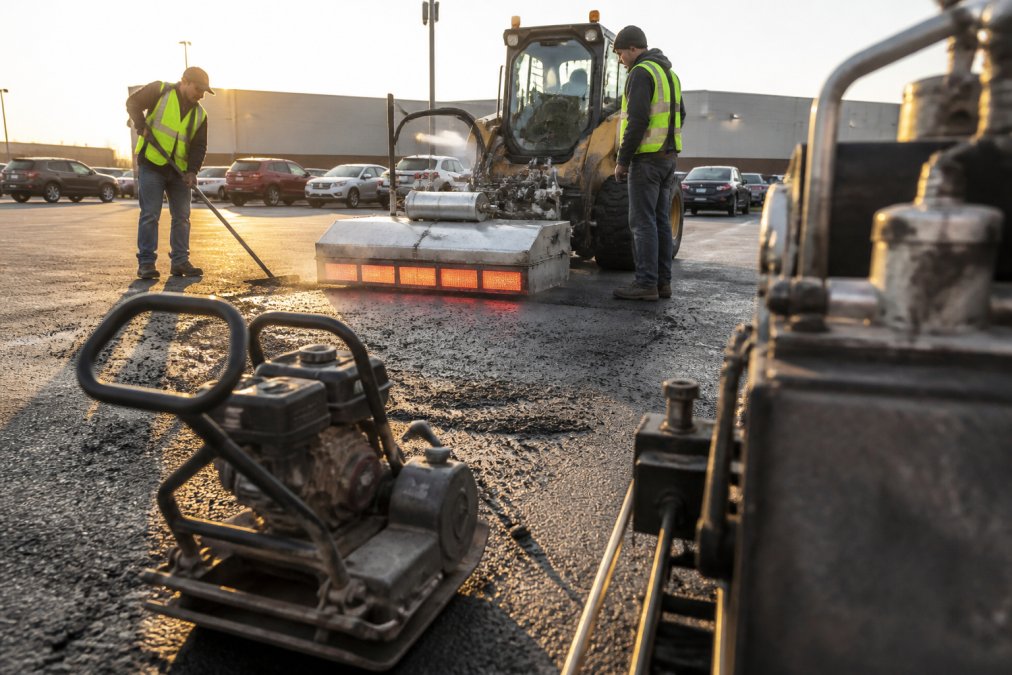
Infrared asphalt repair heats the existing pavement until it softens, then adds fresh material and compacts the whole area into one seamless surface. There is no cold joint, which is exactly why it holds up under heavy traffic.
The method recycles the asphalt already on site, so there is less waste hauled to a landfill. It also reopens to traffic quickly, which matters when closing a lane costs you business. The trade-off is equipment: infrared heaters require trained operators, so this is not a homeowner job.
2. Full-Depth Asphalt Patching Process
The full-depth asphalt patching process removes the failed asphalt and the compromised sub-base, then rebuilds both with fresh material. It is the only method that fixes the root cause when the base itself has failed.
Use it for potholes, alligator cracking, and any area where the pavement has sunk or rutted. It costs more and takes longer than surface repairs because the crew is rebuilding structure, not just covering a hole. For heavy truck traffic, nothing else matches it.
3. Hot-Apply Rubberized Crack Sealant
Hot-apply rubberized crack sealant melts into a flexible rubber bond that moves with the pavement through temperature swings. It is the highest-value preventative step for a commercial lot.
Sealing cracks before water reaches the sub-base prevents the potholes you would otherwise be patching next spring. The catch is equipment: hot-apply sealant needs a melting kettle, so this is professional work rather than a DIY fix.
4. High-Performance Cold Patch
High-performance cold patch is engineered for immediate traffic readiness, which makes it the right answer for an emergency pothole at 7 a.m. on a busy lot.
Standard cold patch is a temporary fix. Higher-density formulas with better aggregate hold up longer, but none of them match a hot-mix or full-depth repair for permanence. Treat cold patch as a stopgap that buys time until a permanent repair can be scheduled.
The Asphalt Maintenance Schedule for Commercial Lots
An asphalt maintenance schedule for commercial lots should move from inspection to crack sealing to sealcoating on a fixed annual cycle, with repairs triggered by what the inspection finds.
A workable schedule looks like this:
- Spring: Walk the lot and map new cracks, potholes, and ponding water
- Spring: Seal cracks wider than a pencil before summer heat opens them further
- Summer: Complete full-depth repairs while weather allows proper compaction
- Fall: Sealcoat to protect the surface before winter freeze-thaw cycles
- Winter: Cold-patch emergencies and log them for permanent repair in spring
The logic behind the order: crack filling is cheap, pothole repair is not. Every crack you seal in spring is a pothole you avoid in winter.
Load-Bearing Capacity: The Hidden Factor in Repair Failure
Load-bearing capacity is the maximum load a pavement section can support without deforming, and it is the factor most repair decisions ignore. A patch can look perfect and still fail because the base beneath it cannot carry the traffic above it. This is the engineering gap most repair guides skip entirely, and it is the single best predictor of whether a heavy-traffic repair will survive past year two.
A flexible asphalt pavement is a layered system, and each layer distributes load differently: (fhwa.dot.gov)
Call now to schedule your free estimate →
- Surface course, the asphalt mat drivers see. It spreads wheel load over a wider area but contributes little structural strength on its own.
- Base course, crushed stone or recycled asphalt pavement (RAP) that carries the bulk of the load. This is where most heavy-traffic failures originate.
- Subbase and subgrade, the compacted layer and native soil beneath. If the subgrade is soft or saturated, everything above it flexes.
When a heavy truck rolls over a section, the load does not travel straight down. It spreads outward through the base at roughly a 45-degree angle, which means the stress reaches the subgrade across an area much wider than the tire footprint (fhwa.dot.gov). A base that is too thin, or that was never compacted to the density the original design assumed, cannot spread that load fast enough. The asphalt above it bends, cracks, and eventually ruts.
The two variables that drive capacity are base thickness and material density. Thickness is set at construction and is expensive to change later. Density is set by compaction during construction, and it is the variable most often compromised, especially in utility cuts and trench backfill where a contractor restored the surface but not the base.
A practical way to think about it: a passenger car and a loaded dump truck impose very different stresses on the same square foot of pavement. A section that performs fine under cars can fail under trucks even when the visible damage looks identical. That is why full-depth repair outperforms surface patching in truck lanes, it rebuilds the base, not just the surface.
Before choosing a method, ask what load the area actually carries and how deep the failure goes:
- Surface-only distress (raveling, shallow cracking, no deflection), a surface repair can hold.
- Load-associated distress (alligator cracking, rutting, shoving, potholes that return in the same spot), the base is involved, and a surface patch will fail again.
- Deflection under load, if you can see the pavement flex when a truck passes, the subgrade is likely involved and full-depth reconstruction is the only durable answer.
A simple field check any property manager can request: have the contractor probe or core the failed area to measure actual base depth and confirm whether the sub-base is saturated. If the base is thin or wet, no surface method, infrared included, will hold under heavy traffic. The repair has to go down to competent material.
Flexible pavement layer design and load distribution
Curing Time vs. Traffic Volume: A Planning Matrix
Curing time and traffic volume must be planned together, because the busiest lots have the least tolerance for closure, and because reopening too early under heavy loads causes premature rutting that no surface repair can undo. The matrix below matches method to traffic reality, with wait times keyed to vehicle weight rather than a single generic number.
| Traffic Type | Recommended Method | Typical Reopen Window | Why |
|---|---|---|---|
| Passenger cars only | Cold patch or crack filler | Immediate to 1 hour | Low load, minimal compaction demand |
| Mixed cars and light trucks | Infrared repair | 1-2 hours | Seamless surface, no cold joint |
| Delivery and service vehicles | Infrared or hot-apply sealant | 2-4 hours | Repeated load cycles stress joints |
| Heavy trucks and trailers | Full-depth patching | Overnight or weekend | Base must be rebuilt and compacted |
Two mechanisms drive these windows. First, hot-mix and infrared material must cool enough to develop stiffness before it can resist deformation; a mix that is still warm when a loaded truck rolls over it will shove and rut. Second, any repair that rebuilds the base needs the new aggregate compacted in lifts to reach density, and density is what carries the load, not the surface.
A few practical rules that follow from the matrix:
- Weight matters more than count. One loaded truck does more damage to a fresh repair than a dozen passenger cars. If the lot serves trucks, plan the closure around truck traffic, not total vehicle count.
- Heat slows everything. On a hot day, hot-mix and infrared repairs take longer to reach traffic-ready stiffness. On a cool day, cold patch sets faster but bonds less well, a trade-off worth knowing before you schedule.
- Cold patch is not a cure. It is traffic-ready immediately, which is its entire value, but it is a stopgap. Under heavy loads it will displace and rut, so log every cold patch for permanent repair.
- Phase by zone, not by lot. Repair one section, reopen it, move to the next. Rolling closures keep tenants and customers moving and let you match each zone's repair to its actual traffic load.
The practical takeaway: schedule high-disruption repairs during low-traffic windows, and match the reopen time to the heaviest vehicle the section will carry, not to the average.
Long-Term Cost-Benefit of Asphalt Repair Methods
Long-term cost-benefit favors methods that fix the base, even when the upfront number is higher. A cheap patch that fails in eighteen months costs more than a permanent repair that lasts a decade, once you count repeat labor and disruption.
The math is straightforward when you track it. Surface repairs get repeated every few years. Full-depth repairs and infrared work, done correctly, hold far longer. Preventative crack sealing extends the pavement life cycle further by keeping water out of the base.
There is also an environmental angle. Infrared repair recycles existing asphalt on site, and low-VOC sealants reduce the chemical load compared with older formulas. For property managers tracking sustainability goals, method choice is part of that story.
Heavy traffic exposes every weak point in a repair, from cold joints to under-compacted base. Getting the method right the first time is what separates a fix that lasts from one you repeat every other year. Houston Pavement Repair LLC specializes in pavement repairs for residential and commercial properties, with expert asphalt and concrete paving services and a free estimate before any work begins. Call now to schedule your free estimate and get a repair plan built for the traffic your lot actually carries.
Frequently Asked Questions
What is the most durable asphalt repair method for high-traffic zones?
Full-depth patching delivers the highest structural strength because it removes the failed asphalt and rebuilds the sub-base before installing new hot-mix. For surface-level damage without base failure, infrared repair creates a seamless, joint-free patch that resists water intrusion and heavy loads. Both methods outperform simple cold-patch fills, which tend to pop out under repeated truck traffic within a season or two.
How does heavy traffic impact the longevity of asphalt patches?
Heavy traffic accelerates failure at the edges of a patch. Every axle load flexes the pavement, and if the patch has a cold joint or weak base, that flexing opens cracks within months. Load-bearing capacity depends on proper compaction, a stable sub-base, and a patch material matched to the traffic volume. Methods that eliminate cold joints, like infrared, typically last significantly longer in high-traffic lanes.
Is infrared asphalt repair effective for commercial parking lots?
Yes. Infrared repair heats the existing asphalt until it softens, then new material is raked in and compacted, creating a monolithic bond with no seam. For commercial lots with steady vehicle loads, this eliminates the cold joint where most patches fail. It also recycles the existing pavement, reducing waste. The main limitation is that it addresses surface and mid-depth damage, not deep sub-base failure.
When should you choose full-depth reclamation over surface patching?
Choose full-depth reclamation or full-depth patching when the sub-base has failed. Signs include alligator cracking, rutting, and potholes that return in the same spot after patching. Surface repairs only fix the top layer, so if the base is compromised, the damage will reappear. Full-depth work costs more upfront but restores structural integrity and is the only permanent fix for base failure.