 ultimate-guide
Why ADA Compliance Is Critical for Business Parking
Table of Contents
- What Is the Americans with Disabilities Act and Why It Applies to Your Parking
- Legal Requirements for Accessible Parking Spaces
- ADA Parking Space Dimensions and Access Aisle Specifications
- ADA Parking Lot Signage Requirements and Pavement Markings
- ADA Compliance Checklist for Parking Lots
- Common ADA Compliance Mistakes and How to Avoid Them
- Consequences of Non-Compliance: Fines, Lawsuits, and Reputational Damage
- Frequently Asked Questions
Last Updated: September 28, 2026
What Is the Americans with Disabilities Act and Why It Applies to Your Parking
The Americans with Disabilities Act (ADA) is a federal civil rights law that prohibits discrimination against individuals with disabilities in all areas of public life, including your business parking lot, which is why ADA compliance is critical for business parking. The ADA isn't optional, it's a legal requirement that applies to virtually every commercial property.
Title III of the ADA covers public accommodations, which includes parking facilities at retail stores, offices, hotels, restaurants, and other commercial spaces. If your business serves the public, your parking lot must comply. The law applies regardless of your company size, revenue, or whether you own or lease the property.
Non-compliance exposes your business to civil lawsuits, federal penalties, and reputational damage. Roughly one in four Americans have some type of disability, making accessible parking both a legal requirement and a practical necessity for serving your customers (the CDC).
Accessible parking spaces require specific dimensions, markings, and surface conditions that demand professional attention. A cracked access aisle or deteriorating pavement isn't just a maintenance issue, it's a compliance violation.
Legal Requirements for Accessible Parking Spaces
Federal ADA standards establish specific requirements for accessible parking spaces, enforced by the Department of Justice. Every business must determine how many accessible spaces are required based on total parking spaces provided.
The calculation is straightforward. For every 1-25 parking spaces, you need at least 1 accessible space (Accessible Parking Spaces). For 26-50 spaces, you need 2. The ratio increases as your lot grows. A 100-space lot requires 4 accessible spaces. A 500-space lot requires 8. These aren't suggestions, they're legal minimums.
Accessible spaces must be located on the shortest accessible route to the building entrance. The route must be level, firm, and stable; buckled or cracked pavement creates accessibility barriers and triggers liability.
Why ADA compliance is critical for business parking extends beyond space count and location. Each accessible space must connect to an access aisle meeting specific width and surface requirements to support safe access for people with mobility challenges and other disabilities.
ADA Parking Space Dimensions and Access Aisle Specifications
An accessible parking space must be at least 8 feet wide with a 5-foot access aisle. Van-accessible spaces require 11 feet width and an 8-foot aisle to accommodate wheelchairs, walkers, and lifts.
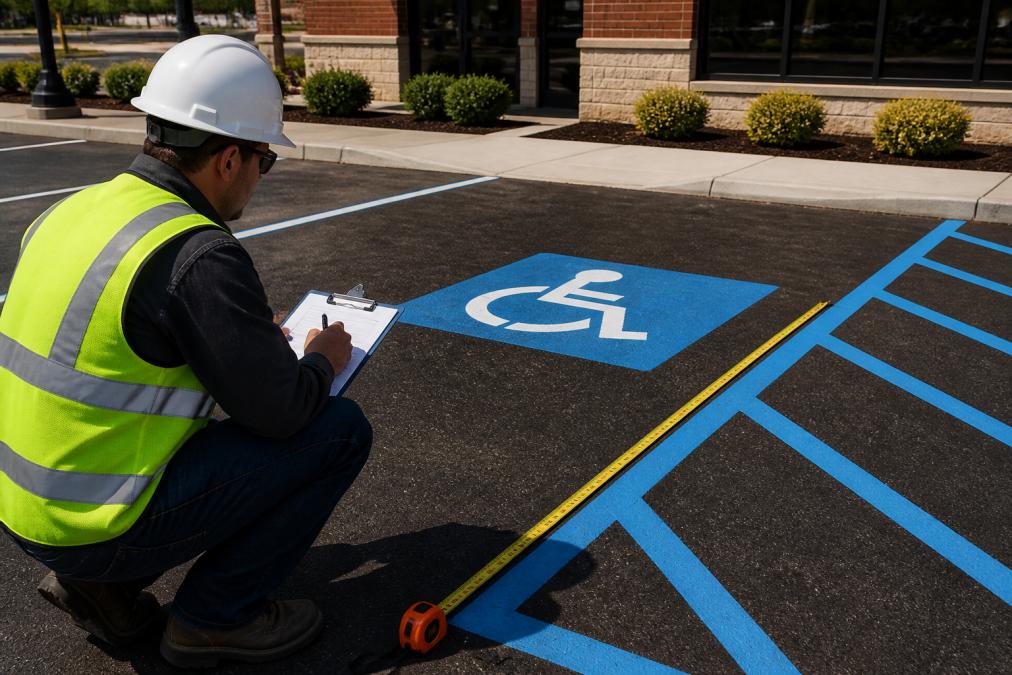
The access aisle is the most misunderstood requirement. Many business owners allow temporary parking there, a violation. The access aisle must remain clear at all times; it's where wheelchair lifts deploy and people with disabilities transfer to and from vehicles.
The surface of both the parking space and access aisle must be firm, stable, and slip-resistant. Cracked asphalt or trip hazards violate ADA standards and create legal liability. Professional pavement repair and maintenance are essential to compliance.
Many parking lots fail to provide the required number of van-accessible spaces, creating a compliance gap that leaves your business vulnerable and excludes people with severe mobility disabilities.
ADA Parking Lot Signage Requirements and Pavement Markings
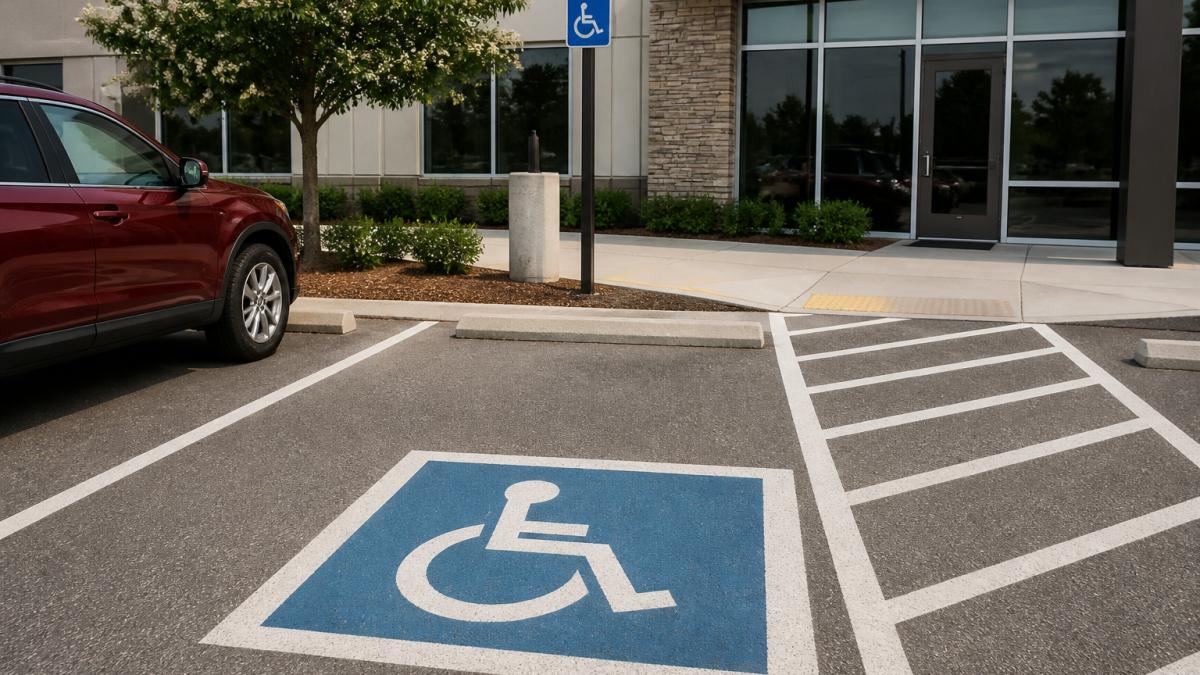
Every accessible parking space must be marked with the international symbol of accessibility (white on blue) painted on the pavement, at least 36 inches wide and visible from the parking space entrance.
A sign at least 60 inches high (measured from ground to bottom) must be installed at each accessible space, displaying the international symbol and visible from a driver's perspective (Accessible Parking Spaces). Obscured signage means non-compliance.
Van-accessible spaces must include "VAN ACCESSIBLE" signage in addition to the international symbol. Failing to clearly designate them is a common compliance mistake that reduces accessibility for people who need those larger spaces.
Pavement markings require maintenance; faded striping doesn't meet ADA standards. Professional pavement services ensure markings and underlying pavement meet ADA specifications.
ADA Compliance Checklist for Parking Lots
Use this checklist to evaluate your parking lot's ADA compliance. Address any gaps to reduce legal risk and improve accessibility for customers and employees.
- Calculate required number of accessible spaces based on total parking spaces
- Verify at least 1 van-accessible space for every 6 accessible spaces required
- Confirm accessible spaces are located on shortest accessible route to entrance
- Measure parking space width (minimum 8 feet; 11 feet for van-accessible)
- Measure access aisle width (minimum 5 feet; 8 feet for van-accessible)
- Check that access aisles are clear of obstructions and parked vehicles
- Inspect pavement surface for cracks, potholes, and trip hazards
- Verify pavement is firm, stable, and slip-resistant
- Confirm blue pavement symbol is visible and properly sized (36 inches minimum)
- Check signage is installed at correct height (60 inches minimum)
- Verify signage displays international symbol of accessibility
- Confirm van-accessible spaces are marked with "VAN ACCESSIBLE" text
- Inspect curb ramps for proper slope and surface condition
- Verify accessible route from parking to building entrance
- Ensure parking lot lighting allows safe navigation
- Document compliance measures and maintenance schedule
A professional audit can identify compliance issues your team might miss and assess pavement condition to identify surface-related gaps requiring professional repair or resurfacing.
Common ADA Compliance Mistakes and How to Avoid Them
ADA compliance failures cluster into predictable patterns. Understanding these mistakes helps business owners avoid costly violations.
Mistake 1: Miscalculating Required Accessible Spaces
The most frequent error is underestimating required accessible spaces. If you've added parking or expanded, your obligation may have increased. A business with 40 spaces needs 2 accessible spaces; adding 15 spaces to reach 55 requires 3 accessible spaces.
Solution: Recalculate your accessible space requirement whenever your total parking count changes. Document the calculation and keep records. If you're unsure, a professional parking lot audit provides certainty.
Mistake 2: Treating Access Aisles as Flexible or Temporary
Managers often allow temporary parking in access aisles, assuming it's acceptable if moved quickly. It's not. An access aisle that's blocked, deteriorated, or undersized is a violation. The space must remain clear 24/7.
Call now to schedule your free estimate →
Solution: Enforce strict no-parking policies in access aisles. Use physical barriers, signage, or parking enforcement to prevent unauthorized use. Train staff on the non-negotiable nature of access aisle access.
Mistake 3: Overlooking Pavement Condition as a Compliance Issue
Parking lot pavement condition is overlooked more often than any other compliance factor. Cracked, potholed, or uneven asphalt creates trip hazards and makes wheelchair navigation difficult. The ADA requires accessible routes be "firm, stable, and slip-resistant." A professional pavement audit should be part of every ADA compliance assessment.
Solution: Conduct a pavement condition assessment as part of your ADA audit. Budget for seal coating, crack filling, or resurfacing as needed. Establish a maintenance schedule to prevent deterioration. Document all maintenance activities.
Mistake 4: Improper Signage Placement and Visibility
Signs placed too low or obscured by vegetation, vehicles, or obstructions don't satisfy ADA requirements. Both pavement markings and signage are required; the pavement symbol alerts drivers in the space, while the sign alerts them as they approach.
Solution: Verify your signage meets the 60-inch height requirement. Ensure signs are visible from the parking lot entrance and approach routes. Clear vegetation and obstructions regularly. Replace faded or damaged signs immediately.
Mistake 5: Underestimating Van-Accessible Space Requirements
Van-accessible spaces are often missing or improperly designated. For every 6 accessible spaces, at least 1 must be van-accessible. Failing to provide the required number leaves your business vulnerable and excludes people with severe mobility disabilities.
Solution: Calculate your van-accessible space requirement based on your total accessible spaces. Ensure each van-accessible space is clearly marked with "VAN ACCESSIBLE" signage in addition to the international symbol. Verify the 11-foot space width and 8-foot access aisle width.
Mistake 6: Retrofitting Without Understanding State-Level Requirements
Many states impose stricter requirements than federal ADA standards. A lot meeting federal minimums might still violate state law. Research your state's accessibility requirements before retrofitting.
Solution: Before retrofitting your parking lot, research your state's accessibility requirements in addition to federal ADA standards.
Mistake 7: Failing to Conduct Regular Compliance Audits
Consequences of Non-Compliance: Fines, Lawsuits, and Reputational Damage
The financial exposure from ADA parking violations extends far beyond a single fine. Understanding the actual cost structure helps business owners justify compliance spending as risk mitigation rather than pure expense.
Federal Penalties
Private Lawsuits and Settlement Costs
Operational Disruption and Remediation Costs
Reputational and Customer Impact
Why Compliance Is the Lower-Cost Option
Frequently Asked Questions
What happens if a business isn't ADA compliant with its parking lot?
Non-compliant parking exposes your business to federal civil penalties ranging from $55,000 to $150,000 per violation, plus ongoing fines. You also face private lawsuits from individuals with disabilities, attorney fees, and mandatory retrofitting costs. Beyond legal liability, non-compliance damages your reputation and may result in loss of customers and business partnerships. The Department of Justice actively enforces ADA compliance in parking facilities.
What percent of parking spaces need to be ADA accessible?
The percentage depends on total parking spaces available. For 1-25 spaces, provide 1 accessible space. For 26-50 spaces, provide 2. For 51-75 spaces, provide 3. For 76-100 spaces, provide 4. For 101-150 spaces, provide 5. For 151-200 spaces, provide 6. For 201-300 spaces, provide 7. For 301-400 spaces, provide 8. For 401-500 spaces, provide 9. For 501-1,000 spaces, provide 2% of total. For 1,001+ spaces, provide 20 plus 1 for each 100 over 1,000. Van-accessible spaces must comprise at least one space in every six accessible spaces.
How do I ensure my parking lot meets current federal standards?
Start with a compliance audit using the ADA Standards for Accessible Design as your baseline. Check that accessible spaces meet dimension requirements (96 inches wide minimum, plus 60-inch access aisles), have proper signage at the correct height (60 inches minimum), include compliant curb ramps, and feature appropriate pavement markings. Verify that routes from parking to facility entrances are accessible and maintained. Consider hiring a professional compliance consultant to identify gaps, then work with a qualified contractor to address deficiencies. Document all improvements for liability protection.
Do small businesses need to be ADA compliant?
Yes. The ADA applies to all businesses open to the public, regardless of size. Title III of the ADA requires public accommodations to provide equal access, including accessible parking. Small businesses with fewer than 15 employees are not exempt from parking accessibility requirements. If your business has a parking lot or parking spaces available to customers or employees, ADA compliance is mandatory. Failure to comply carries the same penalties as larger facilities.