 ultimate-guide
How to Choose a Reliable Paving Contractor in 2026
Table of Contents
- Why Most Paving Projects Fail Within Two Years
- The Core Checklist: How to Choose a Reliable Paving Contractor
- The Most Important Questions to Ask Paving Contractors
- Red Flags: Signs of a Bad Paving Job Before It Starts
- Material Quality and Sub-Base: What a Reliable Contractor Does Differently
- Using an Asphalt Paving Cost Estimator to Compare Bids
- Post-Installation Maintenance Expectations
- Conclusion: Make Your Choice Count
- Frequently Asked Questions
Last Updated: September 9, 2026
Choosing the wrong paving contractor is a costly mistake most homeowners and property managers only make once. A driveway or parking lot is a significant investment, and the difference between a surface that lasts fifteen years and one that fails in two often comes down to the contractor you select. Choosing the wrong paving contractor is a costly mistake most homeowners and property managers only make once. A driveway or parking lot is a significant investment, and the difference between a surface that lasts fifteen years and one that fails in two often comes down to the contractor you select.
A reliable paving contractor is defined less by flashy marketing and more by verifiable credentials, transparent processes, and a willingness to put everything in writing. Most paving failures happen because of poor preparation and a lack of accountability, not bad material. Below, we'll show you how to vet candidates, what questions to ask, and the red flags that signal you should walk away.
Why Most Paving Projects Fail Within Two Years
The root cause of premature pavement failure is rarely the asphalt itself, but almost always an inadequate sub-base or improper installation techniques. When contractors skip critical steps like proper sub-base preparation and compaction to save money or time, the surface above is doomed to crack and settle regardless of material quality.
Drainage issues compound this problem. If water is allowed to pool beneath or alongside the pavement, it erodes the aggregate base, leading to sinkholes and alligator cracking. Many property owners mistake these symptoms for "normal wear and tear," but they are actually structural failures caused by shortcuts taken during the initial installation.
The Core Checklist: How to Choose a Reliable Paving Contractor
A reliable paving contractor is a licensed business that can prove its experience through verifiable references and a physical track record. To find one, use a systematic vetting process rather than relying on the lowest bid or a persuasive sales pitch. We recommend a three-stage approach: verify credentials, inspect physical work, and compare written proposals.
This process takes time, but it is the only way to separate professional operations from mobile crews that may not be around when problems surface. Use the sections below to build your checklist for how to choose a reliable paving contractor who will stand behind the work.
Verify Licensing, Insurance, and Bonding
Your first step is to ask for proof of licensing, insurance, and bonding before discussing any project details. A legitimate contractor will provide these documents without hesitation, while an unprofessional operator will often offer excuses or vague assurances. You want to see a certificate of insurance covering general liability and workers' compensation, protecting you from liability if an accident occurs on your property.
Bonding is equally critical, as it offers financial recourse if the contractor fails to complete the job or violates the contract terms. According to guidance on hiring contractors from the Federal Trade Commission, verifying licenses and insurance is a fundamental step in protecting yourself from fraudulent business practices. If a contractor cannot produce these documents, removing them from your list immediately is the correct decision.
Demand References and Inspect Past Work
Credentials on paper are necessary, but they don't tell you if the contractor does quality work. Speak with past clients and see completed projects in person. Ask for a list of references from the last six to twelve months, specifically projects similar in scope to yours.
When you call references, ask pointed questions about the timeline, cleanliness, communication, and whether any issues arose after the work was completed. More importantly, drive by the job sites yourself and look for cracks, uneven settling, or poor drainage. A reputable contractor will gladly provide addresses of recent work, whereas one who hesitates or offers only photos likely has something to hide.
The Most Important Questions to Ask Paving Contractors
Asking the right questions is the fastest way to gauge a contractor's expertise and honesty. A professional will welcome detailed inquiries about process and materials, while an amateur will often deflect or give vague answers. Here are the non-negotiable questions you should ask every candidate:
- Who will be on site managing the crew? You need to know if the owner supervises the job or if it's handed off to a subcontractor you haven't vetted.
- What does your sub-base preparation process look like? The answer should include specifics about excavation depth, aggregate base material, and compaction methods.
- How do you handle site drainage? The contractor should have a plan to direct water away from the new surface, not just pave over existing problems.
- Can you provide a detailed written estimate and project timeline? Vague bids that lack line items for material and labor are a major warning sign.
- What kind of workmanship warranty do you offer? A written warranty covering installation defects shows the contractor is willing to stand behind the work.
Red Flags: Signs of a Bad Paving Job Before It Starts
Spotting signs of a bad paving job before work begins is easier than you think. The first major red flag is a door-to-door sales pitch offering a "leftover asphalt" discount. These crews are often unlicensed and uninsured, relying on pressure tactics to secure cash payments for substandard work.
Other warning signs include a refusal to provide a written contract, a demand for a large upfront deposit, and a lack of local physical address or phone number. Professional companies have offices and established business records; transient crews operate out of trucks and change their names frequently.
Predatory Scam Tactics to Walk Away From
Predatory paving scams are common enough that the Better Business Bureau has published scam alerts on paving and driveway repair offers to warn consumers. These scams typically involve unsolicited offers, claims about materials left over from another job, and pressure to decide immediately.
If a contractor cannot provide a verifiable business address, refuses to put the quote in writing, or insists on cash payment before starting, you are almost certainly dealing with a scam. The consequence is not just a poor surface; it's the loss of your money and the cost of paying a legitimate contractor to tear out and replace the defective work.
Material Quality and Sub-Base: What a Reliable Contractor Does Differently
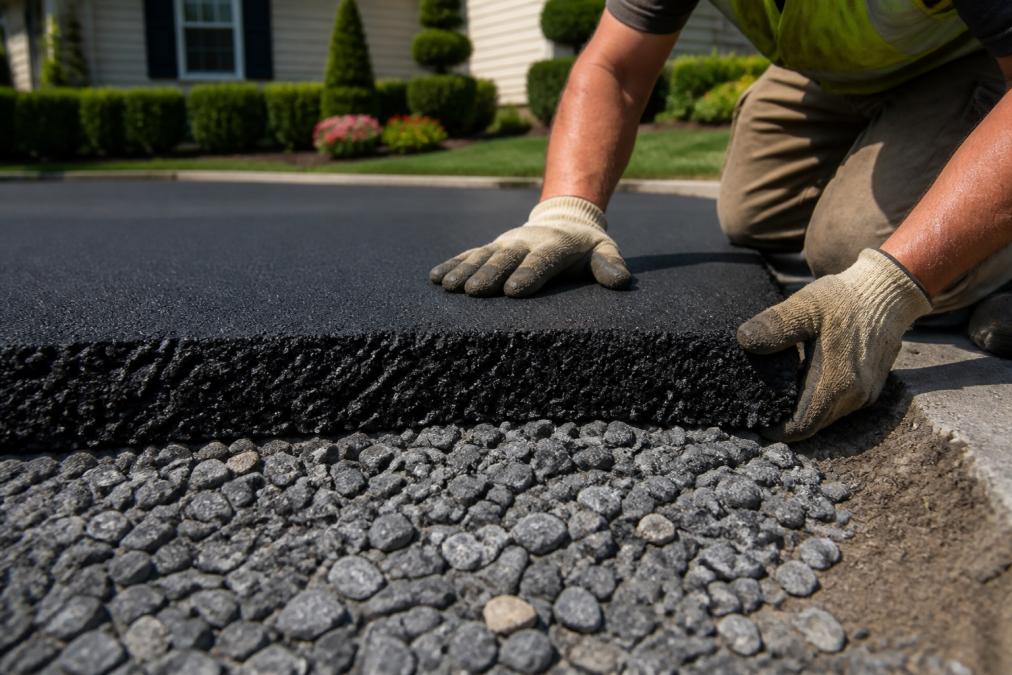
The difference between a reliable paving contractor and a low-bidder often comes down to what happens beneath the surface. A quality installation starts with excavating the old pavement and unsuitable soil, then building a stable foundation using a compacted aggregate base. The thickness of this base should be specified in the contract and matched to the expected load.
Most property owners don't realize that "asphalt" covers a wide range of mix designs, each suited to different applications. For a residential driveway, a common specification is a surface course mix with a nominal aggregate size of 1/2 inch, providing a smooth, dense finish. For a commercial parking lot with heavy truck traffic, a contractor should specify a heavier mix with a larger aggregate, often 3/4 inch, to resist rutting. A contractor who cannot articulate the difference between a surface course and a binder course, or who plans to use the same mix for every job, is not tailoring the solution to your needs.
Similarly, the sub-base is not just "gravel." It is a graded aggregate base (often crushed limestone or recycled concrete aggregate) that must be placed in lifts and compacted to a specific density, typically 95% to 98% of the maximum dry density as determined by a Proctor test. A contractor who skips compaction testing or cannot tell you the required density is guessing. Ask for the compaction test results before the surface is laid, a verifiable data point that separates a professional operation from a crew that simply spreads stone and paves over it.
The asphalt itself is temperature-sensitive. It must be delivered to the site between 275°F and 300°F and laid down before it cools too much to achieve proper compaction (fhwa.dot.gov). On a cold day, a contractor might struggle to keep the mix hot enough, leading to a surface that is not fully compacted and will ravel or crack prematurely. A reliable contractor will schedule work based on weather forecasts, not just crew availability.
Concrete work has its own specifications. The compressive strength, measured in psi, is critical: a standard residential driveway is typically poured with 3,500 psi concrete, while a commercial loading dock might require 5,000 psi or higher. The water-to-cement ratio is equally important; too much water weakens the final product, leading to cracking and scaling. Ask the contractor what psi they are specifying and how they control water content on site. A reliable contractor will have a clear answer and will not rely on the ready-mix truck driver to add water.
Call now to schedule your free estimate →
By asking these technical questions, you are evaluating whether the contractor understands the science behind the surface. A contractor who can explain the "why" behind their material choices is far more likely to deliver a pavement that performs as expected. This level of scrutiny is rare, but it is the most effective way to ensure you are getting a pavement designed for your specific load and climate conditions.
Using an Asphalt Paving Cost Estimator to Compare Bids
To compare bids fairly, you need an asphalt paving cost estimator that goes beyond the bottom-line price. A basic estimator focuses on square footage, but a more useful comparison accounts for the scope of work, including excavation, sub-base material, and site cleanup. When you request estimates, insist that each contractor breaks down pricing by these components.
This breakdown allows you to see where the differences lie. A bid that is significantly lower may be using a thinner aggregate base or excluding the cost of removing the old pavement. By comparing line items, you can ensure you are comparing equal scopes of work. Also, verify the project timeline and expected duration before you plan to use the surface.
Post-Installation Maintenance Expectations
A reliable contractor will be honest that pavement is not maintenance-free. To protect your investment and extend pavement durability, plan for routine preventative maintenance. Pavement has a predictable lifecycle, and each maintenance step has an optimal window; missing that window turns a minor issue into a full replacement.
The first and most critical step is curing. New asphalt needs time to cure and harden. While you can typically drive on a residential driveway within 24 to 48 hours, the surface remains soft and susceptible to indentation from heavy objects for several weeks. For concrete, curing involves keeping the surface moist for at least 7 days to reach design strength.
Sealcoating is the next major milestone. Most manufacturers recommend waiting at least 6 to 12 months after installation before applying the first coat of sealant, allowing the asphalt to fully cure and outgas volatile compounds. After that, a typical schedule is every 2 to 3 years, depending on traffic and climate. Sealcoating protects the asphalt binder from UV oxidation and prevents water penetration, and its cost is a fraction of a new surface, making it the most cost-effective maintenance step.
Crack filling is another non-negotiable task. Small hairline cracks can be filled with a hot-pour rubberized crack filler, but the key is to address them early. Once water gets into a crack and freezes, it expands and widens, leading to alligator cracking and potholes. Inspect your pavement twice a year, spring and fall, and fill any cracks wider than a credit card. Ignoring a 1/4-inch crack for a single winter can turn a $50 repair into a $500 patch.
Do not let a contractor talk you into sealcoating a new driveway immediately. This is a common upsell that can actually trap moisture and cause the asphalt to blister. A reliable contractor will tell you to wait.
For commercial properties, the maintenance schedule is more demanding. A parking lot with daily traffic will need more frequent inspections and crack filling. Plan for line striping to be refreshed every 1 to 2 years for safety and ADA compliance. A reliable contractor will provide a maintenance plan outlining these intervals and can schedule routine service calls.
Finally, consider the impact of de-icing products in winter. Rock salt can be harsh on concrete, so use calcium chloride-based de-icers for concrete surfaces. For asphalt, most de-icers are safe, but avoid metal shovels or blades that can gouge the surface.
A contractor who sells you the job but neglects to explain this upkeep is not providing the full service you need. The long-term appearance and structural integrity of your pavement depend as much on post-installation care as on the initial installation. Ask your contractor for a written maintenance schedule before you sign the contract; this shows they are invested in the lifecycle of the pavement, not just the initial sale.
Conclusion: Make Your Choice Count
Selecting a contractor requires diligence, but the effort pays off in a surface that performs for decades rather than years. The process is straightforward: verify credentials, inspect past work, ask specific questions, and compare detailed bids that cover the entire project scope. By using the checklist and red flags outlined here, you can approach your project with confidence and avoid costly mistakes.
At Houston Pavement Repair LLC, we provide expert asphalt and concrete paving and repair services for residential and commercial clients. Contact us today to schedule your free estimate and experience our commitment to excellence.
Frequently Asked Questions
What questions should I ask a paving contractor before hiring?
Ask about their licensing, insurance coverage, and whether they are bonded. Request local references you can call and ask how long they have been in business under the same name. Inquire about the sub-base preparation process, the type of asphalt mix they use, and whether they handle drainage issues. Always ask for a written contract that includes the project scope, timeline, material specs, and a workmanship warranty.
How do I know if an asphalt paving job is good?
A good paving job starts with a properly prepared sub-base. Signs of quality work include a smooth, uniform surface with no roller marks, proper drainage away from structures, and clean, compacted edges. The contractor should use a reputable hot mix asphalt and compact it correctly. Ask about the thickness of the pavement, as a reliable contractor will specify a minimum of 2-3 inches for residential driveways after compaction.
How can I verify a paving contractor's license and insurance?
Ask the contractor for their license number and proof of insurance directly. You can verify their license status with your state or local licensing board. Confirm their liability insurance and workers' compensation coverage are current by asking for a certificate of insurance from their provider. Do not take their word for it; call the insurance agency to confirm the policy is active and covers your project site.
What are the red flags of a dishonest paving contractor?
Walk away from contractors who knock on your door offering leftover asphalt at a discount, demand full payment upfront, or lack a physical business address. Be wary of those who cannot provide references or proof of insurance, pressure you to sign a contract immediately, or quote a price far below competitors. A reliable contractor does not use high-pressure sales tactics and will gladly provide a written estimate and time to review it.
Should I get multiple quotes for a paving project?
Yes, get at least three written quotes from different contractors. Comparing bids helps you understand the fair market range for your project size and material specifications. However, do not choose solely on the lowest price. Evaluate each quote for the project scope, asphalt thickness, sub-base preparation, and warranty terms. The cheapest bid often cuts corners on materials or compaction, leading to costly repairs later.
How much does it cost to pave a 2000 sq ft driveway?
Pricing for a 2000 sq ft driveway varies significantly based on your location, the condition of the existing base, and the chosen materials. The final cost depends on whether the contractor needs to remove old pavement, fix drainage issues, or add more aggregate base. To get an accurate number, request a site inspection and a detailed written estimate. A contractor can provide a more precise cost estimate after evaluating your specific project.