 ultimate-guide
Residential Driveway Paving Pricing Guide for 2026
Table of Contents
- What Goes Into a Residential Driveway Paving Pricing Guide
- Factors Affecting Driveway Paving Price You Need to Understand
- Concrete vs Asphalt Driveway Cost: A Side-by-Side Breakdown
- How Long Does Asphalt Paving Last Compared to Other Materials
- Site Preparation, Excavation, and Sub-Base Work: The Costs Most Quotes Hide
- Financing, Permits, and What to Check Before You Sign
- Frequently Asked Questions
Last Updated: September 19, 2026
What Goes Into a Residential Driveway Paving Pricing Guide
A residential driveway paving pricing guide breaks down the real costs behind a quote: materials, excavation, sub-base preparation, labor, equipment, drainage, and permits. We build estimates this way because surface-only quotes hide the work that determines whether a driveway lasts. The honest answer to "How much is this going to cost?" is that driveway paving pricing depends on square footage, site conditions, and material choice, any quote that skips those variables is a guess.
Factors Affecting Driveway Paving Price You Need to Understand
Three variables move a driveway quote more than anything else: site conditions, driveway size and access, and material choice. Material costs, labor rates, and equipment needs all scale from those three. A flat, stable lot with easy truck access prices very differently from a sloped property with poor soil and a narrow gate, so understanding these factors before you collect quotes strengthens your negotiating position.
Site Conditions and Soil Stability
Soil stability decides how much sub-base work your driveway needs. Expansive clay soils, common across the Houston area, swell when wet and shrink when dry. That movement cracks concrete slabs and rut asphalt if the base underneath isn't built to handle it. Contractors test soil and adjust the aggregate base depth accordingly. Poor drainage or a high water table adds cost, because the fix is a drainage system, not a thicker surface layer.
Driveway Size, Access, and Drainage Slope
Square footage is the base multiplier in every estimate: a two-car driveway needs roughly double the material and labor of a single-car driveway, and a long rural approach can triple it. If a dump truck or paving equipment can't reach the work area, crews hand-carry material, raising labor rates. Proper grading and a drainage slope away from the foundation protect the pavement and the house, driveways that hold water fail early, no matter what material sits on top.
| Cost Factor | What It Changes | Typical Impact on Quote |
|---|---|---|
| Soil stability | Aggregate base depth, stabilization needs | Higher if soil is expansive or wet |
| Square footage | Material volume, labor hours | Scales directly with size |
| Site access | Equipment and hauling method | Higher for tight or obstructed access |
| Drainage slope | Grading and drainage systems | Higher if regrading is required |
| Material choice | Surface cost and lifespan | Varies widely by material |
Concrete vs Asphalt Driveway Cost: A Side-by-Side Breakdown
Concrete vs asphalt driveway cost is the comparison homeowners research most: asphalt costs less upfront, concrete costs more but typically lasts longer with less routine maintenance. What most guides skip is that the right answer depends on your climate and how long you plan to own the home, a material that wins in one region can be the wrong call 1,000 miles away.
Upfront and Lifecycle Cost by Material
| Material | Upfront Cost | Lifespan | Maintenance | Best For |
|---|---|---|---|---|
| Asphalt | Lowest | 15-20 years | Sealcoat every 2-3 years | Budget-conscious homeowners, cold climates |
| Concrete | Moderate | 30+ years | Occasional crack repair | Long-term value, hot and dry climates |
| Interlocking pavers | Highest | 25-50 years | Re-sanding, spot repairs | Curb appeal, easy single-point repairs |
| Permeable pavers | High | 20-30 years | Vacuum sweeping, joint refill | Stormwater compliance, eco-conscious owners |
| Recycled asphalt (RAP) | Low to moderate | 10-15 years | Sealcoat every 2-3 years | Budget projects, low-traffic drives |
Upfront price is only half the equation. Over 20 years, a cheaper asphalt driveway that needs resealing every few years and a full replacement around year 18 can cost more than a concrete slab poured once. Run the math on total cost of ownership, not just the bid number.
Climate-Specific Material Recommendations
Material performance is climate-dependent, and the wrong pick fails early regardless of how well it was installed.
The Permeable Paving Angle Most Guides Ignore
Permeable pavers, porous asphalt, and permeable concrete allow water to drain through the surface into the ground below. They cost 20-40% more upfront but can reduce or eliminate separate drainage infrastructure, offsetting part of the premium. A growing number of local stormwater ordinances encourage or require permeable surfaces for new or expanded impervious cover, and if your jurisdiction charges a stormwater utility fee based on impervious area, permeable paving may reduce that recurring bill.
How to Choose
For most homeowners weighing upfront budget against long-term cost, asphalt wins on price and concrete wins on longevity. Neither is "better" in the abstract, the right pick depends on your climate, how long you plan to stay, your soil, and how much maintenance you'll actually do. If stormwater rules apply in your area, add permeable options before you sign.
How Long Does Asphalt Paving Last Compared to Other Materials
How long asphalt paving lasts depends on base preparation, drainage, traffic, and maintenance. A well-built asphalt driveway typically lasts 15 to 20 years, while concrete often reaches 30 years or more and pavers can last decades longer with spot repairs. Those numbers assume the sub-base was done right, on weak soil or with poor drainage, even a premium surface fails years early.
Site Preparation, Excavation, and Sub-Base Work: The Costs Most Quotes Hide
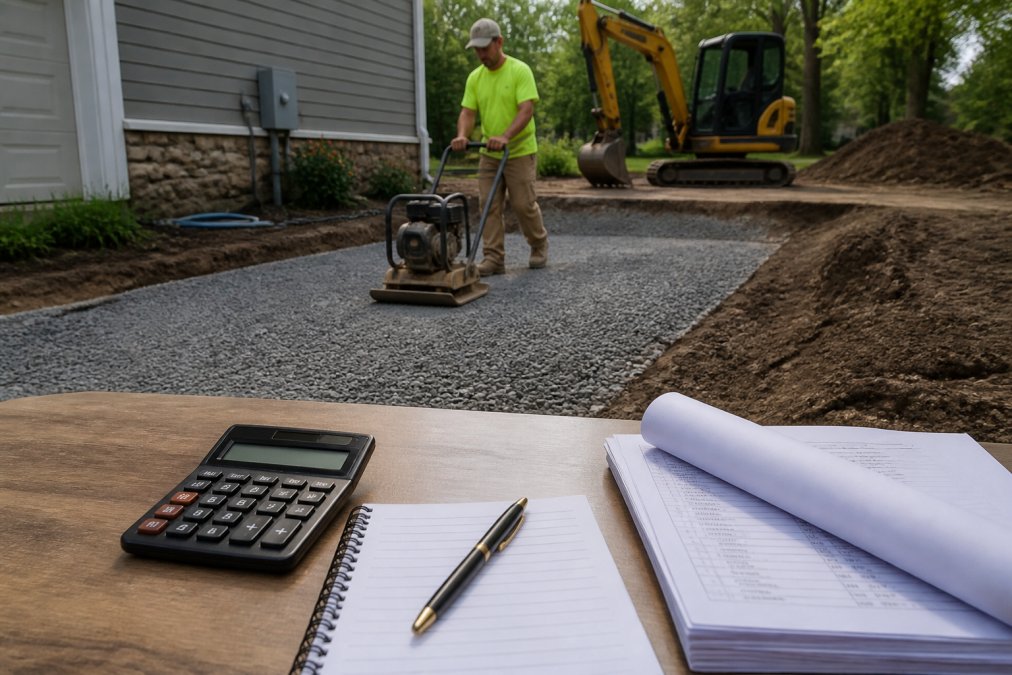
Excavation and sub-base preparation are where honest estimates separate from cheap ones. A proper installation removes the old surface, excavates to the correct depth, grades for drainage, lays aggregate base in compacted lifts, and verifies compaction before any asphalt or concrete goes down. Contractors who skip excavation or compact in one thick layer save money on the quote and cost you a driveway.
What a Proper Sub-Base Actually Looks Like
A residential driveway sub-base is typically built in layers, not dumped in one pass. The general sequence:
- Stripping and excavation. Remove topsoil, grass, and any existing surface. Excavate to a depth that accommodates the base plus the surface material. For asphalt, that's often 6-8 inches of total section; for concrete, 8-12 inches depending on soil and traffic. The exact numbers depend on your soil report and local frost depth.
- Subgrade preparation. Grade and compact the exposed native soil. Soft spots, often where organic material or old roots remain, must be removed and replaced with suitable fill, not just covered over.
- Aggregate base placement. Base material (typically crushed stone or recycled concrete aggregate) is placed in lifts, usually 2-4 inches at a time, and compacted between each lift. A single thick layer can't be compacted to the same density, so contractors who skip lifts produce a base that settles unevenly.
- Compaction verification. Density is checked against a target, often expressed as a percentage of maximum dry density from a standard Proctor test. A common specification is 95% or higher. If your contractor can't tell you what density they're targeting, that's a red flag.
- Fine grading and drainage. The finished base is graded to shed water away from the foundation and any structures. Standing water on the base before paving is a sign the slope is wrong.
Where the Hidden Costs Live
Every step above has a cost driver a lump-sum quote can obscure:
- Hauling and disposal. Old concrete, asphalt, and excavated soil have to go somewhere, and disposal fees vary widely by jurisdiction and material. Recycled concrete and asphalt can sometimes be crushed on-site and reused as base, cutting both hauling and material cost.
- Soil stabilization. Expansive clay soils, common in many parts of the country, require over-excavation and replacement, lime or cement stabilization, or a geogrid reinforcement layer. Each option carries a different price tag and lifespan outcome.
- Drainage corrections. If the existing grade slopes toward the house, regrading or a French drain may be required. This is often the single largest hidden line item.
- Equipment access. A narrow gate or a steep slope can force crews to use smaller equipment or hand-carry material, which raises labor hours.
- Permit and inspection fees. Some jurisdictions require a pre-pour or pre-pave inspection of the sub-base. That inspection is a cost, but it's also your best protection against a shortcut.
How to Verify the Work Without Being a Paving Expert
You don't need to run a plate compactor to catch a bad base. Use this visual checklist at each stage:
- Old surface fully removed, not overlaid
- Excavation depth matches the spec
- Aggregate base laid in thin, compacted lifts
- Compaction verified before paving
- Drainage slope graded away from the foundation
- Edges contained and secured
- No standing water on the base after a rain or hose test
- Base surface is uniform, with no soft or spongy spots underfoot
Financing, Permits, and What to Check Before You Sign
Permits and financing are the two items homeowners overlook until they're already committed. Many jurisdictions require a permit for driveway work, especially when it touches the right-of-way or changes drainage, ask who pulls it, because an unpermitted job can create problems when you sell. Many paving companies offer payment plans, so ask before assuming the full amount is due upfront.
A practical decision framework for choosing a contractor:
- Get at least three itemized quotes, not lump sums
- Compare base depth, compaction method, and drainage scope line by line
- Call two recent references and ask whether the driveway still drains well
- Confirm who handles permits and disposal
- Read the warranty: what's covered, and for how long
Frequently Asked Questions
How much does driveway paving cost per square foot?
Driveway paving pricing varies by material, site conditions, and region, so no single per-square-foot figure applies everywhere. Asphalt typically costs less per square foot than concrete, while interlocking pavers sit at the higher end. Your quote will also include sub-base preparation, grading, and drainage work that can shift the total significantly. Request a free on-site estimate so the numbers reflect your actual driveway dimensions and soil conditions.
Does asphalt or concrete cost more for a residential driveway?
Concrete generally costs more upfront than asphalt for the same square footage, but the gap narrows when you factor in maintenance and pavement longevity. Asphalt needs sealcoating every few years, while a well-poured concrete slab can go longer between repairs. Climate matters too: Houston's heat and heavy rain affect both materials differently. A contractor can compare both options for your specific site before you commit.
How long does asphalt paving last before it needs replacement?
A properly installed asphalt driveway with a solid sub-base and regular sealcoating typically lasts 15 to 20 years. The biggest variables are compaction quality, asphalt thickness, and drainage. Driveways that hold water or sit on unstable soil fail sooner, which is why fixing grading and drainage slope during installation matters more than the surface material itself. Skipping maintenance shortens that lifespan considerably.
What factors affect my driveway paving price the most?
The biggest cost drivers are driveway size, sub-base preparation, excavation, and whether your site needs drainage systems or grading corrections. Access also matters: tight spaces slow down paving equipment and add labor hours. Material choice, asphalt thickness, and local labor rates round out the list. Getting multiple contractor quotes with itemized breakdowns helps you see where the money actually goes.
Can I finance a residential driveway paving project?
Many paving contractors offer payment plans or work with financing partners, though terms vary by company and project size. Ask about deposit requirements, milestone payments, and whether a lien waiver is provided at completion. For larger jobs, some homeowners use home improvement loans or contractor-specific financing. Always get the payment schedule in writing before work begins so there are no surprises mid-project.
Driveway pricing gets confusing fast when quotes arrive as single numbers with no breakdown. Houston Pavement Repair LLC provides expert asphalt and concrete paving and repair services, with free estimates that itemize excavation, sub-base work, materials, and drainage so you can see exactly what you're paying for. Our team specializes in pavement repairs and serves homeowners and property managers across the area. Call now to schedule your free estimate and get a clear, line-by-line quote.