 How-to
How to Identify Asphalt Cracks in Commercial Lots?
Last Updated: October 29, 2026
Quick Summary
To identify asphalt cracks in commercial lots, classify each one by its width, pattern, and whether it shows movement. Hairline and isolated cracks are usually surface issues, while wide, connected, or displaced cracks signal base problems. Walk each zone, measure the widest point, and record findings to compare over time.
- Measure crack width at its widest point with a tape or crack gauge.
- Hairline cracks under 1/8 inch wide are often sealed and monitored.
- Alligator cracking, a web of connected cracks, usually means the base has weakened.
- Vertical displacement of about 1/4 inch or more signals structural movement.
- Inspect commercial lots at least twice a year, in spring and fall.
Table of Contents
- Common Types of Asphalt Cracks You Will Find
- Structural vs. Cosmetic Asphalt Cracks: How to Tell the Difference
- Step-by-Step: How to Inspect a Commercial Parking Lot
- Measuring Crack Width, Length, and Severity
- Asphalt Crack Repair Methods and When to Use Them
- Scheduling Your Next Lot Inspection or Repair Estimate
- Frequently Asked Questions
Catching asphalt cracks early saves commercial property owners real money. A small crack that gets ignored can let water get underneath, and a simple sealing job can turn into a full pavement replacement.
Commercial lots take heavy and repeated traffic. Delivery trucks, garbage trucks and daily customer traffic put repeated load on the same spots, and the resulting cracks tell you what is happening underneath.
Why it matters for property managers:
- Cracks let water seep into the base layers
- Water weakens the base, which causes potholes
- Early repairs cost far less than full rebuilds
Common Types of Asphalt Cracks You Will Find
Asphalt cracks fall into a few main groups, each pointing to a different cause. Knowing the type is the fastest way to judge severity.
Most cracks you will see on a commercial lot are one of these:
- Hairline cracks: Very thin, often less than 1/8 inch wide
- Wide cracks: Open cracks that let water and debris in
- Random cracks: Irregular cracks with no clear pattern
A common mistake is treating all cracks the same. A hairline crack and a wide crack may look similar from a distance but call for very different responses.
Alligator and Fatigue Cracking
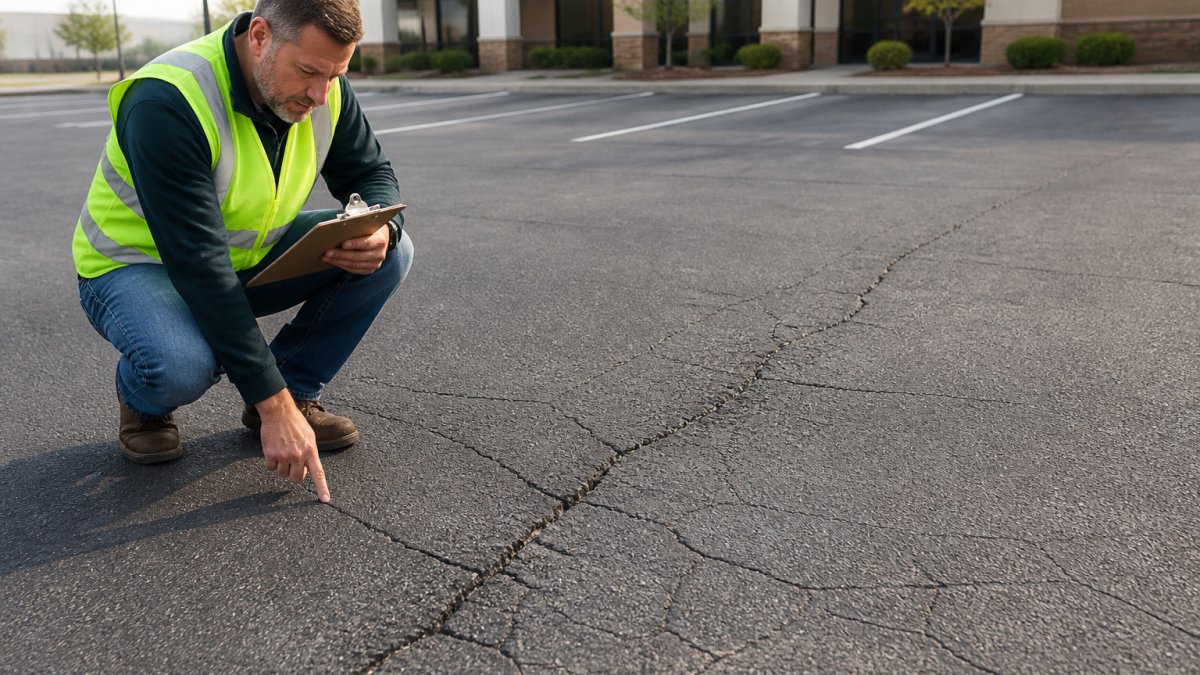
Alligator cracking looks like a web of connected cracks, resembling alligator skin, and is one of the most serious patterns you can find. It usually means the pavement has been flexing too much under repeated load, and the base has likely weakened.
When you see alligator cracking, the surface is failing from below. Patching the top alone rarely fixes it.
Longitudinal, Transverse, and Block Cracks
These three crack types run in clear directions and each one tells a story:
- Longitudinal cracks run parallel to the direction of traffic. They often form along joints or edges of the lot.
- Transverse cracks run across the lot at roughly right angles to traffic. Temperature changes and shrinkage often cause them.
- Block cracks form a grid of rectangular blocks. They usually point to age and shrinkage of the asphalt itself.
What crack patterns indicate depends on where they sit and how they connect. A single crack near a curb differs from one running across a full drive aisle.
The main crack types on a commercial lot, with what each one usually signals.
| Crack type | Typical sign | Key note |
|---|---|---|
| Hairline | Under 1/8 inch wide | Often sealed and monitored |
| Wide | Open, lets water and debris in | Needs prompt attention |
| Random | No clear pattern | Irregular, requires classification |
| Structural | Signals movement in the base | Treat as a base problem |
| Alligator | Web of connected cracks | Failing from below |
| Longitudinal | Runs parallel to traffic | Often forms along joints or edges |
| Transverse | Runs across the lot at right angles | Temperature and shrinkage often cause it |
| Block | Grid of rectangular blocks | Points to age and shrinkage |
Structural vs. Cosmetic Asphalt Cracks: How to Tell the Difference
This is the question property owners ask most often. The distinction is about what is happening below the surface, not how the crack looks. A cosmetic crack is a surface-layer issue that can be sealed and monitored. A structural crack means one or more pavement layers, surface, base, or subgrade, are moving, settling, or failing. Misclassifying one as the other is how small repairs turn into full rebuilds.
A Visual Decision Guide
Work through these questions in order for any crack you find:
- Is the crack moving or has it widened since the last inspection? Compare against prior photos and log. A crack that has grown measurably is behaving structurally, regardless of current size.
- Is there vertical displacement? Run a 4-foot straightedge or level across the crack. A lip, fault, or step of roughly 1/4 inch or more indicates movement between adjacent sections, a structural signal.
- Is the crack connected to a pattern? A single isolated crack is often surface shrinkage. Cracks that connect into alligator, block, or radiating patterns indicate load or base distress.
- Does water enter and stay? Pour a small amount of water at the crack and watch. If it disappears quickly, the crack is open to the base, a pathway for subgrade weakening. If it pools, drainage is already compromised.
- Does the pavement deflect or pump? Under slow vehicle movement or foot pressure, deflection or water pumping from cracks is a strong indicator of base instability.
- Is there a soft spot nearby? Probe the surrounding area. Localized softness next to a crack points to a subsurface void or saturated base.
If the answer to any of questions 1, 2, 5, or 6 is yes, treat the crack as structural until a professional evaluation says otherwise.
Do Not Confuse Cracks With Other Distresses
Cracking is often mixed with other pavement failures, each with a different cause and fix. Rule out these lookalikes before classifying a defect as a crack:
- Potholes: A localized bowl-shaped failure where surface material has broken away, usually beginning as a crack that spalled or a patch that failed. A repair item, not a sealing item.
- Raveling: Surface aggregate is lost, leaving a rough, pitted texture. This is surface binder failure, often from aging or poor compaction, addressed with a surface treatment, not crack sealant.
- Rutting: Longitudinal depressions in the wheel paths, typically from repeated heavy loads or an unstable base. A structural signal even when no crack is visible.
Cosmetic vs. Structural: A Working Classification
Use this as a screening guide, not a formal engineering standard:
- Likely cosmetic: Narrow, isolated, shallow, no displacement, no connection to other cracks, no water pathway to the base, no soft spots nearby. Candidates for crack sealing and monitoring.
- Likely structural: Wide, connected in a pattern, vertically displaced, deflecting or pumping, adjacent to soft spots or standing water, or recurring after prior repair. These need a professional pavement evaluation before any repair is selected.
- Uncertain: Moderate width, some connection, no clear displacement, document it, photograph it, and re-inspect in 60 to 90 days. Growth or change moves it into the structural category.
When to Escalate
Request a professional pavement evaluation when any of the following is present:
- Deflection, pumping, or soft spots under traffic
- Vertical displacement of roughly 1/4 inch or more across a crack
- Alligator cracking covering a meaningful area of a drive aisle or loading zone
A qualified pavement professional can confirm whether the issue is surface-only or involves the base, and can recommend sealing, patching, full-depth repair, or replacement based on actual condition.
Call now to schedule your free estimate →
Step-by-Step: How to Inspect a Commercial Parking Lot
Most guides tell you to walk the lot and look for cracks. That is not an inspection, it is a stroll. A repeatable commercial-lot inspection produces comparable records season after season, so you can tell whether a crack is stable or spreading. Use the same route, zones, and recording format every time.
Before You Walk: Set Up the Survey
- Pull the site plan. Print or load a scaled lot map. If none exists, sketch the lot and label drive aisles, parking rows, entrances, loading zones, dumpster pads, and drainage structures.
- Number the zones. Divide the lot into manageable sections, typically one zone per drive aisle, one per parking row, and separate zones for the entrance throat, loading dock apron, dumpster pad, and any fire lane. Zones of roughly 2,000 to 5,000 square feet keep records granular without becoming unmanageable.
- Assign a condition rating scale before you start. A simple 1-5 scale (1 = sound, 5 = failed) applied consistently beats adjectives. Write it down so the next inspector uses the same one.
- Gather tools. A 25-foot tape measure, a crack gauge or calibrated straightedge, a 4-foot level, chalk or paint crayons, a clipboard with the zone map, a camera or phone, and safe boots.
The Walk: What to Do in Each Zone
Work one zone at a time and finish it before moving on. In each zone:
- Walk the perimeter first. Cracks concentrate at edges, curbs, gutters, and joints. Note edge deterioration, curb separation, and any gap between pavement and gutter.
- Walk the traffic path. Follow wheel paths and turning arcs. Turning and braking areas, entrance throats, drive-aisle corners, and loading aprons, show the earliest fatigue and shear damage.
- Check the drainage path. Locate every catch basin, trench drain, and swale. Look for standing water lines, sediment rings, and cracks running toward or away from drains.
- Probe soft spots carefully. Press with your boot heel or a blunt probe near cracks. Do not walk onto areas that deflect or pump. Mark them and keep clear.
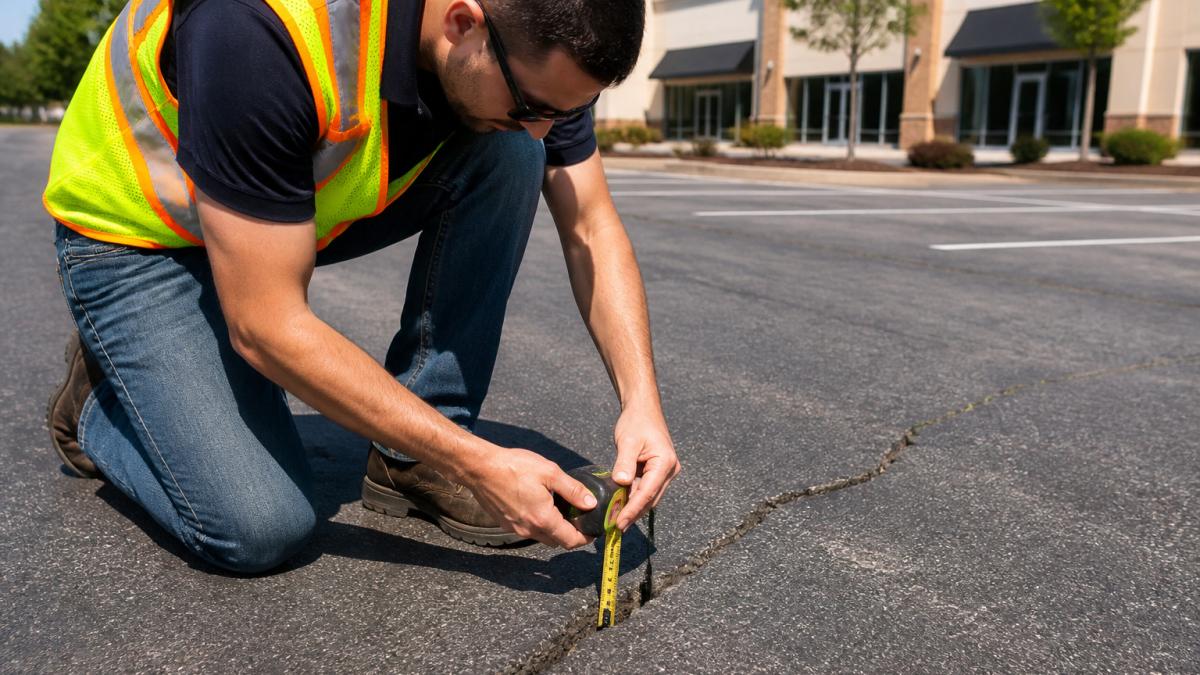
- Record every defect in place. For each crack, note zone, location within the zone, type, width at the widest point, approximate length, whether it connects to other cracks, and whether water can enter. Photograph with the tape measure in frame and a zone label visible.
Photograph and Map Every Defect
A photo without scale and location is nearly useless six months later. Use this standard for every photo:
- One wide shot showing the crack in context (the zone, nearby curb, or drain).
- One close shot with the tape measure or crack gauge across the widest point.
- One overview shot of the zone from a fixed reference point you will return to next inspection.
On the zone map, mark each defect with a number matching the photo file and log entry. A simple spreadsheet with columns for date, zone, defect number, type, width, length, connected (Y/N), water present (Y/N), photo reference, and condition rating turns a walk into a comparable record.
How Often to Inspect
Twice a year is the practical minimum for most commercial lots, once in spring after freeze-thaw cycling and once in fall before winter. Add a walk-through after any major storm, after a tenant change that alters traffic patterns, and any time a driver or tenant reports a bump, pothole, or trip hazard. High-traffic lots with heavy truck volume, distribution centers, retail with daily deliveries, restaurant pads, often warrant quarterly walks.
What to Do With the Results
At the end of the walk, sort your log by condition rating and by zone. Cracks in pedestrian routes, accessible parking and access aisles, and entrance/exit throats carry the highest safety priority regardless of width. Cracks in low-traffic storage rows can often wait for the next sealing cycle. Bring the log and photos to your pavement contractor, a documented history is the difference between a targeted repair and a blanket replacement quote.
Measuring Crack Width, Length, and Severity
Numbers make your inspection useful. Without them, two people can look at the same crack and disagree about it.
- Width: Use a tape measure or a crack gauge at the widest point
- Length: Measure the full run of the crack from end to end
- Depth: Estimate by looking at the edges, or use a probe if you have one
A practical severity guide for commercial lots:
- Low: Hairline cracks under 1/4 inch wide, no connection, no water
- Medium: Cracks between 1/4 inch and 1 inch wide, some connection
- High: Cracks over 1 inch wide, connected patterns or soft areas
These ranges are a working guide, not a formal standard. When in doubt, have a pavement professional check the area.
Asphalt Crack Repair Methods and When to Use Them
Different cracks need different fixes. Choosing the right method is what makes the repair last.
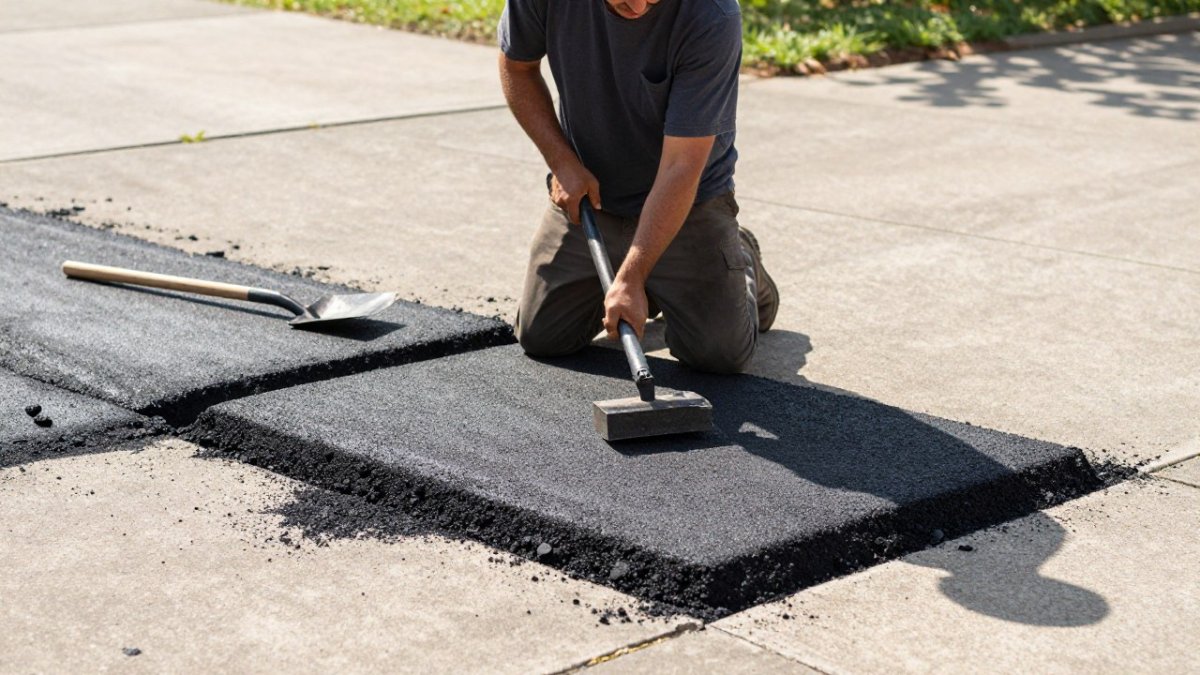
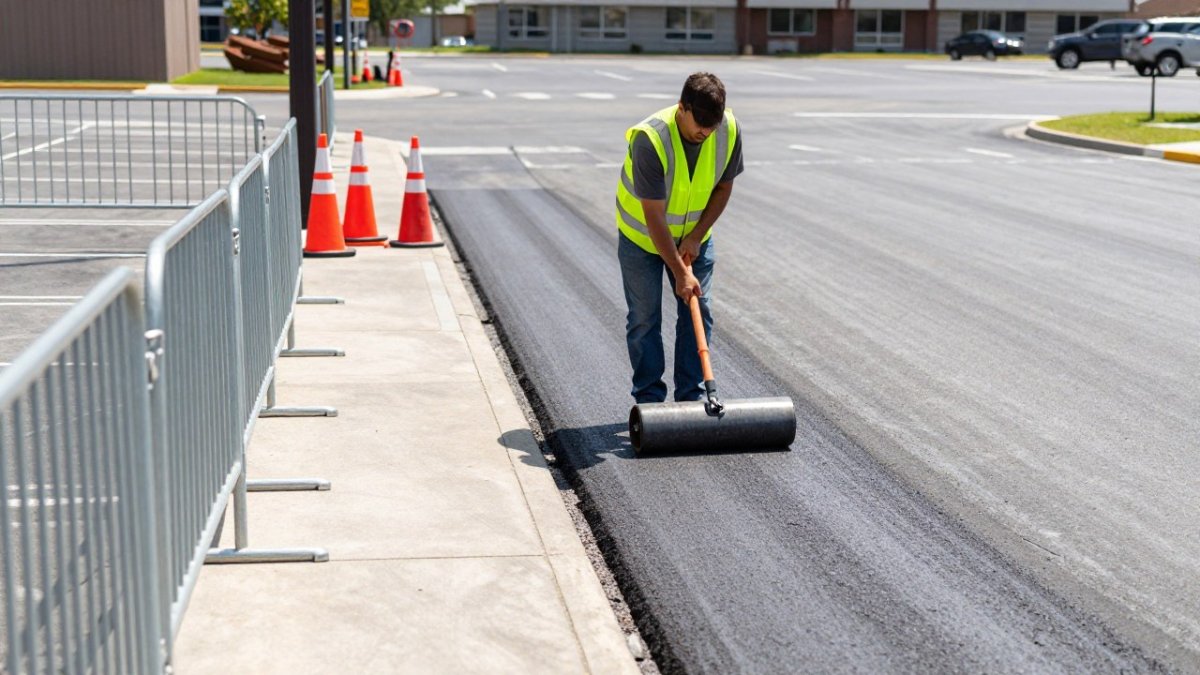
- Crack sealing: Best for hairline and narrow cracks. Fills the crack to stop water from getting in.
- Crack filling: Used for wider cracks. Adds material to seal and support the edges.
- Patching: Used for small holes and localized failures. Replaces damaged asphalt in one spot.
Crack sealing is generally suited to early-stage damage, working best when cracks are caught before water and traffic widen them. Explore the benefits of asphalt crack sealing for businesses before committing. Read signs that crack sealing is worth the investment to judge whether it fits your lot.
A common approach is to seal cracks as soon as they are found, then re-inspect each season.
Scheduling Your Next Lot Inspection or Repair Estimate
Once you know what you are looking at, the next step is planning. Setting up a regular schedule keeps small problems from becoming big ones.
- Spring: Full inspection and crack sealing before heavy use
- Fall: Re-check cracks and seal any new ones before winter
- After major storms: Quick walk-through to catch new damage
Pricing for crack sealing and repairs depends on lot size, crack count, and the repair method.
If you are unsure whether your lot needs attention, call Houston Pavement Repair LLC to schedule your free estimate today.
Frequently Asked Questions
Is it common for asphalt to crack?
Yes. Nearly all asphalt pavement cracks eventually because of repeated traffic loads, oxidation that makes the binder brittle, daily temperature swings that cause expansion and contraction, and water that seeps into the base. Cracking is a normal stage of aging rather than a sign of a bad installation, but its pattern and size tell you how far along the deterioration has progressed. Catching cracks early, while they are narrow and isolated, usually costs far less to address than waiting until the surface breaks apart.
How can you tell if an asphalt crack is structural or cosmetic?
Structural cracks are caused by failure in the base or subgrade and usually show up as interconnected patterns, such as alligator cracking, with edges that are raised, spalled, or moving under traffic. Cosmetic or surface cracks are typically narrow, isolated, and confined to the top layer. A practical test is to walk the crack and press on either side: if one side sinks or rocks, the problem likely extends below the surface, which calls for a closer look by a professional.
Which types of asphalt cracks should be repaired first?
Prioritize cracks that let water into the base, which includes wider cracks, cracks in drive lanes and fire lanes, and any alligator cracking that is spreading. Water infiltration can accelerate base failure and turn a small crack into a pothole over time. Hairline cracks in low-traffic areas can usually wait and be monitored.
When should a commercial asphalt crack be evaluated by a professional?
Have a professional evaluate the lot when cracks are wider than about one-quarter inch, when alligator cracking covers a noticeable area, when you see standing water in or around cracks, or when edges are lifting or sinking. Property managers should also request an evaluation before a new tenant move-in, after a major storm, or when liability concerns arise from trip hazards. A written assessment gives you documentation for budgeting and for any insurance or lease discussions.
Houston Pavement Repair LLC can inspect your lot, document each crack, and recommend the right repair. Call us today to schedule your free estimate.