 how-to
Extending Commercial Pavement Lifespan: A 7-Step Plan
Table of Contents
- Step 1: Conduct Regular Pavement Inspections and Document Surface Condition
- Step 2: Prioritize Commercial Asphalt Pavement Maintenance Based on Condition
- Step 3: Manage Water Intrusion and Drainage to Prevent Pavement Failure
- Step 4: Apply Commercial Parking Lot Sealcoating on Schedule
- Step 5: Address Asphalt Crack Repair Before Damage Spreads
- Step 6: Patch Potholes and Localized Damage Promptly
- Step 7: Plan Commercial Pavement Rehabilitation and Long-Range Lifecycle Management
- Frequently Asked Questions
Last Updated: October 8, 2026
Step 1: Conduct Regular Pavement Inspections and Document Surface Condition
Inspections are the foundation of extending commercial pavement lifespan, catching problems before small cracks become expensive failures.
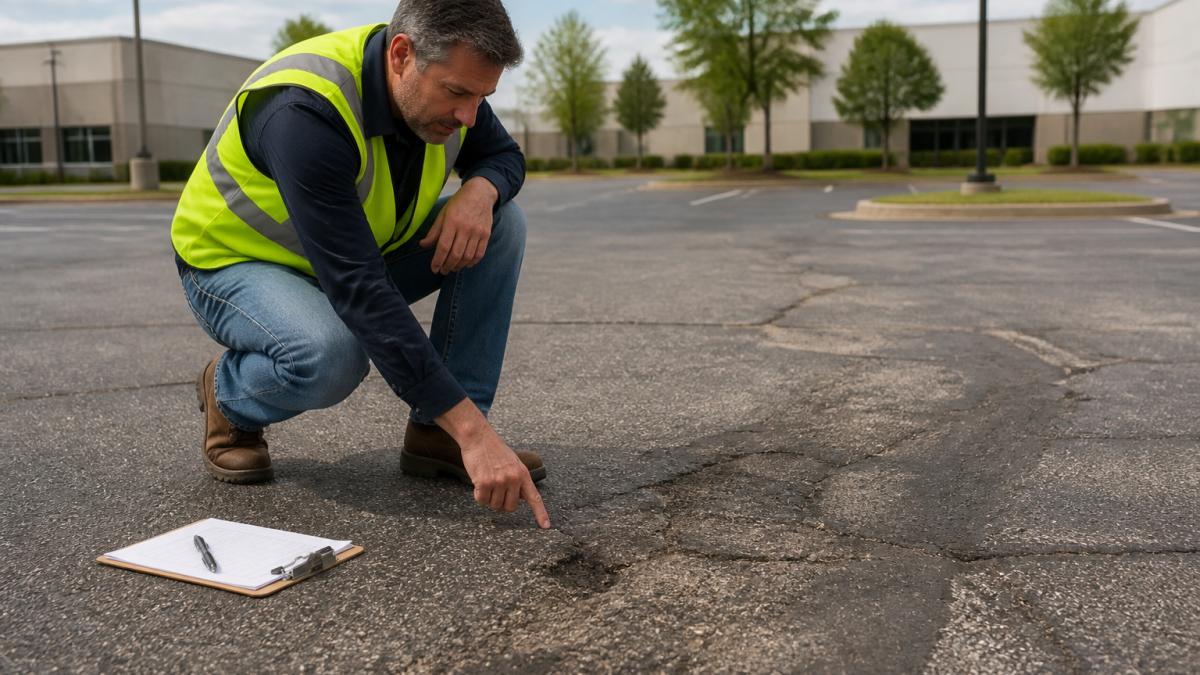
What to look for during inspections
Focus on these visible signs of deterioration:
- Cracks, Small hairline cracks, alligator cracking (interconnected pattern), or linear cracks running across the surface
- Potholes, Holes of any depth, especially those collecting water
- Surface wear, Faded color, exposed aggregate, or rough texture indicating oxidation
Document findings, photos, locations, severity, to create a baseline for tracking change.
Creating an inspection schedule
Most commercial properties benefit from inspections at least twice per year, in spring and fall. After heavy rain, check for drainage problems; after winter, look for frost heave and salt damage. Keep a simple log of dates, findings, and locations to prioritize repairs and demonstrate due diligence.
Step 2: Prioritize Commercial Asphalt Pavement Maintenance Based on Condition
Not all pavement problems are equally urgent. Sequence work so safety hazards, water pathways, and structural failures come before cosmetic wear, keeping spending predictable.
A practical condition-rating framework
Walk the lot in a grid (or use your site plan) and score each zone on four factors:
- Cracking, none, hairline, interconnected (alligator), or wide/working cracks
- Deformation, flat, minor rutting, deep rutting, or shoving/pushing at edges
- Surface integrity, intact, raveled/oxidized, loose aggregate, or missing sections
Assign each zone a band:
- Band A (Good), cosmetic wear only. Schedule preventive treatment.
- Band B (Fair), isolated defects, no structural loss. Repair within 6-12 months.
- Band C (Poor), widespread cracking, rutting, or recurring potholes. Repair this budget year.
This banding turns a walk-through into a prioritized work list and a defensible answer when an owner or tenant asks why one area was fixed before another.
Commercial-specific prioritization factors
Commercial sites have several user types, which changes priority order:
- Delivery and truck routes, loaded trucks concentrate stress on specific lanes and turning radii. Those areas fail first and should be inspected and repaired ahead of general parking stalls.
- Drive-through and pick-up lanes, idling vehicles drip oil and coolant, and stop-start traffic accelerates rutting at the same spot repeatedly.
- Dumpster pads and loading docks, heavy static loads, hydraulic fluid, and frequent scraping. These often need different treatment (concrete or heavy-duty asphalt) rather than standard patching.
Typically 20-30% of the paved area generates 70-80% of repair cost. Identifying that 20-30% is the point of prioritization.
Building a multi-year maintenance budget
Preventive maintenance is almost always cheaper than rehabilitation, but only if planned across years:
- Inventory, list every paved zone with its square footage and current band.
- Estimate unit costs, crack sealing, patching, sealcoating, and mill-and-overlay are typically priced per square foot or per linear foot. Get current local quotes rather than relying on national averages.
- Assign each zone a treatment based on its band (see the treatment-selection guide below).
- Spread the work across a 3-5 year cycle so no single fiscal year carries the full cost.
Example: if a full-depth repair costs roughly ten times a crack-seal of the same area, sealing two years earlier is the higher-return decision. Get local pricing, since the multiplier varies by market.
Treatment selection by condition band
| Condition band | Typical treatment |
|---|---|
| Band A | Sealcoat on schedule; crack seal as needed |
| Band B | Crack seal + localized patching; sealcoat after repairs cure |
| Band C | Patching, full-depth repair of failed sections, then sealcoat |
| Band D | Mill-and-overlay or full reconstruction |
This table is a starting point, not a substitute for a site assessment. Two lots with the same band can need different treatments depending on traffic, drainage, and base condition.
Step 3: Manage Water Intrusion and Drainage to Prevent Pavement Failure
Water is the single largest cause of premature pavement failure on commercial sites, but it rarely announces itself as a water problem. It shows up as a crack that keeps reopening, a pothole that returns every spring, or a rut that deepens in the same wheel path.
How water actually destroys pavement
Asphalt sits over a compacted aggregate base and subgrade. When water reaches the base:
- Loss of support, saturated aggregate loses interlock and can no longer distribute load. The surface deflects under traffic and cracks.
- Erosion and pumping, as vehicles pass over a saturated base, water is forced in and out, washing fines out of the aggregate and creating voids. This is why potholes often appear suddenly after a wet season.
- Freeze-thaw expansion, water in cracks and voids expands when it freezes, widening cracks and lifting sections. Repeated cycles turn a hairline crack into a full-depth failure in a few winters.
Surface repairs alone rarely solve a recurring problem, if the base stays wet, the repair fails again.
A drainage inspection checklist
Walk the site during and immediately after heavy rain, when problems are visible. Check:
- Inlets and catch basins, are they clear of debris, leaves, and sediment? A blocked inlet backs water onto the lot within minutes of a storm.
- Grate condition, broken or missing grates are both a drainage failure and a trip hazard.
- Flow paths, does water sheet toward drains, or does it pool in low spots? Watch where the water actually goes, not where the site plan says it should.
Diagnosing the cause before you repair
Match the symptom to the likely cause:
- Ponding in a low spot that was not there originally, often base settlement or subgrade consolidation, not a surface issue.
- Recurring pothole in the same location, usually a base-layer void or an undrained low point. Patching alone will not fix it.
- Water entering at a building edge or curb, often a grading or downspout issue that can be corrected without touching the pavement.
Operational and safety considerations
Drainage problems also affect site function:
- Trip and slip hazards, ponded water hides surface defects and, in freezing conditions, becomes an ice hazard on walkways and accessible routes.
- Accessible routes, standing water at curb ramps or accessible stalls can make a route unusable and create compliance exposure.
- Traffic disruption, drainage repairs often require lane or stall closures. Schedule them during low-traffic periods and coordinate with tenants in advance.
Step 4: Apply Commercial Parking Lot Sealcoating on Schedule
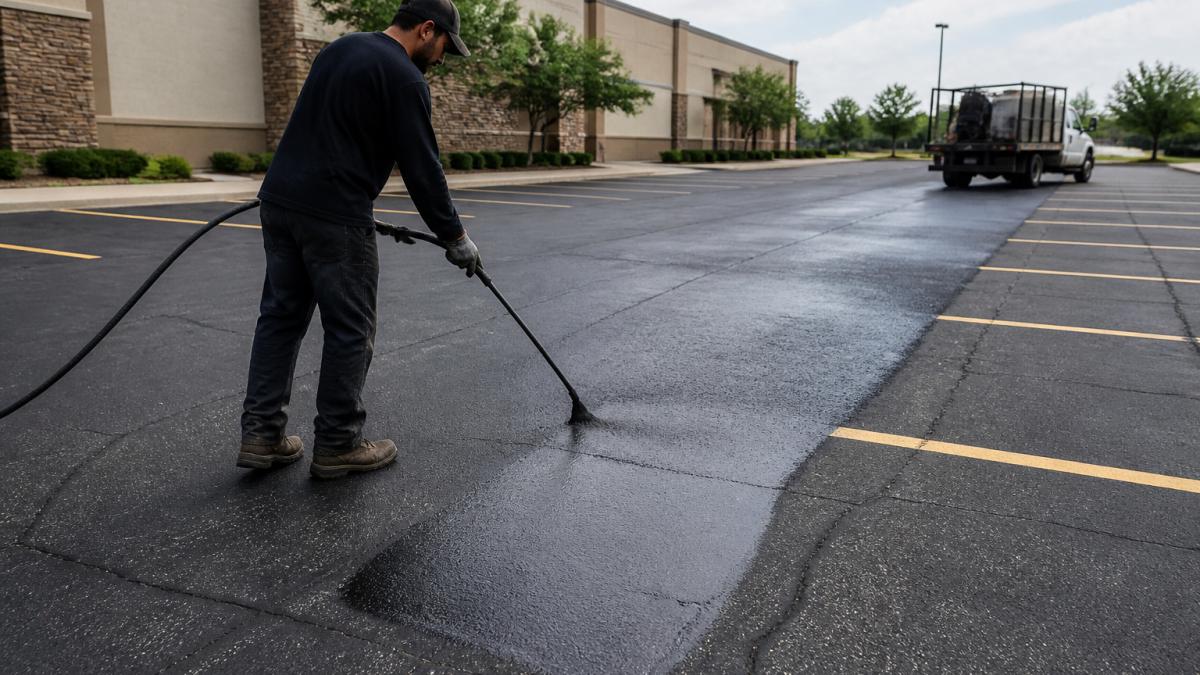
Sealcoating protects asphalt from UV exposure, oxidation, and weather damage, extending surface life by 3-5 years per application.
When to sealcoat and how often
Most commercial asphalt benefits from sealcoating every 2-3 years; new pavement should be sealed after 6-12 months of traffic. Reseal when the previous coat wears thin or loses its dark color. High-traffic lots may need resealing every 2 years, light-traffic areas every 3-4 years. Sealcoating is preventive maintenance, not repair, and works best on pavement in good condition, repair extensive cracking or potholes first.
Seasonal considerations and weather protection
Apply sealcoat in warm, dry weather, spring and early fall are ideal. Avoid application if rain is forecast within 24-48 hours or nighttime temperatures drop below 50°F; cold slows cure and wet conditions prevent adhesion. In harsh-winter areas, spring application protects through freeze-thaw season; in mild climates, fall application prepares pavement for winter moisture.
Step 5: Address Asphalt Crack Repair Before Damage Spreads
Cracks are entry points for water, and small cracks become potholes. Addressing them early stops this progression.
Call now to schedule your free estimate →
Crack types and when to repair
Hairline cracks (less than 1/8 inch wide) are cosmetic and can be monitored.
Working cracks (1/8 to 1/4 inch) need attention within 6-12 months, they admit water and widen over time.
Wide cracks (more than 1/4 inch) demand immediate repair. They're actively admitting water and accelerating base layer failure.
Alligator cracking (interconnected pattern covering an area) indicates deeper structural problems.
Hot crack fill versus other repair methods
Hot crack fill is the standard for working cracks: heated rubberized asphalt is forced into the crack, sealing it against water.
Cold pour sealants are cheaper but less durable, fine for hairline cracks in mild climates, but they fail faster in freeze-thaw environments.
For most commercial pavement, hot crack fill is the right choice.
Step 6: Patch Potholes and Localized Damage Promptly
Potholes are safety hazards, accelerate surrounding pavement failure, and create liability if a customer is injured. Address them quickly.
Identifying pothole formation and traffic wear
Potholes form when water weakens the base beneath a crack and traffic breaks apart the surface; once started, a pothole grows with each vehicle. Traffic wear shows as rutting, depressions in wheel paths that signal the pavement is softening under load. Inspect wheel paths and high-traffic areas carefully; they fail first and fastest.
Patching versus full-depth repair decisions
Semi-permanent patches remove loose material, clean the hole, and fill with new asphalt compacted properly.
For small isolated potholes, a semi-permanent patch usually suffices; for large failures or recurring potholes, full-depth repair prevents repeat problems.
We assess each pothole to determine whether patching will solve the problem or whether the underlying base layer needs attention.
Step 7: Plan Commercial Pavement Rehabilitation and Long-Range Lifecycle Management
Eventually, even well-maintained pavement reaches the end of its serviceable life. Planning for that transition keeps your property safe and your budget predictable.
When rehabilitation becomes necessary
Most commercial asphalt lasts 15-20 years with proper maintenance. As it ages, repairs grow more frequent and expensive until rehabilitation or replacement becomes more cost-effective than continued patching.
Signs that rehabilitation is approaching:
- Widespread alligator cracking affecting 25% or more of the surface
- Rutting deeper than 1 inch
- Multiple potholes recurring in the same areas
A professional pavement condition assessment can determine whether your lot needs rehabilitation (overlay or mill-and-fill) or full replacement.
Budgeting for long-term pavement preservation
Plan a capital replacement budget years ahead, setting aside funds annually so rehabilitation doesn't catch you off guard.
Extending commercial pavement lifespan is achievable with consistent, condition-based maintenance. Regular inspections identify problems early. Prioritized repairs address the most critical issues first. Preventive treatments like sealcoating and crack filling protect your investment.
Frequently Asked Questions
How long does commercial asphalt pavement typically last?
Commercial asphalt pavement typically lasts 15 to 20 years with proper maintenance. The actual lifespan depends on traffic volume, climate, drainage quality, and how consistently preventive maintenance is performed. Heavy-traffic parking lots may deteriorate faster without regular sealcoating and crack repair. Properties that ignore early signs of damage see significantly shorter service life.
What maintenance helps commercial pavement last longer?
Regular inspections, timely crack sealing, sealcoat application every 2 to 3 years, pothole patching, and proper drainage management directly extend pavement lifespan. Cleaning debris and sweeping surfaces prevents water pooling. Addressing deterioration early stops small cracks from becoming expensive failures. A documented maintenance schedule ensures nothing is overlooked and helps justify budgeting to ownership.
How does poor drainage shorten pavement life?
Water intrusion is one of the fastest ways to destroy asphalt. When water pools on the surface or infiltrates through cracks, it weakens the base layers underneath, causing accelerated deterioration, pothole formation, and structural failure. Ponding water also creates safety hazards and makes the surface slippery. Addressing drainage problems and preventing water from sitting on pavement is critical to extending lifespan.
When should cracks in commercial pavement be repaired?
Cracks should be sealed as soon as they appear, ideally when they are narrow and before water starts infiltrating. Small cracks are inexpensive to repair with hot crack fill or sealant. Waiting allows cracks to widen, water to penetrate deeper, and damage to spread, turning a minor repair into a major rehabilitation project. Annual inspections help catch cracks early.