 how-to
How to Choose the Right Driveway Thickness
Table of Contents
- Why Driveway Thickness Matters More Than You Think
- Minimum Concrete Driveway Thickness Standards
- Asphalt Driveway Thickness and How Long Does Asphalt Paving Last
- Sub-Base Preparation for Driveways: The Foundation That Determines Everything
- Factors That Change Your Driveway Thickness Decision
- Reinforcement Options: Rebar vs. Wire Mesh
- Common Mistakes to Avoid When Choosing Thickness
- Getting Your Driveway Thickness Right: Action Steps
- Frequently Asked Questions
Last Updated: October 3, 2026
Why Driveway Thickness Matters More Than You Think
Most homeowners and property managers don't think about driveway thickness until cracks appear. By then, the damage is done.
Thickness isn't just a number. It's the foundation of durability. A driveway that's too thin will fail under normal use. Getting it right requires understanding your specific situation: soil type, climate, vehicle weight, and drainage patterns.
This guide covers the standards, the factors that change those standards, and how to make the decision that fits your property. Below, we'll show you exactly how to choose the right driveway thickness for your situation.
Minimum Concrete Driveway Thickness Standards
Residential building code requirements
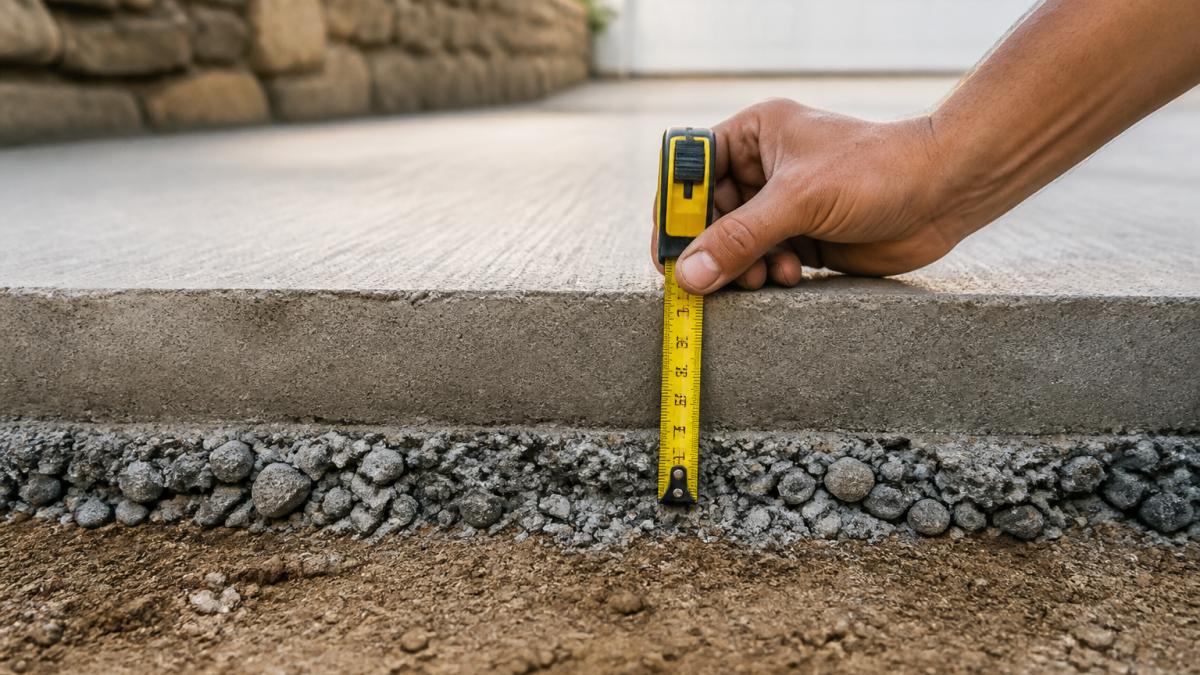
Concrete driveway thickness starts with a baseline. Most residential building codes call for a minimum of 4 inches for standard use. This assumes moderate vehicle traffic on stable soil with proper drainage.
The 4-inch standard exists for a reason. It balances cost with durability for typical residential driveways. But "standard" doesn't mean "right for you."
Building codes set minimums, not maximums. Your actual driveway thickness may need to exceed the code requirement depending on conditions. Local jurisdictions sometimes add their own rules. Check with your city or county before planning your project.
Why 4 inches is the baseline
Four inches became the standard because it handles typical loads. A passenger car weighs 3,000 to 4,000 pounds. A pickup truck weighs 4,500 to 6,000 pounds.
But this assumes proper sub-base preparation. Without it, even 4 inches fails.
The 4-inch rule also assumes you're not parking heavy equipment, commercial trucks, or RVs regularly. If you are, thickness needs to increase. A concrete driveway thickness of 5 or 6 inches handles heavier loads much better.
Temperature also matters. In freeze-thaw climates, concrete needs extra thickness to resist cracking from ice expansion. We'll cover that in the climate section.
Asphalt Driveway Thickness and How Long Does Asphalt Paving Last
Standard asphalt thickness for residential use
Asphalt driveway thickness typically ranges from 2 to 3 inches for residential properties. This is thinner than concrete because asphalt is more flexible. It bends slightly under weight instead of cracking.
The standard asphalt thickness of 2.5 inches works for most homes with normal vehicle traffic. Heavier use requires 3 inches or more.
Asphalt sits on a sub-base, just like concrete. The sub-base does most of the work. A weak sub-base makes even 3 inches of asphalt fail quickly.
Lifespan factors and maintenance impact
How long does asphalt paving last? The answer depends on thickness, climate, and maintenance.
A properly installed 2.5-inch asphalt driveway lasts 15 to 20 years in moderate climates.
Maintenance extends lifespan. Seal coating every 2 to 3 years protects the surface from water and UV damage. Filling cracks before they grow prevents major problems.
Without maintenance, even thick asphalt deteriorates faster. With regular care, you can stretch the life of your asphalt driveway by several years.
Thickness affects maintenance costs too. Thicker asphalt requires fewer repairs. Thin asphalt needs patching sooner and more often, which adds up over time.
Sub-Base Preparation for Driveways: The Foundation That Determines Everything
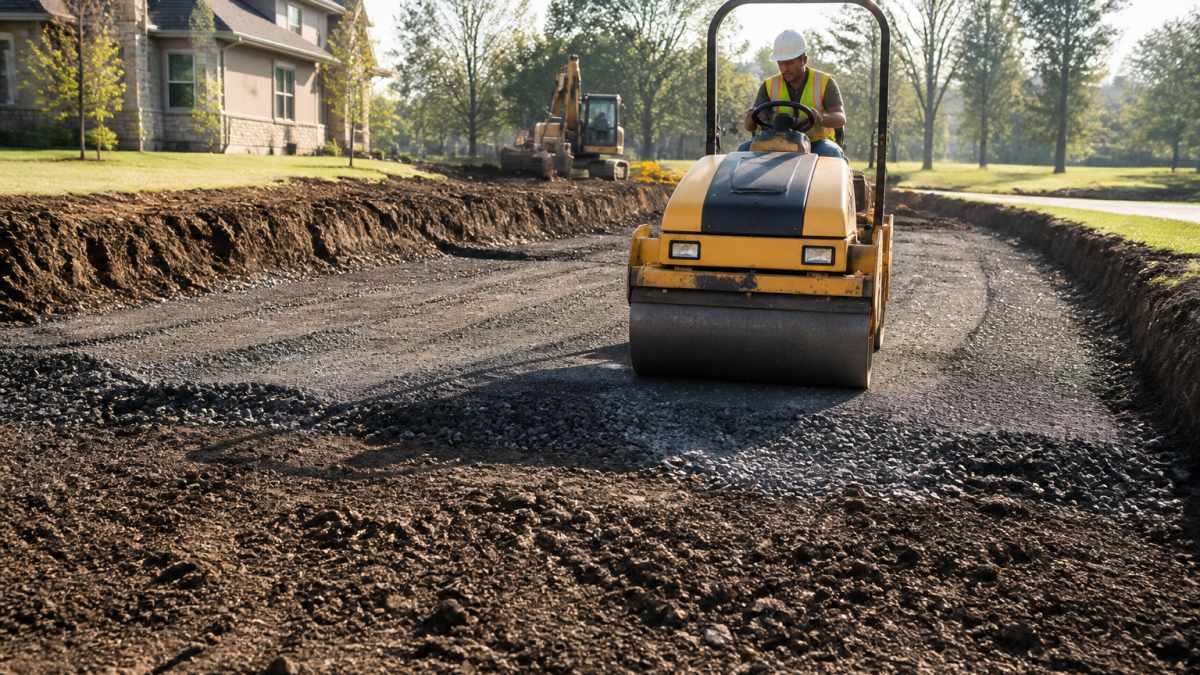
Soil composition and stability assessment
The sub-base is where driveway thickness decisions really matter. You can have 6 inches of concrete on bad soil and it will still fail.
Start with soil composition. Different soils behave differently. Clay soils hold water and shift with freeze-thaw cycles. Sandy soils drain well but compact unevenly. Loamy soils are more stable.
Soil testing isn't always required, but it's smart. A basic soil assessment shows whether your sub-base is stable. If it's not, you have two choices: improve the soil or increase driveway thickness to handle the movement.
Aggregate base layer depth and compaction
The aggregate base layer sits directly under your driveway. It's usually 4 to 8 inches of compacted gravel or crushed stone. This layer distributes weight and provides drainage.
Compaction matters more than depth. Poorly compacted aggregate shifts under load. The driveway above it cracks.
For standard residential driveways on stable soil, 4 inches of compacted aggregate is typical. On weaker soil, increase it to 6 inches.
The relationship between aggregate base and driveway thickness is direct. A weak sub-base requires thicker concrete or asphalt above it. A strong, well-compacted base allows thinner driveway surfaces.
Factors That Change Your Driveway Thickness Decision
Climate conditions and freeze-thaw cycles
Climate is one of the largest factors in driveway thickness. Freeze-thaw cycles are brutal on pavement.
When water enters concrete or asphalt and freezes, it expands. This expansion cracks the surface. As ice melts, gaps form.
In mild climates with no freezing, driveway thickness can stay at the minimum.
Concrete in freeze-thaw climates should be at least 5 inches thick. Six inches is better.
Proper air entrainment in concrete helps too. Air-entrained concrete has tiny air bubbles that allow water to expand without cracking.
Drainage also protects against freeze-thaw damage. Water that drains away can't freeze and expand. We'll cover drainage next.
Vehicle weight and heavy traffic loads
Driveway thickness must match the weight it will carry. A single-car garage needs less thickness than a driveway parking three trucks.
Passenger cars are relatively light. A pickup truck is heavier. An RV is much heavier.
For passenger cars only, 4 inches of concrete is adequate. For mixed use with trucks, go to 5 inches.
Call now to schedule your free estimate →
Asphalt follows the same logic. Two and a half inches handles cars. Three inches handles mixed traffic. Four inches or more handles heavy vehicles.
The key is live loads. A live load is weight that moves and changes. Parking a car is a live load.
Drainage slope and water management
Water is the enemy of durable driveways. Proper drainage extends the life of both concrete and asphalt, regardless of thickness.
Driveways should slope at least 1 percent away from structures. This means a quarter-inch drop per foot of length.
Pooled water seeps down into the sub-base. It weakens the foundation. In freeze-thaw climates, it freezes and expands, cracking the surface.
Proper slope is cheap insurance. It protects your driveway thickness investment. Without it, even a thick, well-built driveway fails prematurely.
Consider subsurface drainage too. If your lot has poor natural drainage, a perforated pipe under the driveway helps.
Reinforcement Options: Rebar vs. Wire Mesh
When reinforcement becomes necessary
Reinforcement strengthens concrete. It helps resist cracking and holds broken pieces together if cracks do form.
Wire mesh is a grid of wires welded together. It's cheaper and easier to install. Rebar consists of steel bars placed in a pattern. It's stronger but costs more and takes longer to install.
For standard residential concrete driveways, wire mesh is usually sufficient. It controls small cracks and keeps them from growing into major problems.
Rebar becomes necessary when:
- Driveway thickness exceeds 5 inches
- Soil is unstable or settling
- Heavy vehicles park regularly
- The area has severe freeze-thaw cycles
Rebar provides better crack control in these situations. The added cost is worth it if conditions demand it.
Joint spacing and crack control
Concrete cracks. Joints control where cracks happen. Without joints, cracks form randomly and grow large. With joints, cracks stay small and controlled.
Standard joint spacing is 4 to 6 feet in each direction. This creates a grid of squares or rectangles.
Joints should be cut to one-quarter the driveway thickness. For a 4-inch driveway, cut joints 1 inch deep. For 6 inches, cut them 1.5 inches deep.
Wire mesh or rebar helps joints work better. They hold concrete pieces together even as cracks form at joints.
Proper joint spacing is as important as driveway thickness for controlling cracks.
Common Mistakes to Avoid When Choosing Thickness
Ignoring climate. Freeze-thaw climates need thicker driveways.
Skipping sub-base preparation. This is the biggest mistake. A 6-inch driveway on a poorly prepared 2-inch sub-base will fail.
Choosing asphalt to save money, then not maintaining it. Asphalt is cheaper initially but requires regular seal coating and crack filling.
Not accounting for future use. You might park one car today, but what if you add a truck or RV later?
Assuming thicker is always better. There's a point of diminishing returns.
Forgetting about drainage. A thick driveway with poor drainage fails faster than a thinner one with good drainage.
Getting Your Driveway Thickness Right: Action Steps
Step 1: Know your soil. Walk your property after rain. Does water pool or drain?
Step 2: Assess your climate. Check historical freeze-thaw data for your area.
Step 3: List your vehicles. What do you park regularly? Just cars? Trucks? RVs?
Step 4: Plan for drainage. Measure the slope from your house to the edge of the driveway.
Step 5: Choose concrete or asphalt. Concrete lasts longer but costs more upfront.
Step 6: Determine thickness. Use this table as a starting point:
| Conditions | Concrete Thickness | Asphalt Thickness |
|---|---|---|
| Mild climate, cars only, stable soil | 4 inches | 2.5 inches |
| Freeze-thaw climate, cars only, stable soil | 5 inches | 3 inches |
| Mixed traffic (trucks), stable soil | 5 inches | 3 inches |
| Heavy vehicles, freeze-thaw, unstable soil | 6+ inches | 3.5+ inches |
Step 8: Plan your sub-base. Specify at least 4 inches of compacted aggregate base.
Frequently Asked Questions
Is 3.5 inches thick enough for a driveway?
Three and a half inches falls short of standard residential building code requirements, which typically call for a minimum of 4 inches of concrete. At 3.5 inches, your driveway will have reduced load-bearing capacity and is more susceptible to cracking under vehicle weight and freeze-thaw cycles. Unless your driveway carries only foot traffic, 4 inches is the safer minimum. Thicker slabs (5-6 inches) are recommended if you park heavy vehicles or expect significant ground movement due to poor soil stability.
What is the standard thickness for a residential asphalt driveway?
Residential asphalt driveways typically require 2 to 3 inches of asphalt binder layer over a properly compacted aggregate base of 4 to 6 inches. The total system depth matters as much as the asphalt thickness itself. A 2-inch asphalt layer over a weak base will fail faster than a 2-inch layer over a well-compacted 6-inch aggregate foundation. Asphalt paving lifespan depends heavily on sub-base preparation and drainage slope; proper installation can extend life to 15-20 years, while poor preparation reduces it to 5-10 years.
Does driveway thickness affect load-bearing capacity?
Yes, thickness directly controls load-bearing capacity. A 4-inch concrete slab is designed for standard passenger vehicles (2,000-3,500 lbs per wheel). A 5-inch slab handles heavier loads better and distributes weight more evenly across the subgrade. If you park commercial trucks, RVs, or multiple heavy vehicles regularly, you need thicker concrete (5-6 inches minimum) to prevent surface cracking and structural failure. Poor sub-base compaction can reduce effective load-bearing capacity even if the concrete is thick, so base preparation is equally important as slab thickness.
How much does sub-base preparation cost compared to the surface layer?
Sub-base preparation typically accounts for 20-30% of total driveway installation cost, while the surface layer (concrete or asphalt) makes up the remainder. Many homeowners underestimate this cost, but skimping on base preparation is the leading cause of premature failure. Proper soil analysis, aggregate base depth, and compaction prevent costly repairs later. If your soil is unstable or drainage is poor, sub-base costs can increase significantly. Contact Houston Pavement Repair LLC for a free estimate that breaks down base preparation and surface costs for your specific site conditions.
Choosing the right driveway thickness is the difference between a surface that lasts five years and one that lasts fifteen. Most failures trace back to thickness that didn't match the site conditions. At Houston Pavement Repair LLC, we start every project by assessing soil, climate, and use. Then we recommend the thickness that protects your investment. Call now to schedule your free estimate and get a professional recommendation for your specific property.