 how-to
Improving Parking Lot Safety for Customers: A Practical Guide
Table of Contents
- Why Parking Lot Safety Matters for Your Customers and Business
- Conduct a Comprehensive Parking Lot Safety Inspection
- Create Your Commercial Parking Lot Safety Checklist
- Address Parking Lot Pedestrian Safety with Clear Routes and Markings
- Improve Parking Lot Lighting and Visibility
- Repair Potholes and Uneven Pavement Before They Cause Accidents
- Establish a Maintenance Schedule and Measure Your Progress
- Frequently Asked Questions
Last Updated: October 6, 2026
Why Parking Lot Safety Matters for Your Customers and Business
Improving parking lot safety for customers isn't just about liability, it's about making people feel secure the moment they step out of their vehicle.
Customers avoid lots with visible damage, poor lighting, or unclear walkways, leave negative reviews, and take their business elsewhere.
The stakes are real: one accident can bring lawsuits, insurance claims, and reputational damage, while unsafe conditions erode trust and reduce foot traffic.
This guide covers practical steps to audit your lot, identify hazards, and make lasting improvements in surface conditions, pedestrian safety, visibility, and maintenance.
Conduct a Comprehensive Parking Lot Safety Inspection
Start with a thorough walk-through of your lot, looking for anything that could injure a customer or damage their vehicle. This baseline tells you what needs immediate attention and what can wait.
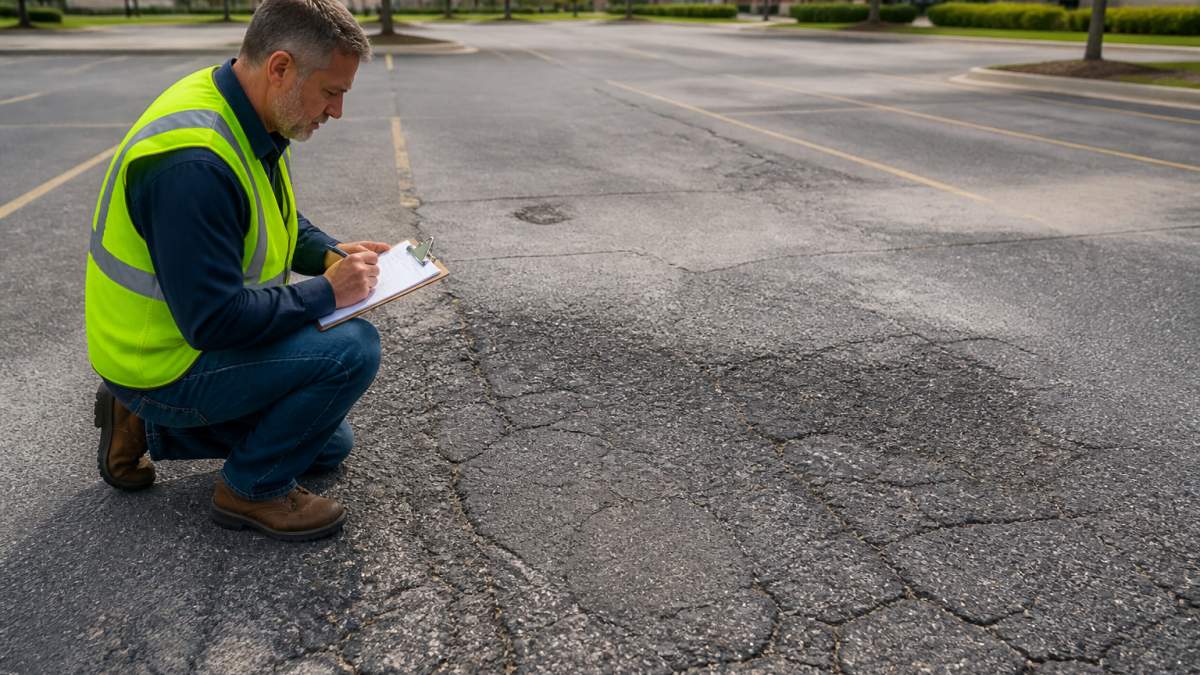
What to Look for During Your Inspection
Walk your lot systematically, including corners and edges where damage often starts.
Surface damage:
- Cracks (small cracks grow into potholes)
- Potholes (trip hazards and vehicle damage)
- Sunken or raised sections (catch toes and wheels)
- Loose gravel or debris
- Water pooling (standing water indicates drainage problems)
Pedestrian hazards:
- Uneven transitions between surfaces
- Missing or faded line markings
- Curb damage or missing pieces
- Debris in walkways
Visibility issues:
- Dark or unlit areas
- Burned-out lights
- Overgrown vegetation blocking sightlines
- Glare from reflective surfaces
Access and flow:
- Unclear parking space markings
- Missing directional signs
- Blocked or damaged parking barriers
- Congested entry or exit points
Photograph and note each hazard's location, this record becomes your action plan.
Create Your Commercial Parking Lot Safety Checklist
A checklist only works if it produces a decision. The table below converts each inspection item into a scored, dated, assigned action so you can defend your maintenance record and prioritize spending. Print one copy per zone and complete it quarterly, monthly during winter or peak season.
Scoring and Priority Rules
Score each item 0-3:
- 0, No issue. Document and move on.
- 1, Cosmetic. Note it; address at next scheduled maintenance.
- 2, Functional risk. Schedule repair within 30 days.
- 3, Immediate hazard. Barricade or cone the area today; repair within 72 hours.
Any item scored 3 triggers a written hazard notice, a photo, and a same-day work order, the record that matters if a customer is injured.
| Inspection Item | Score (0-3) | Hazard Type | Owner | Target Date | Date Closed |
|---|---|---|---|---|---|
| Cracks wider than a quarter inch | Trip / water intrusion | ||||
| Potholes (any depth) | Trip / vehicle damage | ||||
| Standing water 24+ hours after rain | Slip / freeze risk | ||||
| Lights out or dim | Security / trip | ||||
| Faded or missing stall lines | Vehicle conflict | ||||
| Faded or missing pedestrian crosswalks | Pedestrian conflict | ||||
| Wheel stops broken or missing | Vehicle / trip | ||||
| Curb damage at accessible stalls | Accessibility | ||||
| Accessible stall signage missing or obstructed | ADA compliance | ||||
| Curb ramps cracked or blocked | Accessibility | ||||
| Signage missing, faded, or blocked by foliage | Wayfinding | ||||
| Bollards or barriers loose or leaning | Vehicle intrusion | ||||
| Debris, sand, or leaves in walkways | Slip / trip | ||||
| Snow or ice piles blocking sightlines | Visibility | ||||
| Overgrown shrubs at corners or crosswalks | Sightline / security |
Documentation That Protects You
For every scored item, capture a dated photo, the location in plain language ("north row, stalls 14-18"), the score, and the owner. Store these in one shared log, not scattered across email threads. If a claim is filed months later, a dated photo with a closed work order is the difference between a defensible record and an open question about whether you knew.
Accessible Parking and Inclusive Routes
Accessible stalls are the highest-liability items on the lot and the most often overlooked. Verify that stalls meet ADA Standards for Accessible Design dimensions and signage, that access aisles stay clear of carts and snow, and that the route from stall to entrance is continuous, firm, and free of abrupt level changes. A customer using a wheelchair or walker should reach the door without entering a drive lane; if they cannot, that is a score-3 item.
Assigning Owners and Cadence
One named person owns the checklist, assigns each item to a trade, paving, striping, electrical, landscaping, or janitorial, and confirms closure. Review it monthly with whoever controls the maintenance budget so score-3 items are funded immediately and score-2 items batched into the next repair window. An unassigned checklist is a wish list; an assigned one is a maintenance program.
Address Parking Lot Pedestrian Safety with Clear Routes and Markings
Pedestrians need to know where to walk and where vehicles travel; without clear routes, customers wander into traffic or trip on unmarked obstacles.
Use contrasting colors: white or yellow lines are standard and highly visible. Refresh markings annually or when they fade, faded lines confuse rather than guide.
Install signage at key decision points, arrows for foot traffic, warnings for steps or curbs, at eye level and readable from 20 feet away.
Check curbs: broken or missing edges are trip hazards, so repair them immediately. If pedestrian areas lack curbs, consider adding them to define boundaries.
Consider accessible routes: pathways wide enough for wheelchairs and mobility devices, no steep grades, and ramps at elevation changes.
Improve Parking Lot Lighting and Visibility
Poor lighting is a safety and security issue. Customers feel vulnerable in dark areas. Criminals exploit shadows.
Evaluate your lighting by walking the lot at dusk and at night, noting dark spots, uneven light, and glare.
Call now to schedule your free estimate →
Install lights at regular intervals along pedestrian pathways, spaced so no area falls into complete darkness, aiming for even illumination.
Choose fixtures that minimize glare and light pollution; LEDs are energy-efficient and provide good visibility.
Maintain lights regularly: replace burned-out bulbs immediately, clean fixtures, and schedule monthly checks to catch failures early.
Consider motion-activated lighting in low-traffic areas to save energy while ensuring lights are on when customers arrive.
Repair Potholes and Uneven Pavement Before They Cause Accidents
Potholes damage vehicles, create liability claims, and signal neglect. Small cracks become large potholes within months if untreated, so fix them early.
Identify all potholes and cracks during your inspection. Prioritize by size and location. Potholes in high-traffic areas or near parking spaces are urgent.
Temporary patching buys time but doesn't solve the problem. Customers notice patches fail and reappear. It looks cheap and unreliable.
Houston Pavement Repair LLC specializes in expert asphalt and concrete paving and repair services.
Address uneven pavement too: raised or sunken sections catch toes and wheels, creating trip and vehicle-damage risks. Grinding or resurfacing creates a smooth, safe surface.
Develop a repair schedule based on your inspection. Tackle high-priority items first. Plan repairs during slow business periods to minimize disruption.
Establish a Maintenance Schedule and Measure Your Progress
Most parking lot safety programs fail not because the owner ignores problems but because nobody can prove conditions are improving. This section gives you a maintenance cadence, measurement framework, incident-response procedure, and phased budget so you act on the checklist instead of filing it.
Maintenance Cadence
| Task | Frequency | Trigger to Escalate |
|---|---|---|
| Full safety inspection (checklist) | Quarterly | Any score-3 item |
| Lighting check | Monthly | Two or more outages in one zone |
| Sweep and debris removal | Weekly (or after storms) | Visible sand, leaves, or trash in walkways |
| Line and crosswalk striping review | Annually, plus after sealcoat | Faded lines in high-traffic rows |
| Crack filling | Annually | Cracks wider than a quarter inch |
| Sealcoating | Every 2-3 years | Oxidation, raveling, or water intrusion |
| Drainage and catch basin clearing | Twice yearly, before and after wet season | Standing water 24+ hours after rain |
| Signage and bollard inspection | Quarterly | Missing, faded, or leaning fixtures |
| Accessible route verification | Quarterly | Any obstruction or surface break |
Increase frequency for high-traffic retail, medical, or grocery lots where turnover and cart traffic accelerate wear.
Measure What Actually Changed
Pick five metrics and track them on the same spreadsheet as your checklist. Numbers, not impressions, tell you whether the program is working.
- Incidents and injuries, reported slips, trips, falls, and vehicle-to-vehicle or vehicle-to-pedestrian collisions, by location.
- Near misses, customer or staff reports of a hazard that almost caused harm. Near misses are leading indicators; treat them as seriously as incidents.
- Inspection completion rate, percentage of scheduled inspections actually completed on time.
- Average repair time, days from hazard identification to closure, segmented by priority score.
- Customer feedback, parking-related complaints and reviews, tagged by theme (lighting, cleanliness, accessibility, damage).
Review the five metrics monthly. If near-miss reports rise while incidents stay flat, your reporting culture is improving, not your lot worsening. If average repair time for score-3 items creeps above 72 hours, the bottleneck is almost always budget authority, not contractor availability.
Incident Response Procedure
Write a one-page procedure and post it where staff can find it:
- Secure the scene. Cone or barricade the hazard; do not move an injured person unless they are in immediate danger.
- Call for help. Dial 911 for any injury, suspected injury, or vehicle collision with a pedestrian.
- Preserve evidence. Photograph the hazard, the surrounding surface, and any lighting conditions before anything is moved or repaired.
- Collect statements. Get names and contact information from the injured party and any witnesses.
- Notify your insurer and counsel per your policy's reporting timeline.
- Log the incident in the same system as your checklist so the corrective action is traceable.
- Repair and verify. Close the hazard, re-inspect the area, and document the fix.
A written procedure staff have read is worth more than a perfect lot with no plan for when something goes wrong.
Budget and Prioritization
Split your annual lot budget into three buckets:
- Immediate safety (roughly the first dollars you spend each year). Crack filling, pothole patching, bulb replacement, debris removal, and any score-3 item. These are low-cost, high-impact fixes that reduce liability fastest.
- Planned maintenance. Sealcoating, striping, drainage work, and signage replacement scheduled on the cadence above.
- Capital projects. Full-depth pavement reconstruction, lighting system upgrades, and lot reconfiguration. These require planning, engineering, and a longer lead time.
Fund the immediate bucket first, a property that spends its whole budget on a reseal and leaves potholes open has the wrong priority order. If capital funds are tight, phase work by zone, starting with the entrance, primary pedestrian route, and accessible stalls, where customer volume and liability intersect.
OSHA guidance on workplace walking-working surfaces and slip, trip, and fall hazards
Frequently Asked Questions
How often should a commercial parking lot be inspected for safety hazards?
Most facilities managers should conduct formal inspections quarterly and walk-throughs monthly. After severe weather events, inspect immediately for new damage. Regular inspections catch potholes, surface cracks, and lighting issues before they cause customer accidents. Documenting findings helps track patterns and prioritize repairs that improve parking lot safety for customers.
What are the most common parking lot hazards that affect customer safety?
Potholes and uneven pavement cause trips and vehicle damage. Poor lighting creates security concerns and visibility problems. Inadequate pedestrian markings and barriers increase vehicle-pedestrian collisions. Water pooling from drainage issues creates slip hazards and accelerates pavement deterioration. Overgrown weeds hide hazards and obstruct sight lines. Faded traffic signs and parking space markings confuse drivers and pedestrians.
What should be included in a parking lot pedestrian safety plan?
A parking lot pedestrian safety plan should define clear walking routes separate from vehicle traffic, install visible crosswalks with fresh paint markings, place directional signs, ensure adequate lighting along pathways, remove obstacles and debris, maintain smooth surfaces free of potholes, and trim vegetation to maintain sight lines. Regular maintenance of these elements protects customers and reduces liability.
How does poor lighting affect parking lot safety for customers?
Inadequate lighting increases trip hazards because customers cannot see potholes, cracks, or debris. Dark areas create security concerns and attract criminal activity. Customers avoid poorly lit lots, reducing business. LED lighting upgrades improve visibility, reduce energy costs, and signal that you prioritize customer safety. Well-lit parking lots deter crime and help customers navigate safely to and from their vehicles.