 How-to
7 Parking Lot Safety Upgrades That Cut Business Liability
Last Updated: October 31, 2026
Quick Summary
Reducing business liability with parking lot safety starts with a scored checklist that ranks every hazard by likelihood and severity, then fixing the highest-score items first. Lighting upgrades deliver the most risk reduction per dollar, and dated inspection logs, photos, and repair invoices prove reasonable care after an incident.
- Score each hazard from 1 to 5 for likelihood and severity, then multiply for a risk score.
- Check for burned-out lighting fixtures monthly and log every repair.
- Walk the lot weekly for new cracks, potholes, and debris.
- Keep inspection logs, timestamped photos, repair invoices, and incident reports in one file per lot.
- Fund Phase 1 fixes from the operating budget and schedule later phases into the capital plan.
Table of Contents
- Why Parking Lot Safety Directly Affects Business Liability
- Start With a Parking Lot Safety Checklist for Businesses
- Parking Lot Lighting Safety: The Upgrade With the Biggest Payoff
- Parking Lot Striping and Signage That Prevent Confusion and Collisions
- Parking Lot Maintenance Best Practices That Remove Trip and Fall Hazards
- Documenting Reasonable Care: Records That Protect You After an Incident
- Budgeting Your Safety Upgrades by Cost and Lifecycle Value
- Schedule a Free Parking Lot Safety Assessment
- Frequently Asked Questions
Why Parking Lot Safety Directly Affects Business Liability
Parking lot safety is the practice of designing, maintaining, and documenting a commercial lot so that customers, employees, and visitors can move through it without injury or property damage.
Most owners learn this the hard way.
Across many commercial lots, the same pattern appears: small, cheap-to-fix defects that nobody logged.
If you want the broader picture first, our practical guide to improving parking lot safety for customers covers the fundamentals before you start prioritizing.
Start With a Parking Lot Safety Checklist for Businesses
A parking lot safety checklist for businesses is a scored list of every hazard on the property, ranked by how likely it is to cause injury and how much it would cost you.
Walk the lot on foot, in daylight and again after dark. Score each item from 1 to 5 for likelihood and 1 to 5 for severity. Multiply the two numbers.
How to Score and Prioritize Each Hazard
Use this simple matrix to decide what gets fixed first:
| Hazard | Likelihood (1-5) | Severity (1-5) | Priority |
|---|---|---|---|
| Broken curb at main entrance | 4 | 3 | Fix now |
| Faded crosswalk markings | 3 | 4 | Fix now |
| Uneven pavement near dumpster | 2 | 3 | This quarter |
| Missing space signs | 2 | 2 | This year |
Work top to bottom. The high-score items are the ones a lawyer would find first after an incident.
Parking Lot Lighting Safety: The Upgrade With the Biggest Payoff
Parking lot lighting safety delivers more risk reduction per dollar than almost any other upgrade. Good light prevents crime, prevents trips, and makes every other safety feature work better.
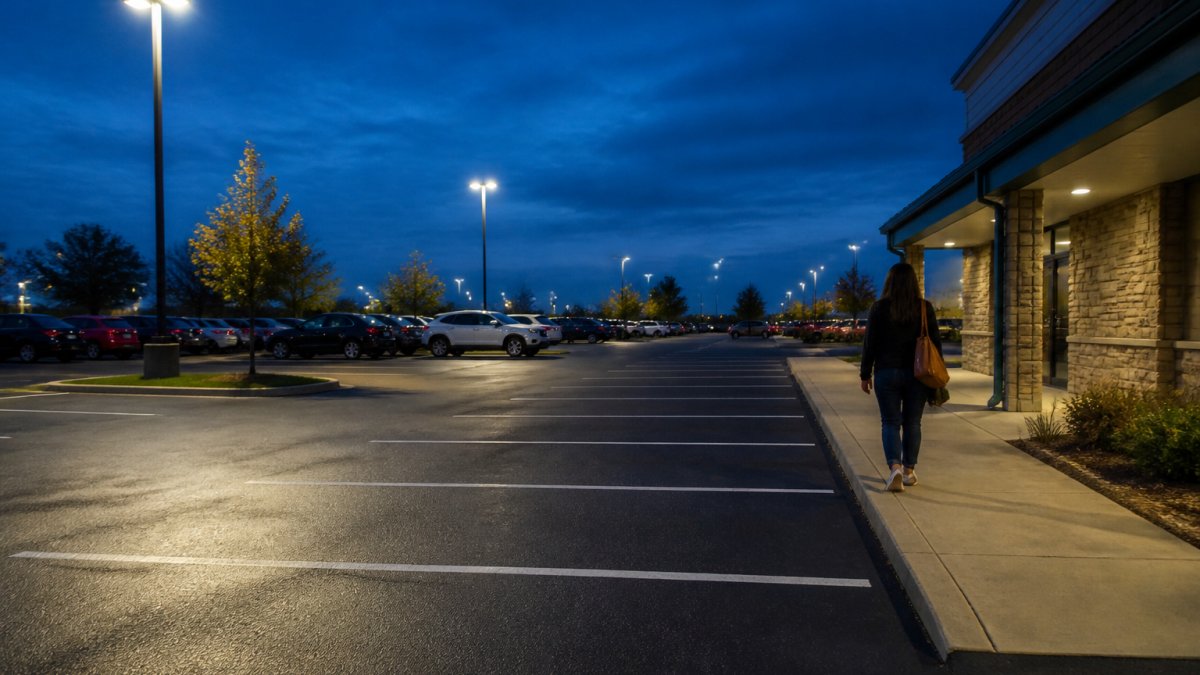
Aim for even coverage with no dark pockets between poles. Check for burned-out fixtures monthly, and log every repair. Poor visibility near entrances and stairwells is where most incidents happen.
Parking Lot Striping and Signage That Prevent Confusion and Collisions
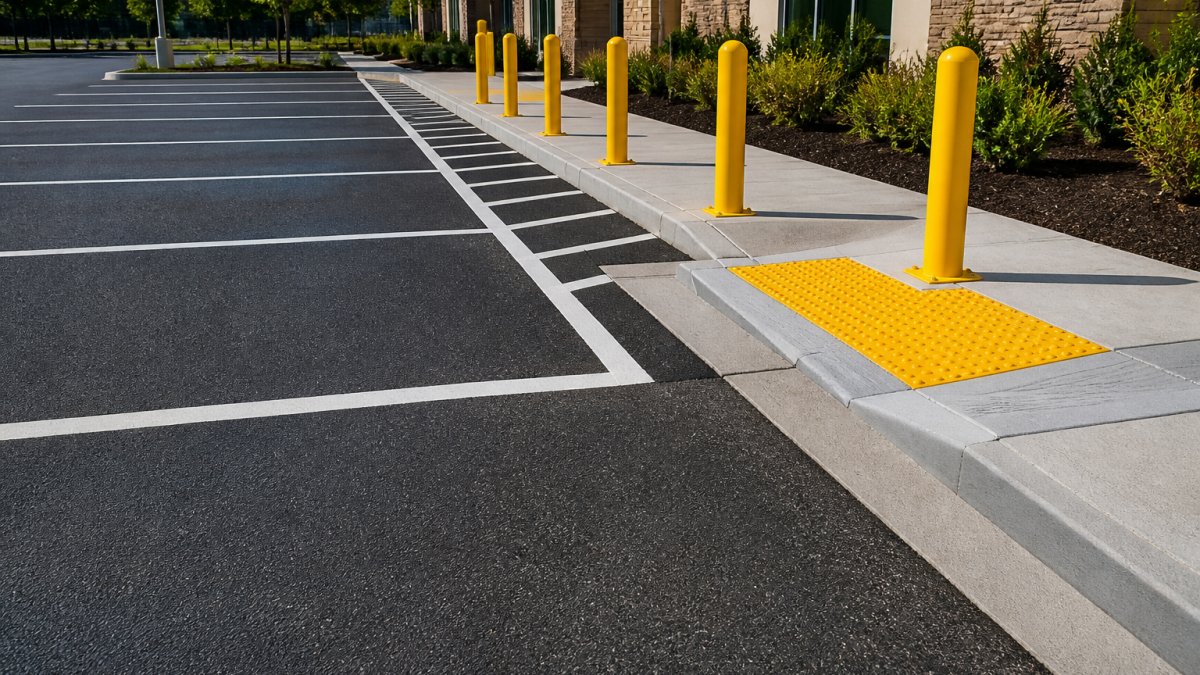
Striping and signage are how you tell drivers and pedestrians where to go. Confused drivers cause collisions. Clear markings prevent them.
Fresh paint does three jobs at once:
- Separates traffic flow at intersections
- Marks accessible spaces correctly
- Directs foot traffic away from vehicle lanes
Accessibility rules matter here. The ADA requirements for business parking explain how accessible spaces, aisles, and signs must be laid out. Getting these wrong creates both safety and compliance problems.
Parking Lot Maintenance Best Practices That Remove Trip and Fall Hazards
Parking lot maintenance best practices are the routines that keep small defects from becoming claims. Regular inspections and quick repairs do most of the work.
Set a schedule and stick to it:
- Weekly: walk the lot for new cracks, potholes, and debris
- Monthly: check curbs, handrails, and drainage grates
- Seasonally: re-seal and re-stripe before weather turns
Remove hazards fast. A parking curb knocked loose is a trip hazard today and a lawsuit next month. Repair response time should be measured in days, not months.
Drainage, Weather, and Seasonal Damage
Water is the quiet destroyer of pavement. Standing water softens the base, cracks the surface, and freezes in winter. Storm damage then turns a small dip into a real hole.
Drainage problems are a common cause of commercial pavement failure, and the specific failures are worth watching for. Fix grading and clear grates before the rainy season, not after.
Documenting Reasonable Care: Records That Protect You After an Incident
Reasonable care is the legal standard that asks whether you did what a sensible owner would do under the same circumstances. In a premises liability claim, the question is rarely whether a hazard existed, hazards exist on every lot.
Call now to schedule your free estimate →
Most owners lose this argument not because they were careless but because they cannot show a pattern. A plaintiff's attorney will ask for inspection logs, repair invoices, and incident reports.
The Four Records That Do the Work
Build one file per lot and keep it in a single place, paper binder, shared drive, or maintenance software. The format matters less than the consistency.
- Inspection logs. Date, time, inspector initials, weather, and a pass/fail line for each checklist item. A log with gaps is worse than no log, because it proves you had a system and stopped using it.
- Photo evidence. Before-and-after photos of every repair, timestamped. A cracked curb photographed on the day it was reported and again on the day it was fixed tells a complete story in two frames.
- Maintenance and repair invoices. These are your proof of action. Keep them linked to the inspection entry that triggered them so the timeline is traceable.
Retention and Response Timelines
Keep inspection and repair records for as long as possible, since a claim can surface well after an incident. Consult your attorney or insurer about the retention period that applies to your property.
Pair the file with a written response standard. A written commercial pavement maintenance plan gives you a ready template to build the schedule and the paper trail together.
What This File Actually Does for You
Three things, in order of value. First, it supports claims handling, your insurer can defend a claim far more effectively when you hand over a clean timeline. Second, it demonstrates ongoing safety efforts, which is the heart of the reasonable care standard. Third, it turns your checklist from a one-time exercise into a repeatable process, because every inspection entry creates the next action item.
Budgeting Your Safety Upgrades by Cost and Lifecycle Value
Safety spending should follow the risk scores from your checklist, not a wish list. But a risk score alone does not tell you what to buy or when. The missing step is comparing each upgrade on three axes: how much risk it removes, what it costs up front, and what it costs to own over its life. That comparison is how you turn a hazard list into a funded plan.
A Simple Prioritization Method
For each candidate upgrade, estimate three numbers on a 1-to-5 scale and write them next to the risk score from your checklist:
- Risk reduction, how much the upgrade lowers the likelihood or severity of the hazards it touches. Re-lamping a dark entrance scores high; repainting a rarely used stop line scores low.
- Up-front cost, materials, labor, and downtime. Use your contractor's estimate, not a guess.
- Lifecycle burden, how often it needs maintenance and how much that maintenance costs per year. A durable repair that needs attention every five years beats a cheap patch that fails every season.
Rank by risk reduction first, then by lifecycle burden, then by up-front cost. That order keeps you from buying the cheapest fix for the wrong hazard.
Phasing the Spend Across the Year
Most owners cannot fund every upgrade at once, and they do not need to. A common pattern is a three-tier phase:
- Phase 1, Fix now. High risk score, low cost, fast to complete. Loose curbs, burned-out fixtures, faded crosswalks at the main entrance. These are the items a lawyer finds first after an incident, and they are usually the cheapest to correct.
- Phase 2, This quarter. Medium risk, moderate cost. Pavement repairs near high-traffic walkways, drainage corrections before the rainy season, signage replacement.
- Phase 3, This year. Lower risk or higher cost. Full re-striping, lot re-lamping, layout changes that separate pedestrian and vehicle paths.
Fund Phase 1 out of operating budget, then schedule Phases 2 and 3 into the capital plan. For a deeper look at planning and phasing the spend, see our guide on how to budget for commercial parking lot repairs.
The Cheap-Patch Trap
A cheap patch that fails in a year costs more than a proper repair that lasts, not just in materials, but in the liability exposure of a hazard that reappears. Every time a defect returns, you have a new inspection entry, a new repair, and a new window in which someone could be hurt. Lifecycle value means counting those cycles, not just the first invoice.
Measuring Whether the Spend Worked
A budget is only useful if you can tell whether it moved the needle. Track a small set of indicators and review them quarterly: inspection completion rate, average repair response time against your written standard, lighting coverage on the night walk, near-miss reports, and incident frequency by location. If response time is creeping up or near misses cluster at one entrance, the next budget cycle has a clear target.
Schedule a Free Parking Lot Safety Assessment
Here is the challenge. You can read every guide on parking lot safety and still not know which hazard on your own lot poses the biggest risk.
Houston Pavement Repair LLC provides expert asphalt and concrete paving and repair, with reliable pavement solutions and a free estimate. Contact us to schedule your free estimate.
Call now to schedule your free estimate with Houston Pavement Repair LLC.
Frequently Asked Questions
What parking lot hazards can expose a business to liability?
The most common exposures are uneven or cracked pavement, potholes, faded striping, burned-out lighting, missing signs, and clogged drainage that leaves standing water. Each of these can contribute to a slip and fall, a trip, or a vehicle collision. Under premises liability, property owners and managers are generally expected to find and fix these conditions within a reasonable time. Keeping a written parking lot safety checklist and acting on what it finds is the clearest way to show you took that duty seriously.
How often should a business inspect its parking lot?
Walk the lot monthly for a full parking lot safety checklist, and do a quick visual sweep weekly for lighting outages, new potholes, or debris. After heavy rain or a storm, inspect drainage areas and low spots before the next business day. Every inspection should be dated and logged. If a hazard is found, note the date it was reported and the date it was repaired. That repair response time is the kind of record that shows reasonable care if a claim is ever filed.
Does repairing potholes and cracks really reduce slip, trip, and vehicle accident claims?
It removes the physical cause of many claims. A pothole or raised curb edge is a trip hazard for pedestrians and can damage tires and suspension, which leads to property damage complaints. Crack sealing and patching also stop water from getting under the surface, where freeze-thaw and heavy rain break down asphalt faster. Following parking lot maintenance best practices on a schedule costs far less than repaving a section that was left to fail, and it gives you documentation that hazards were addressed.
Which parking lot safety upgrades should businesses prioritize first?
Rank upgrades by how likely a hazard is to cause injury or damage and how many people it affects. Lighting and trip hazard repair usually come first because they prevent the most common claims. Striping and signage come next, since they reduce vehicle-pedestrian conflicts. Then address drainage and long-term pavement condition. A short walkthrough with a paving contractor can help you rank items by risk and budget, so you fix the highest-exposure problems first instead of spreading money evenly across the lot.
Every lot has a weak spot. The question is whether you find it first or a claim does. Call now to schedule your free estimate and get a clear, prioritized plan for your property.